Art since 1940/Strategies of Being


„Every intelligent painter carries the whole culture of modern painting in his head. It is his real subject, of which everything he paints is both an homage and a critique, and everything he says a gloss.“ – Robert Motherwell

„I´ll tell you what´s going to happen: The public will keep on buying more and more art, and husbands will start bringing home little paintings to their wives on the way home from work, and we´re all going to drwon in a sea of mediocrity. Maybe Tinguely and a few others sense this and they are trying to destroy art before it is too late.“ – Marcel Duchamp

„Painting has reached a point where youngsters can only add a footnote. It depresses me a little tot hink that what was once Indian territory is now pretty thoroughly mapped out.“ – Robert Motherwell

„I pursue no objectives, no system, no tendency; I have no program, no style, no direction. I have no time for specialized concerns, working themes, or variations that lead to mastery. I steer clear of definitions. I don´t know what I want. I am inconsistent, non-commital, passive; I like the indefinite, the boundless; I like continual uncertainty.“ – Gerhard Richter

„Cobra is a form of art which heads toward childhood, tries to recover folk art and child art for itself with the means available to adulds, non-naive means“ – Pierre Alechinsky

„The art audience is the worst audience in the world. It´s overly educated, it´s conservative, it´s out to criticize, not to understand, and it never has any fun. Why should I spend my time playing to that audience? … I´ll play with the street audience. That audience is much more human, and their opinion is from the heart. They don´t have any reason to play games.“ – David Hammons


(Quotes from: Jonathan Fineberg: Art since 1940 – Strategies of Being, London, 2000)

Giorgio de Chirico


„Damit ein Kunstwerk wirklich unsterblich ist, muss es vollständig aus den Grenzen des Menschlichen heraustreten: Gesunder Menschenverstand und Logik werden ihm fehlen. – So rückt es in die Nähe des Traums und auch des kindlichen Gemüts.“

„Was im Mittelalter die Künstler auf einen Irrweg führte, als sie die gotische Kunst erfanden, war die Naturbetrachtung; dasselbe Phänomen lässt sich bei allen modernen Künstlern beobachten: bei Dichtern, Malern und Musikern. Ein wirklich in die Tiefe gehendes Werk wird vom Künstler aus den entlegensten Tiefen seines Seins geschöpft; dort plätschert kein Bächlein, singt kein Vogel, raschelt kein Laub; Gotik und Romantik verschwinden; und an ihrem Platz erscheinen die Dimensionen, die Geraden, die Formen der Ewigkeit und des Unendlichen. Dieses Gefühl der Offenbarung lenkte die Baumeister Griechenlands; dasselbe Gefühl schuf die römische Architektur; deshalb glaube ich, dass die griechischen und die römischen Bauten und alle, die, wenn auch leicht abgewandelt, nach deren Prinzipien errichtet wurden, die größte Tiefe in der Kunst erreicht haben.“

„Vor allem ist ein großes Feingefühl nötig. Sich alles auf der Welt als Rätsel vorstellen, nicht nur die großen Fragen, die man sich immer wieder gestellt hat – warum die Welt erschaffen wurde, warum wir geboren werden, leben und sterben -, denn vielleicht liegt in all dem, wie ich schon gesagt habe, kein Sinn. Aber das Rätsel mancher Dinge verstehen, die im Allgemeinen als belanglos betrachtet werden. Das Geheimnis mancher Phänomene im Bereich der Gefühle, der Merkmale eines Volkes spüren, so weit kommen, dass man sich sogar die schöpferischen Genies als Dinge vorstellt, als äußerst merkwürdige Dinge, die wir nach allen Seiten drehen und wenden. Auf der Welt leben wie in einem unermesslichen Museum voller Seltsamkeiten, voller wunderlicher, bunt gescheckter Spielsachen, die immer wieder anders aussehen, die wir manchmal kaputt machen, um zu sehen, was drinnen ist, und enttäuscht merken, dass sie leer sind. – Die unsichtbaren Bande, die ein Volk mit seinen Schöpfungen vereinen. – Zum Beispiel, warum die Häuser in Frankreich auf ihre bestimmte Weise gebaut sind und nicht anders; man kann noch so viel Geschichte zitieren; die Gründe nennen, die zu dem oder zu jenem beigetragen haben, man beschreibt, doch erklärt man nichts, aus dem ewigen Grund, dass es nichts zu erklären gibt und das Rätsel doch immer bleibt.“

„In erster Linie ist es nötig, die Kunst von allem freizumachen, was sie bis jetzt an Bekanntem enthält, jedes Sujet, jede Idee, jeder Gedanke, jedes Symbol muss beiseitegeschoben werden … Den Mut haben, auf alles andere zu verzichten. So wird der Künstler der Zukunft sein; einer, der jeden Tag auf etwas verzichtet; dessen Persönlichkeit jeden Tag reiner und unschuldiger wird … So muss die Malerei der Zukunft sein. Dass mehrere Menschen auf dieser Welt so malen können, ist unmöglich … Doch hier muss ich etwas erklären. Ich habe gesagt, dass es nicht viele solcher Menschen geben wird. Aber ich glaube, dass es trotzdem mehr sein könnten, als sie es jetzt sind. Denn es gibt solche, ich habe schon einige kennengelernt, sie sind mit einer großen Sensibilität begabt, können unbekannte Dinge empfinden, ihnen macht der Anblick eines Menschen oder eines Dings nicht den Eindruck, den er im Allgemeinen macht … Eine solche Empfindung kann uns wohl manchmal gefallen, aber lässt uns nie den eisigen Schauder, die solitäre und tiefe Freude der Offenbarung, der als solche begriffenen seltsamen, sinnlosen Komposition spüren: eine Welt, die niemand kennt, und dessen einzige Bewohner vielleicht wir sind…“

„Daraus lässt sich der Schluss ziehen, dass jedes Ding zwei Aspekte hat: einen geläufigen, den wir fast immer sehen und den die Menschen im Allgemeinen sehen, und einen anderen, den geisterhaften oder metaphysischen, den nur seltene Individuen in Momenten der Hellsichtigkeit und der metaphysischen Abstraktion sehen können, so wie gewisse Körper, die, von einer undurchdringlichen Materie zugedeckt, im Sonnenlicht nicht sichtbar sind und nur mithilfe künstlicher Lichtstrahlen wie etwa der Röntgenstrahlen erscheinen.“

„Das Wort „metaphysisch“ führt zu einem Haufen von Missverständnissen, besonders in jenen Köpfen, die an Verstopfung leiden und die, denen die gesunde Anstrengung des Schaffens fremd ist, von Plagiaten und Allgemeinplätzen leben und ihre chronische Galle jedes Mal ausspucken, wenn ihnen was unterkommt, das den Kreis ihrer intellektuellen Fähigkeiten sprengt … Doch sehe ich selbst in dem Wort „metaphysisch“ gar nichts Düsteres; es ist die Ruhe und die sinnlose Schönheit der Materie, die mir „metaphysisch“ erscheint, und umso metaphysischer erscheinen mir die Gegenstände, die durch die Klarheit ihrer Farben und die Genauigkeit ihrer Maße jeder Wirrnis und Verworrenheit genau entgegengesetzt sind … Die geisterhafte Evokation der Gegenstände, die von der universalen Blödheit als belangloses Zeug abgetan wird.“

„Der dumme, das heißt der unmetaphysische Mensch fühlt sich instinktiv von der Masse, der Höhe, von einer Art wagnerianischer Architektur angezogen. Ein Zeichen von Naivität, es handelt sich um Leute, die keine Ahnung davon haben, wie schrecklich Linien und Winkel sein können; sie werden vom Unendlichen angezogen, und genau darin kommt ihre beschränkte Psyche zum Vorschein, die in demselben engen Kreis eingeschlossen ist wie die weibliche und die kindliche. Wir aber, die wir die Zeichen des metaphysischen Alphabets kennen, wissen, wie viele Freuden und wie viele Schmerzen in einer Arkadenreihe, einer Straßenecke oder auch in einem Zimmer, in einer Tischplatte, zwischen den Seitenwänden einer Schachtel stecken.“

„Gewöhnlich suchen die Leute, wenn sie mit Kindern ins Theater gehen, Vorstellungen ohne intellektuellen Anspruch aus, die den Bedürfnissen der Kinder entgegenkommen; diese Bedürfnisse sind, was das Theater betrifft, natürlich und spontan und werden nicht durch Moden oder Snobismus suggeriert. Die Kinder lassen sich von diesen zwei Faktoren nicht hinters Licht führen, die leider eine gewisse Kategorie von Erwachsenen beeinflussen… (Die Angst, nicht über die neuesten Suchten des Snobismus auf dem Laufenden zu sein, die Angst, nicht intelligent genug zu sein oder sogar dumm dazustehen, diese entsetzliche Angst bringt heute den Geschmack und die Bedürfnisse vieler Menschen zum Schweigen, sodass sie gefügig alle Blödheiten akzeptieren, die ihnen der Snobismus aufdrängen will.)“

„Auf der Bühne sah man alte Propheten, die eine Reihe von Sprüngen machten, und ihre Anstrengungen wurden von Tangomusik begleitet. Wir geben zu, die Wirkung war zumindest komisch. Was mich aber an dem Abend am meisten beeindruckte, war das Publikum, das gleichgültig dieser Beleidigung des gesunden Menschenverstandes beiwohnte. „Wenn wir so weitermachen“, dachte ich, „werden wir auch noch das bisschen Logik verlieren, das wir uns durch jahrtausendelange Mühen haben aneignen können, das befürchte ich. Wir werden unseren gesunden Menschenverstand und unsere Logik verlieren, und diesmal gibt es im Ernst kein Zurück.“ Dann dachte ich traurig darüber nach, dass wir wieder von vorne würden anfangen müssen.“

„Trotzdem ist es vergeblich, nach der Art einiger Phantasten und gewisser Utopisten zu glauben, sie könne die Menschheit erlösen oder regenerieren; sie könne der Menschheit einen neuen „Sinn“ für ihr Leben, eine neue „Religion“ geben. Die Menschheit ist und bleibt das, was sie immer gewesen ist. Sie nimmt diese Kunst an und wieder sie immer mehr annehmen; der Tag wird kommen, an dem sie sich diese Kunst im Museum ansehen und studieren wird; eines Tages wird sie unbefangen und natürlich über diese Kunst sprechen … Was das Verständnis betrifft, das beunruhigt und heute, aber morgen nicht mehr. Verstanden oder nicht verstanden zu werden ist ein heutiges Problem. Eines Tages wird für die Menschen auch von unseren Werken der Aspekt des Wahnsinns weichen, das heißt jenes Wahnsinns, den sie sehen; der große Wahnsinn nämlich, der nicht allen erscheint, wird aber immer bleiben und weiterhin hinter dem unerbittlichen Wandschirm der Materie seine Gesten machen und seine Zeichen geben.“

„Trotzdem ist es etwas Schönes und auch Erholsames, in der weiten Domäne der materiellen Vervollkommnungen immer zu suchen, ohne Unterlass zu suchen. Die Suche ist körperlich anstrengend, aber die Art Anstrengung bringt unserem Geist die Entspannung, die der Künstler so notwendig braucht wie Nahrung und Schlaf. Ohne diese Entspannungen können wir gleich unsere Pinsel zerbrechen und uns der reinen Meditation, der kosmischen Träumerei hingeben, was der erlesenste Rausch ist, aber auch der gefährlichste.“

„Das Genie kann nur von einem Genie erklärt werden – eine Wahrheit, die auf Baudelaire, den Opiumsüchtigen, zurückgeht.“


(Giorgio de Chirico: Das Geheimnis der Arkade. Erinnerungen und Reflexionen. Bonn, 2011)

Failed Note about Vegetius

A while ago I annouced that I wanted to read De Re Militari, written by Vegetius at the end of the 4th century. Meanwhile I have to announce that I do not find De Re Militari particularly interesting and that I could not concentrate on reading a lot of it. I looked through it twice over the course of some months, but I could not get into the undertow. So I am going to bring it back to the library today or tomorrow. In any case De Re Militari is more immediately practically oriented concerning military affairs of the ancient Roman Empire and not exactly of the timeless quality as the work of Sun Tzu and the like.

shotgungirl2 shotgungirl7 shotgungirl8

I, however, have not managed to read Clausewitz either, if I remember correctly, because it also did not “take”; at least that was my impression back then. But I have read Herman Kahn´s On Thermonuclear War, and some other books by Herman Kahn. They say Herman Kahn had a 200 IQ though that got deleted from the Wikipedia article although I found that information also in an article of Germany´s Der Spiegel from the 1960s (Duell im Dunkel) a while ago (I don´t know the reason for that but it is true that IQ/intelligence testing becomes wobbly in the higher ranges). At any rate Herman Kahn was able to put a lot of things together, indeed. He (apparently) was one of the role models for Kubrick´s character of Dr. Strangelove btw (others may have been Kissinger and McNamara).

shotgungirl10 shotgungirl11 shotgungirl5 shotgungirl12

A while ago I read something about the possibilities of using electromagnetic pulses in future warfare. Which made me think of writing a book titled “On Electromagnetic Pulse War” myself, after I would be done with literature and art (or take a break of it), because there would be nothing left to further explore.

shotgungirl9 shotgungirls shotgungirls4

I wrote this Failed Note about Vegetius due to conscientousness, to provide infomation about what has happened alongside the Vegetius project, even if nothing in particular has happened. I reiterate, due to conscientousness. Apart from that to frustrate my enemies with this who think they can spot weaknesses within me. Occasionally I confirm weaknesses of mine or do not mind if the enemies rejoice about them, as well as occasionally I may find it more appropriate to show them who´s the boss in order not to let them become overconfident or dangerous or allow them to make a mess. And in particular, this Failed Note about Vegetius gives me the opportunity to post some of my hitherto collected shotgun girl pics, which is probably the most important of its elements.

shotgungirl13 shotgungirls2 shotgungirls3

However, I have been reading a lot more political stuff more recently than I did over the course of the last years (because politics simply appears as the management of human ineptitude and therefore loses its magic to the scholar once he has achieved Satori), or at least I collect articles for further review, especially those who are posted by the Center for Security Studies of the ETH Zürich. Conventional wisdom among scholars is is that large interstate wars are likely to be a thing of the past and the 21st century is, on the whole, going to be more peaceful than any century ever, but as I see there are also opposing views upon that. I need to read that and meditate about that.

Foresight into 21st Century Conflict: End of the Greatest Delusion?

Global Risks 2035: The Search for the New Normal

A Fractured Way Forward for a Global Peace and Security Agenda

Chinese Military Strategy: A CIMSEC Compendium

Somehow related to that I plan to write a note about stuff that has been vomited up on the global political arena in 2016 by the end of the year. I hope I can manage to do it on time. I am happy to announce that atm I am doing quite well with writing the Notes about Art and Artists. I have so far completed the notes about Duncan Wylie, Edward Hopper, H. C. Westermann and Alice Aycock; and maybe – because Duncan Wylie is interested in having that note published soon – I am going to change my original plans about in what order I would have them published. There has been a plan in my head about that, but now it gets kinda overturned (though not in a chaotic or dangerous way). That will feel good as well, I suspect.

artist5 artist6 nails

Update about Ultracomplex People

“And if we can build machines that are even more complex than humans, then they might have experiences and abilities that we can’t even imagine.”

“Pain in the Machine” investigates whether pain and suffering are as essential for machine learning as they are for human cognitive development.
MOTHERBOARD.VICE.COM
Micheal Chappelle haha my comment is still on there i forgot about that
jeans1 jeans2 harleyquinn10
LOL due to me being ultracomplex I will explain in more detail the overman to you and teach you the overman. Posthumous we might be born. Maybe it will not be very spectacular in my case, since we might get overtaken by machines and shit soon and rendered useless. That will feel good.
monitor2 monitor4 monitor3

11/9 2016 in America

In his thirties, Blaise Pascal turned his back toward the study of pure mathematics and instead was determined to study humans, which he expected to be more promising, a much vaster and more fascinating domain, where the true infinity lies maybe (despite however, if I remember correctly, one of his main Pensées was that human existence is drab and dull and the ways most humans try to cope with that are equally drab and dull). – For some years I have now been speculating whether my own trajectory is the reverse of that of Pascal (or Grothendieck´s) since it is the study of humans which obviously does not pay off. Humans, on the whole, aren´t complex. They aren´t fascinating. They aren´t enchanting. The colourfulness of the many facets of the human experience derives from an original uninteresting white light source, egocentricity, including their neuroses, and the irrationality and unpredictability (by philosophers optimistically and overly empathetically dubbed “free will”) due to their incompetence of intellect and character. Maybe it is cooler to study minerals and mineralogy, it may basically be about the same subject, it may be less exciting though but also does not make you look at a seemingly endless chain of disappointments… So maybe I shut everything else down and switch enitirely to the study of pure mathematics.

Why Do We Pay Pure Mathematicians?

Philip Hautmann Although also pure mathematics is not where the magic lies, haha (in the end, so at least it might keep you entertained for some while).

The great mystery of mathematics is its lack of mystery

Occasional Note about Lull

Dark ambient usually is for pussies; Lull, a so called isolationist dark ambient project by Mick Harris (former drummer of Napalm Death), is nevertheless cool. For instance the Continue album is neither particularly scary nor does it create an atmosphere that is truly welcoming; it is neither truly artificial nor is it truly natural; it does not actually create space neither does it display time (however at the most abstract level it may do so); there is no movement only an endless shift; it neither actually displays presence nor does it display absence; it is neither truly brown not is it truly green yet might display a constant morphing of a drab brown into a drab green – though not in the true mindspace rather in the phase space projection of it or so; it is not actually immersive nor does it repel you; it is not the transcendence of dichotomies nor is it the implosion of dichotomies; it does not make me think of Bodhidharma nor does it lay bare the inner processes of Shankara to me; …….. aaaahhh… what great glory…..; nothing in particular happens for one hour, and I think if´d last ten hours I wouldn´t become supersaturated by it. Scelsi would´ve been quite fond of that and I´m quite fond of Scelsi.

darkambient

Lull ‎- Continue. Released: 01 Oct 1996. Mixed At – The Box Recorded At – The Box…
YOUTUBE.COM
An interview with Mick Harris, the man behind the Isolationism dark ambient…
YOUTUBE.COM

Prelude to Notes about Art and Artists

I plan/hope to write some notes about art and artists, about Bacon, Freud, Auerbach, Reinhardt, Stella, Newman, Westermann, Hopper and Duncan Wylie as well as a general text about What is a Metaphysical Artist? in the course of this month, I am pseudo-overdue with it, apart from that always jumping between disciplines, but this is a good thing since via such pseudo-circuitous routes (actually hypercycles) you may be able to add more value to the initial stuff in the end. In this context I also studied stuff about the most contemporary art and tried to get it and despite my sensational intelligence and erudition I still feel unsure about how to catch the metaphysics in it (I do not deny that there is some, yet is diffused, haha, the postmodern condition; postmodernity is but an age bygone, New Realism in philosophy may serve as a tool to get the whole structure again and its pseudo-fractal-like geometry, etc.)

After attending the opening of the new Tracey Emin retrospective at the Hayward Gallery, I’m finally ready to come out and say it.

Stephen Faust Art meant little to me, except as something other people did, until I was about 19, when the 1 to 1 relationship between symbol and substance of science gave over to the many to 1 and the 1 to many truths of art, and one began to explore and comprehend the logics of ex temporae appropriation of substance to symbols and of symbol to substances that most human beings engage of in their vacillating consciousness, where many to many logics abound, as the profound of the substance symbolized meets the symbols of substances utilised of their seekings for satisfactions. Get this about Art, one might say: “Many are the ways, but they are not all. My many and your many may be spoken of in many ways, and their meeting might well be Art speaking, to you; to me, there are many things I have to do, and many things within me which would sing, and, no matter what the symbol, if it does ring of truth to you, others may not hear it; if it brings my truth to you, are you sure you did not queer it; and if it rings of truth from me, can you be sure that you got near it ? If my art did not speak to more than myself, then t’were silence the greater art.”

Prelude to Note about James Joyce and the Sinthome

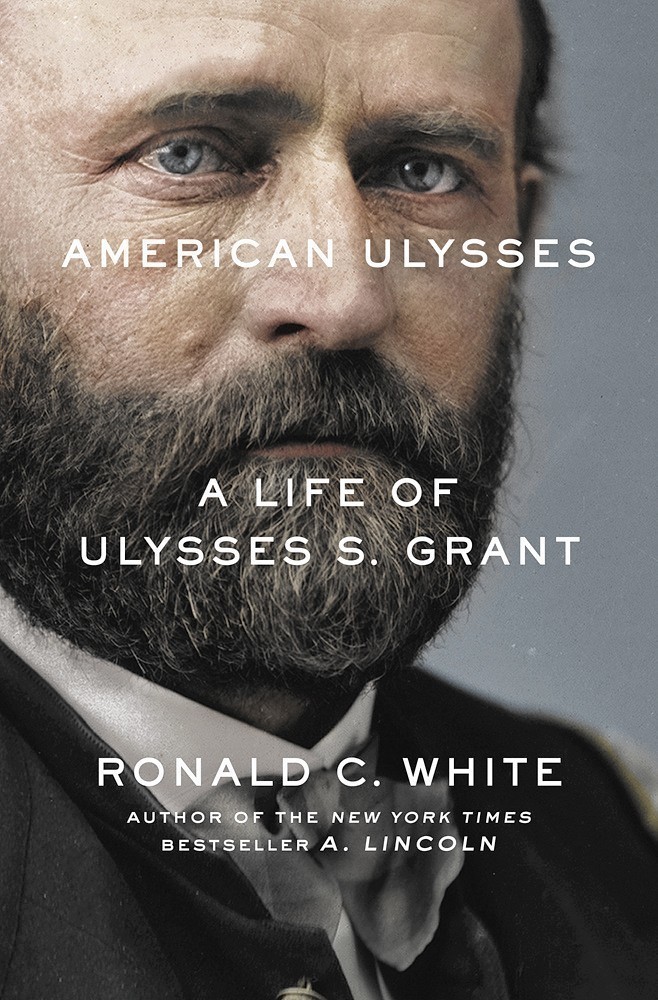
“My only misgiving regarding “American Ulysses” is that its length (864 pages) will scare off all but the most enthusiastic Civil War enthusiasts. I hope as many people as possible read this book”

– I think I will read this book, since I also think it is better than the Irish Ulysses (this is easy; the Irish Ulysses is the greatest shit book of all time, next to Finnegan´s Wake).

We should be grateful to historian Ronald C. White for a thorough and nuanced biography of one of the most consequential figures in American history.
CSMONITOR.COM|BY THE CHRISTIAN SCIENCE MONITOR

Philip HautmannThe Irish Ulysses being the greatest shit book of all time seems to confirm that creative endeavour gets spoiled and is doomed, when ego is a primary motive; that might be the case with the ordinary genius; the non-ordinary, transcendent genius will rather strive not for immortality among humans but for an abstract immortality, realignment with spacetime, which is his true element; the psychology of the transcendent genius is NOT very much alike the human psychology but is of a higher order. Thus spake L´Innomable.

Update about the Pathless Path

The true scientist, philosopher, artist – i.e. the truth-seeker – will strive for knowledge about what is already known, but, essentially, strive to look deep into the universe to discover new stars, new galaxies, new worlds. – In doing so, the truth-seeker also looks into himself; a triviality. – New worlds, new illuminations, are to be found in the unexpected, the trivial, on the street, in non-locations (non-lieus, Nicht-Orte) – to which the truth-seeker has a natural bond and solidarity – when the locations of the sublime – to which the truth-seeker also has a natural bond and a natural solidarity -, of course, have been explored as well; the locus of the existential truth is the true individual, the locus of truth of the world is a flower-like domain shifting through totality. – To become the locus of truth the truth-seeker must do what is called to “empty himself”. This means he must study a lot, as much as possible, and then 1) realign it with reality 2) deconstruct it – to gain pure insight, pure perception, pure forms of perception on which he can re-establish pure concepts – therein, he will come into contact with the nullfläche, the primal ground of his own mind, upon which everything else emerges, naturally (the vision of the primal ground is personal and subjective though there are similarities among those visions; it might be a surface of dirty white where no location is distinguished from any other, or, in closer touch with the outside world, an unspectacular ventilation shaft). In an act like this, everything is contained, like in the movements, gestures and actions of children everything is contained about what can ever be said, thought and perceived about those acts, because everything about those acts is authentic, simple and direct, because they incorporate the full potential of the idea of those movements, nothing is hidden, everything is there, such is purity. – This is, then, “the pathless path”. – Some might find a speech like that “a mystery wrapped in an enigma”. That is a good step to begin with. Meditate about that.

childartist

childartist2 art2 artist

pathlesspath


Thomas Traherne

„You must have glorious principles implanted in your nature; a clear eye able to see afar off; a great and generous heart, apt to enjoy at any distance; a good and liberal soul prone to delight in the felicity of all; and an infinite delight to be their treasure. Neither is it any prejudice to you that is required. For there is a great difference between a worm and a cherubim. And it more concerneth you to be an illustrious creature than to have the possession of the whole world.“
stars3 stars12 stars11
“ You never enjoy the world aright, till the sea itself floweth in your veins, till you are clothed with the heavens, and crowned with the stars; and perceive yourself to be the sole heir of the whole world: and more than so, because men are in it who are every one sole heirs, as well as you. Till you can sing and rejoice and delight in God, as misers do in gold, and kings in sceptres, you never enjoy the world.”
stars13 stars10 stars6
Centuries of Meditation