I have stated elsewhere (in the Book of Strange and Unproductive Thinking) that I find Faust a quite strange, annoying and unconvincing figure (as well as that Goethe < Büchner). Likewise – despite Faust is a character through which humanity is individualised (like Don Quixote, Yorick, K., Malone, Ishmael or Peer Gynt) – Nietzsche said that, upon reflection, probably all that remains of Faust is a bizarre, degenerated example of scientific man. Ibsen wrote his Peer Gynt as an allusion to Faust and someone said Ibsen´s Peer Gynt is a bizarre satire upon Goethe´s Faust. I find Peer Gynt a more convincing, direct epitome of humanity, also given the ethical implications of Peer Gynt, although I somehow think that the mirror image of Faust (who is, of course, the much more comprehensive character) is somehow necessary to make Peer Gynt truly shine. Otto Weininger was very fond of Peer Gynt and it was Otto Weininger who made me understand Peer Gynt so that I wrote my Rompf as an allusion and a bizarre satire upon Peer Gynt. Otto Weininger (wrongly) was somehow dismissive of Ibsen´s later plays and said that, if he had wanted, Ibsen could have become greater than Goethe (because he somehow didn´t like Ibsen´s progressive attitude towards women). Otto Weininger was also dismissive of Nietzsche and called him a genius of seventh (lowest) grade (because he missed the ethical component in Nietzsche´s philosophy). Otto Weininger mourned that there was no one around like Goethe anymore in his days. I think if Otto Weininger had stayed alive he would have become greater than Goethe and Nietzsche, but he was psychologically troubled and did not survive. I partially understand Otto Weininger´s psychological troubles (in the dimension of overexcitabilities common among geniuses) and as far as I can see I am the only one around who actually understands Otto Weininger as a philosopher. I also think Ibsen was at least a more convincing and powerful playwright than Goethe. I have written one play so far and it was a bizarre satire upon theater and theater audience. I wonder what would have become of Büchner if he had stayed alive. I think Büchner would have become a major existential philosopher like Weininger or Nietzsche, not a theorizer of colours like Goethe. Enter Nikolaus Lenau.
Nikolaus Lenau denied Goethe possessing a „monopoly“ upon Faust, instead understood the archetype of Faust as a creative common of mankind and wrote his own version of Faust (like Christopher Marlowe had already done before Goethe). Nikolaus Lenau is relatively obscure today although Wikepedia bluntly states that he was the greatest Austrian poet of the 19th century. His Faust is a somehow more dire figure than Goethe´s and is frantically and desperately motivated to understand the presumed „truth of it all“. As he gets thrown into the world of the living by the devil he neither finds fulfilment in elementary constructiveness (love, giving birth) nor in destructive passions and finally finds himself cut off from everything so that, in a metaphysically deluded reflection upon his emotional alienation, he kills himself (and falls prey to the devil´s plot). Lenau´s Faust finds himself in a heterogenous, emotionally detached world and, as long as he cannot be omnipotent, omniscient, omnisentient and sovereign rather chooses death, his endeavour to „weld together himself, world and God“ („Dich, Welt und Gott in eins zusammenschweißen“) a failure. Lenau´s Faust indeed does not have the universality of Goethe´s Faust, it is rather a reflecion upon Lenau`s inner world as he finds himself torn between a longing for a protective God and being embedded in nature and being an autonomous god himself, unable to find reconciliation and consolation between the two extremes. As Faust is an archetype for (metaphysically) struggling man, Lenau was right to weld his alter ego together with the Faust archetype. I came across Nikolaus Lenau´s Faust when Alexander Nitzberg and his companion Peter Sendtko made a theatrical performance of the poem/play at Roman´s atelier some weeks ago; it was really lovely.
I still have not read Proust´s Recherche, I bought a copy of Swann´s Way when I was 19 or so and finally managed to read it some years ago. As far as I understand, Proust is longing for closure within intensity too which he tries to achieve via realization of memory. Proust´s Recherche is also archetypical. Gilles Deleuze bluntly announces (in Proust and Signs) that the Recherche is not an undertaking directed into the past and into autobiographical memory but into the future and into learning where memory is the material through which the subject enriches itself and comes to itself. Neither the subject nor the world does express itself directly, the chiffres of the world are the signs (for instance social signs, romantic signs, etc.), and via understanding the signs the subject progressively deciphers the world. The purest signs are the signs of art as they are immaterial and spiritual. The signs of art are deeper than the subject or object that carries and sends out the signs and more elementary as they reveal the essence. The essence of an object is its true embeddedness in the world, that what is actualised about it and its potentialities, it is, with reference to the note about Deleuze and Rancière and as Angell de la Sierra puts it, the „meta-noumenon … nothing less than the existential ontology of the object, another way of expressing its circumstantial semantic content, now and later on, a mind´s view of ,objective reality`“. The essence of the subject is to become a „point of view“ upon the world, finally, as Deleuze notes, a de/transpersonalised „spider“ which reacts to and acts upon the vibrations within the world-net. In becoming a „point of view“ the subject becomes objectified, eternal and immortal and it is eventually via the artwork via which man is able to make sense of the world and establish identity. It is associative intelligence, not logical intelligence (which is the intelligence of Faust) which reveals essence. – Trying to live in this world with a pronounced artist´s intelligence is not easy of course, but I have to say that Faust´s problems are to a considerable degree alien to me. The arid character of the world gets compensated as before my inner eye as lose graceful gestures I occasionaly witness (for instance by birds, by twinkling stars or by children) get inflated into a graceful world and potentialities seem to pour out everywhere (despite being aware that that´s a kind of bluff package, yet only partially). I do not communicate much with people but I feel, in a way, in a communion with them much more than the chatterboxes out there commonly do. Memory is virtually present not in a fotographic, textual way but via a hypertextual monitor on which I can recall memories to a given sensual or intellectual stimulus via association, enriching both the stimulus and the memory content with additional meaning. That monitor kind of enwraps and cocoons me and gives me presence. Faust obviously lacks such a thing.
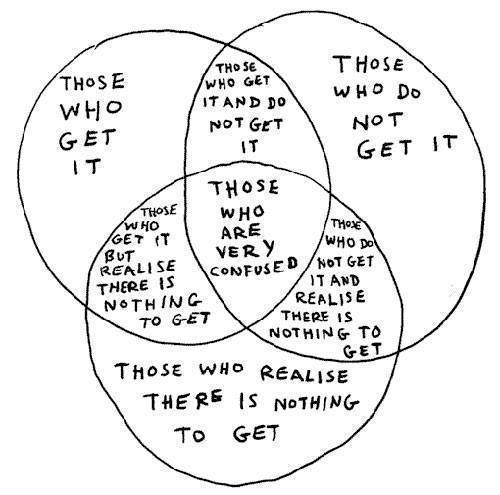
A while ago I have started to ruminate about the „hyperset“. The occasion was a diagram I saw which made me think of a, say, meta-diagram as a necessity to competently understand and process the diagram, as a, so to say, conscious reflection over the diagram. Likewise, I have observed that I seem to belong to many groups within the human realm which often venn very thin and marginally, or not at all, making the final intersection a set to which seemingly only I belong, in solitude, on this earth, maybe also in this history. However, I also seem to understand all the sets at a higher level than those who only belong to the respective sets, I have higher awareness, I have higher consciousness of them. That diversification and pluralism is a good thing is commonplace, that the one who only understands a single discipline actually doesn´t understand that discipline either is what they say. Pluralistic understanding is good. Deleuze (and Guattari) refers to transversality as a mode of establishing connection between heterogenous sets that make up reality. Transversality does not try to totalize and normalise heterogeneity but is affirmative towards difference, lets them resonate and explores interdependencies. It is experimental and reflects anti-logos and becoming, the associative method of the Recherche, the instability of the world and the object as well as the emergence of essence through the process of art. Artistic style (i.e. a subjective mode of expression which is of objective substance) is what holds heterogeneity together and is the correlate to the logos (Welsch takes „transversal reason“ as a model for reason in postmodernity). This is vibrant and humming and makes us think of a microcosmic reflection of macrocosm (which also Deleuze does in Proust and Signs). Remember, Otto Weininger says: „The ego of the genius accordingly is simply itself universal comprehension, the centre of infinite space; the great man contains the whole universe within himself; genius is the living microcosm. He is not an intricate mosaic, a chemical combination of an infinite number of elements; the argument in chap. iv. as to his relation to other men and things must not be taken in that sense; he is everything. In him and through him all psychical manifestations cohere and are real experiences, not an elaborate piece-work, a whole put together from parts in the fashion of science. For the genius the ego is the all, lives as the all; the genius sees nature and all existences as whole; the relations of things flash on him intuitively; he has not to build bridges of stones between them.“ That is, well, the purest emanation of the hyperset, not somehow clumsily (or, if you want, more cautiously and operational) as it appears before my inner eye or that of Deleuze, Guattari or Proust (not to speak of Faust). Unfortunately Otto collapsed psychologically under its airy weight.
Despite having written the First Prelude to a Note about the Hyperset months ago it seems that I have not progressed a lot about thinking about it further and deeper, which is, however, excusable since I have done other things. I wonder whether the „hyperset“ can be a mathematical object and how it could be modelled, maybe it could shed light on the incompleteness theorem. I also wonder whether consiousness could actually be understood as a hyperset, or what we refer to as the soul, or processes of „emergence“ in nature (which are, so far, little understood). It reflects however an elevated state of mind which is, in the same fashion, „grounded“. Maybe I also lose interest in the hyperset, though I don´t really think so because first I like the name and second I think it is actually a name and category that refers to something real and one day, after I am gone, they will jubiliatingly scream „the hyperset, the hyperset!“ when they´ve done something dilettante; but that does not differ from what I do and how I came to think of the hyperset.
Deleuze (respectively the Deleuze/Guattari hermaphrodite) says art is about Becoming. Deleuze (respectively Deleuze/Guattari) is very fond of transformations that stem out from the obscure and unexpected (from „chaos“) and lead to new ways of how perceive things. He likes that so much that in his philosophy true „events“ (not subjects, objects, structures, etc.) embody the highest degree of reality since they´re the ones that inflict change on reality. The true artist permanently „becomes“ and calls for „a new earth, a new people“, that is to say for new modes of understanding and being alongside his specific vision which is, if it is of the highest caliber, self-transcendent. Becoming happens at „zones of indistinguishability“ between qualities (for instance that the maltreated, oppressed human becomes animal, the maltreated, oppressed animal becomes human), via his empathy and associative intelligence and powered by his drive to transform and finally to incorporate being in its totality, the true artist is sensitive for spotting and experiencing zones of indistinguishability. Deleuze/Guattari says (with reference to Lawrence) the artist carves slits and openings into the firmament, respectively into common understanding, to let some chaos in, which then allows syntheses of new and higher order. Deleuze/Guattari also says that the artist, in a way of defying chaos, tries to reach into the infinite and then tries to project it into the finite i.e. the true artwork being a zone of highest order in which the infinite shines trough. Deleuze says, if we try to understand art and artists in such ways, i.e. as people that dive into the unknown solely for the sake of achieving knowledge and transformation of mind, artists who write „minor“ literature, only, actually, a small minority of people doing art could be labelled artists (respectively writers, as he is, in the respective text – Literature and Life – specific about literature).
Ranciére understands aesthetics, as well as politics, as regimes which legitimise certain objects/subjects/entities as theirs. The paria, the proletarian, the slave is originally excluded from the sphere of politics; with finding a voice they become political subjects; they are able to participate at the political process, they are included in the political process. Politics does happen when excluded parias become included and transform from (quasi)objects to authentic subjects of politics. Therefore, politics is about finding strategies for the excluded to become included. Likewise, the regime of aesthetics defines what is to considered as beautiful or as art. These regimes are open and in flux. Rancière is concerned about how art could contribute to political change. He makes reference to Schiller and to the idea that art is kind of democratic since the sensual, the aesthetic, can be experienced by everyone, as well as to the idea that art orginates from a ludic drive (Spieltrieb) in man. The playfulness alongside the ludic drive can be seen as opposed to the seriousness of material conditions, as well as where true freedom and the possibility of self actualisation lies, which becomes projected into the vision of a somehow brotherly society of competent, empathetic individuals. Rancière, who has a keener eye on investigating paradoxes (of art, politics, literature, etc.) than offering a stringent philosophy (like Deleuze) says that, in practical terms, political revolutions via aesthetic revolutions largely have failed, degenerating, in the 20th century, into consumer aesthetics in capitalism or Stalinist pomp under communism. (I, however, am quite content with living in a consumer society. Likewise, under specific circumstances there is nothing wrong with being sympathetic with communism. Bolz reminds us that living in a consumer society prevents us from relapsing into religious or ideological fanaticism and extremism, or communism.) Rancière claims that while Deleuze wants to extend philosophy into spheres that are external to philosophy, he himself is rather interested in using philosophical understanding and method in other playgrounds of the human mind, or in the most practical arenas. He is also skeptical of Deleuze´s notion of philosophical concepts or books as „tools“/“toolkits“, given the emptiness of many texts in which others try to use the Deleuzian tools, and he confirms that Deleuze establishes a kind metaphysical imaginary that is alien to him. He seems to have a need for precision that may rather be found in the writings and approaches of Deleuze´s temporary friend, Foucault. — Rancière´s text „Is Art Resistant?“ provided the ferment of this text, and I am glad that after weeks of intellectually working on it i now finally seem to be able to get the fucking thing done.
So there you have the art genius, trying to look at the world in order to determine its value – the artist, spiritualised with empathy and sense for connection and therefore trying to spiritualise the objects of art, trying to establish connection and communion in the world — with his vast intellect he sees abstractions and general modes of being in the individual and the idiosyncratic as well as he sees the individualities and idiosyncracies which evade the abstractions. He sees occasional gestures and movements full of grace, in a specific way a person laughs for instance, which give him awareness of the presumably graceful nature of the world and of people — a giant, a cosmic spectacle before his eyes, in his mind ———– which unfortunately effectively gets contrasted via a more sober look on the world: In which most people, effectively, are not specifically intelligent nor equipped with pleasant personalities. Their epistemology is simple and they can´t think, which is why offering genuine innovative philosophy and art is about the same as trying to offer a paper on advanced topology or differential geometry to people – it is equally incomprehensible to them although it is (apparently) written in the same language they use, not in the language of mathematics. Likewise, beauty is, indeed, recognisable for everyone, just most people don´t care a lot about it, let alone that they were able to understand beauty on a more abstract level and intellectualise it in order to solidify their understanding and enliven it (with those intelligent enough to intellectualise stuff often not being receptive to beauty or genuine creativity in turn), same goes for originality. Despite people are quite self-centered they usually don´t even know how to dress themselves properly. Look at how people are running through the city or sitting in restaurants and obviously take a look at nothing – whereas my own sight usually roams and roves and tries to look at my surroundings their glimpses don´t! They are, to a considerable degree, not interested in the world they inhabitate, let alone in that which is beautiful, intelligent, vibrant, etc. but in stuff and people in which they can mirror themselves, which is why slightly above average people often are so popular (since average people can project themselves into them) whilst it is often a hindrance to success being very much above average. People like to complain a lot and they´re negativistic, they demand that „more intelligence“ should happen or „true art“ should happen, but when it does happen they regularly don´t pay attention. When they see that intelligence comes around the corner but does not confirm their pre-existing world views, they may hate it. The problem of intelligent artists is that they want to make people more intelligent, but, in the first place, they make them look stupid as they confront people with something they cannot properly understand; and people don´t like that. That is when their „sapiosexuality“ usually ends. Paradoxically, the great genius who establishes the most potent worldview by thinking outside all contemporarian boxes is what is least desired or acknowledged. There may be nothing (of substance) the world is less interested in, and less friendly to, than a truly original thinker as long as he isn´t recognised and verified by the machine. (Meditate about that.) So much for the polemic.
Houellebecq says, while the artist tries to make the world an object of art, the world actually does not at all qualify as an object of art: the world is bluntly rational, without any magic and without particular interest. With that being one of Michel´s usual pessimisms it can actually be, occasionally, quite a nuisance, when the artist and the genius tries to get his firm and powerful, secure grasp on the world and what he grasps into is a kind of foam of stunted or irrelevant understandings, a kind of Emmentaler cheese with a lot of holes and air between the solid structure. This kind of foam is, actually, the world. To many artists it therefore becomes apparent that we are living in a kind of ghost world and then they write sad novels. I find this exaggerated. Foam can be quite beautiful, it changes or vanishes after a while, the foam of the world is stratified and consists of different, and distinguished elements. Art is about giving a lucid impression of the world. Great art is about seeing the universal in that which is transitory, and, therefore, bringing both to life in making it comprehensible for us. Art helps us in understanding a heterogenous and manifold world in which most things forever happen beyond our horizon, not only as it broadens our horizon but as it charges the world, and entitities within the world, with meaning. It illuminates the world as it illustrates the situation of man. Even it is a sad or drab world presented, the intellect rejoices because it makes him see and understand how the pieces fit – „Was im Leben uns verdrießt, man im Bilde gern genießt“ says Goethe. Personal consolation or the possibility to make sense of one´s own situation may also be found in works of art. It gives dignity to the fallen (and may actually be the truest form to deal with horror). And indeed, a work of art may give identity to a people, if not a system of meaning. Identity is good, being equipped with a system of meaning is good, since it increases competence (and gives people a „voice“).
Heterogenousness, due to individuality, is a some kind of oppositional force against reconciliation, and the „new earth“, the „new people“ will be heterogenous all alike. The prospects of a „we all shall come together“, of a reconciled world, are dim since we aren´t all alike. If we were all alike, humanity would cease to exist (and intelligence would cease to be competent since there would be no individuals of above average intelligence to tell the collective what to do). (For instance in the „hellish“ virst volume of Dead Souls) Gogol shows how „individuality“ commonly simply is a nuisance, resulting from lack of heart, mind and soul (not from excess), a mode in which stupidity is displayed. Because of stupidity, reconcilement decreases to become an option. In another dimension, of course, individuality is that which is productively resistant against totalitarian visions of reconcilement, and strong individuality is necessary to evade the influence of other powerful artists. Finally, the extreme individualism of the genius provides the locus of truth since due to his extreme individualism the genius is able to discover authentic human values. The paradox, or the tragedy, is that the genius will forever be alone in his visions and profoundly isolated from society, even if he gets appreciated by society. Whitehead remarks the malady of this world is that average elements can easily be reconciled while the progressively individualistic elements cannot or may even be sorted out or destroyed in the process that makes reality, despite embodying a higher extend of truth. (I, however, advocate the notion that the more individualistic, the more „real“ elements operate at different and distinguished levels of reality and it is probably a good thing that interference between these levels is limited; it need not add up or may be well dangerous to both.) Deleuze says art is about trying to reconcile the „originals“ (genuinely original people) with society (Bartleby or the Formula).
Rancière meditates a good deal about how the specific qualities inherent in art and qualities that make the political may meet, although, with reference to Kant, he emphasises on the sensual and aesthetic qualities and is quite silent about the intellectual qualities of art. – I say maybe the most important quality of the artist is universal empathy. It is his way to relate to the world. Without that his experience of the world can´t be enlivened. Empathy is both an emotional and an intellectual quality and it is noted that exceptionally gifted persons display a high amount of empathy also in their intellectual undertakings (they become unusually immersed in them and de/transpersonalise, etc.). Likewise, art is primarily an expression of associative intelligence which does not primarily aim at exposing the logical structure but the multilayeredness and manifoldness of the world. Divergent thinking is more important than convergent thinking for the artist. As divergent thinking primarily aims at reflecting upon a concept the way of how it could be viewed upon differently, the artist naturally runs (to some degree) against the grain. His intelligence is subversive and his divergent thinking makes him comprehend (and master) chaos. His intelligence expresses itself in an experimental way and opens itself into an evolving future. Associative thinking gives a sense of universal „connectedness“ and a longing for cohesion. Because of that the artist has a strong sense for establishing (authentic) communion between people and between things (which may deem the rest of humanity whimsical or fantastical). While, with reference to Kant, the qualities of the aesthetic (beauty and the sublime) and the qualities of reason and of ethics are distinct, beauty gives us an idea of transcendent order and the sublime fills us with awe for a higher (ethical) instance (deus (absconditus)) to which we have to bow down. Beauty refers to constructiveness and love, the sublime to humility, self-reflection, etc. as a necessary ingredient of how to do things right. Art, therefore, is both contained in itself and self-transcendent. It is both concrete and universal. Art gives a sense for the ambiguity of things and (their embeddedness in) contexts. It opens a dialogue between the empirical and the transcendental. Because of that it is, somehow ironically, the artist, not the scientist, who sheds light on the „thing in itself“. In seeing the universal in the transitory, the multilayeredness and ambiguity of things and contexts, cosmos and chaos, the artist grasps a „meta-noumenal“ essence of a thing, which is „nothing less than the existential ontology of the object, another way of expressing its circumstantial semantic content, now and later on, a mind´s view of ,objective reality`“, as Angell de la Sierra of Omega Society wonderfully makes it explicit of what is apparent to the artistic gnostic in one or the other way and what the art gnostic expresses in one or the other terminology.
The world may be a terrible disappointment for the artist, and it will be so with growing, painful intensity for the omega artist. Yet of course art requires non-art. Beauty erects upon ugliness, the sublime upon our limitedness, the spheres upon suffering. The isolation of the true artist and thinker may be profound and eternal, but without individual elevatedness upon the collective no intelligence and no transformation and progress can ever be possible. Nietzsche, who embodied extreme intelligence and originality, with the consequence of being also the embodiment of an outcast, sadly philosophised that the world can only be justified as an aesthetic phenomenon. As an aesthetic phenomenon the world, however, necessarily must contain stuntedness; Whitehead somehow proposes that God´s will is not to make the world perfect in the ethical sense but aesthetically and therefore allows stuntedness and decay to enforce creativity and to bring in the new. Consider the world as an artwork by God. This is difficult for the human mind to grasp, but, as stated above, intertwined with that, art may offer consolation. Stuntedness may appear beautiful and fascinating. Since before the inner eye of the artist there is constantly something emerging, evolving, if not protuberating, there is no actual stuntedness. With respect to what is important for Deleuze, the artist´s gaze both sees the actual but also the virtual. The „new earth“, the „new people“ is, therein, a virtual quality. It is also, somehow, „out there“ in this world. For practical and metaphysical reasons we should embrace pluralism and the understanding that the world, when trying to grasp it in totality, becomes elusive, opening itself to an understanding that it consists of many worlds (as Markus Gabriel and New Realism annotate).
Deleuze says philosophy is not a power. „Religion, the state, capitalism, science, the law, public opinion and television are powers, but not philosophy.“ Same would apply for art. Since philosophy (art) is not a power it can also not enter into open battle with any power, rather it establishes a guerilla. It is true that the logics of art and of politics are distinguished. Science is the art of grasping the rational aspects of existence, whereas art is the science of investigating the irrational aspects of existence (i.e. the subjective embeddedness of man in nature). They´re different territories. Yet knowledge and understanding vice versa also allows the own and private territory to be understood and explored in greater depth. Who is more powerful is a question of perspective. Finally, it´s only the great works of art which last forver, as the artist may be oppressed, maybe destroyed by any power, but it is him who sees all the kingdoms rise and fall before his inner eye. The powers are transitory, art is the universal. In his downfall, the artist embarrasses and humiliates the powerful transitory victor – who is, then, the vanquisher? Deleuze/Guattari say a true work of art is erected and can stand for itself. Rancière reminds us of the blunt autonomy, the „unavailability“, the statutory character of the statue/artwork, as the autonomy of art and the virtual indifference the l´art pour l´art towards politics carries a moment of resistance, and finally concludes that art is resistant as it does not only enter a dialogue with the political and the transitory but also eternally refuses to do so. Art is its own affirmation, and an affirmation of life. It seeks the liberation of life. It is expression of a liberated, and higher consciousness. It may contain more of the world than the world itself does. And with that I ascend into the regions of the ice mountains and lose myself to never return. Hahahahaha!
A chief characteristic of the sculptures of Baroque artist Johann Georg Pinsel are the exaggerated folds, which will remind the hipster intellectual of Gilles Deleuze´s book about Leibniz and the Baroque; indeed, one of the coolest parts of The Fold. Leibniz and the Baroque is when Deleuze uses his immersive, empathetic language to write about Baroque clothing and why the folds Baroque clothes crinkle are metaphysically connoted (in the opening of the final chapter, A New Harmony).
Deleuze´s main philosophical endeavour may be how to think the many facettes of the univocal one; put in other words he is the thinker of metaphysical confusion. Hence the dynamics between the virtual and the actual (as opposed to Platonism) and the notion of difference and non-identity at the core of every thing, respectively being itself as difference in itself and non-identical to itself, enabling productive dynamics of an open flux, which becomes tangible via the competent, productive agent (alongside Deleuze´s empiricism/Heideggerianism which assumes the subject and his modes of cognition and his modes of being affected as interrelated and elastic (and corruptible) to the dynamics of the outside world, respectively to the outside „forces“). Deleuze thinks that being is essentially composed of relations (i.e. network-like) and via his intellectually mobile concepts Deleuze „puts metaphysics in motion“. He makes us think being in itself is something that is colourful, catchy and cool.
The Fold is a concept Deleuze already used to greater extent in his preceding book about Foucault, refering to ——– but I seem to find out that, despite having planned to write this note since last week and having read and prepared myself a lot to do that, I am not particularly in the mood for doing so now – but I want it to go out now since this weekend the Pinsel exhibition at the Winterpalais, to which this note refers to and is dedicated to, is running out and I want to remind people of it and I want them to visit it. Apart from that I should write an article about Scelsi, Leifs and Ustvolskaya for the Versorgerin this weekend. Also this Pinsel-Deleuze note was considered to be followed by notes about Deleuze and Ranciere and Leibniz and Whitehead (which also annoys me a bit since my main objective is to write about artists now).
Deleuze is likeable because he is the quintessential thinker of the productive mind, unfolding and appealing to us via his erotic, ecstatically faltering language and he is a considerable metaphysicist since he also is aware that the universe is, to some not unsubstantial degree, quite full of shit and of not happy, flamboyant productiveness; that, qua difference and repetition, being is inherently unstable and nothing that actually or necessarily comforts, protects and conceals; that like enlightenment, catastrophe may be the actualisation of the virtual (despite not putting a lot of emphasis on it due to his sovereign, optimistic personality). I made the plan to go through the entire Deleuze again and to write about Deleuze and metaphysics, as I plan to do it with the entire Nietzsche and some other stuff somewhere rather sooner than later, in a general Heideggerian attempt to establish Lichtung. I don´t know whether I will have any message for humanity to deliver or something commonly labelled as wisdom. Rimbaud says, his wisdom is despised like they despise chaos. Maybe one day this century will be called Yorickesque.
25 and a half years ago I bought my first metal album: Iron Maiden´s Seventh Son of a Seventh Son. (I came across popular music as a slow learner because I had considered it as vulgar before; then, at 14, I began to listen to Pink Floyd, Kraftwerk and the like, soon became interested in Iron Maiden and other heavy metal bands, because their obscurity attracted me. The first contact I made with Iron Maiden was when I was little and I saw the Piece of Mind LP at the Pro Kaufland when we were shopping, obviously in the early 1980s, the cover with the monster in the rubber room made an impression on me I still remember, ahhhh…) I initially disliked it but soon got into it, and soon got me some other metal records (from Helloween, Motörhead and Iron Maiden, later in 1991 Guns ´n´Roses and Metallica became big shots, etc.). – Seventh Son of a Seventh Son, one of Iron Maiden´s finest works, is a concept album about a person with supernatural powers. The forces of Good and Evil try to manipulate this person and to turn him into an agent for their causes. As it turns out the Seventh Son of a Seventh Son possesses the faculty of clairvoyance and foresees impending doom, yet, like Cassandra, is not taken seriously by people, respectively after the disaster gets all the blame for it. Despite his powers to see through people and through things the Seventh Son of a Seventh Son is not able to foresee his own demise and it remains dubious what he actually has achieved in the human realm – „The evil that men do lives after them; The good is oft interred with their bones“, a quote from Shakespeare´s Julius Caesar which serves as a Leitmotif for the whole album. In the end it seems the story of the Seventh Son was only an episode in a seemingly eternal struggle between the forces of Good and Evil. – If we zoom out of this section of the fractal, where Good and Evil are categories of the understanding of man, we progressively refer to the cosmos, of the totality of existence, and their dubious purpose, where it is maybe right to envision forces of constructiveness (energy) and forces of dissolution (entropy) as the deep structure, as the ultimate logos; maybe those forces are conscious and god-like, or they create their own (quasi-) consciousness as they progressively unfold, and who knows if it is not the forces of entropy which guarantee the eternal repetition of the cycle (for instance the Penrosian Cycles of Time)? Or is the state of order we experience just a natural and logical state within an infinite mass of chaos which naturally inhabits finite regions of cosmos, bound to dissolute again? – Such questions are of some interest for humans, and although those interests are usually not very pronounced among people they form the screen on which the shadows of all the other ephemeral interests are projected. It is the call of the genius, who naturally sees all the ephemeral in its cosmic significance, who projects daily struggles into cosmic struggles, who expands finite contexts into the infinite – sometimes for good, sometimes for worse – to establish systems of reference, of meaning. In their final consequences, people will not truly understand them. Apart from that, everyone will understand them. Because they are just natural and soulful, intellectually and emotionally intelligent abstractions of everyday life, of the common life experience.
01 – Moonchild 02 – Infinite Dreams 03 – Can I Play With Madness 04 – The Evil That Men Do 05 – Seventh Son Of A Seventh Son 06 – The Prophecy 07 – The…
Adressing those articles again the health benefits of listening to heavy metal are apparent. Heavy metal is simply better music than what is usually displayed in other genres. It is more intense, more erudite, more sophisticated, more simple and direct, more natural. There is more melody and harmony and more abrasiveness. It involves new ways to express melody and harmony in a dialectics with cacophony. It gets you much more immersed. That is why metal fans have an unusually strong attachment to their music. It is more sincere and demands passion, professionalism and devotion, yet is also more tongue-in-cheek and funny. That is to say it is more multi-faceted and comprehensive; what you see is not what you get, what you get is more. It is also more authentic, i.e. heavy metal fans avoid the psychological downsides of conformism and the unhappiness it involves. If your cognitive type is being a mismatcher you will be naturally more attracted to counterculture; if mismatching is most pronounced you will be most attracted to (the extreme subgenres of) heavy metal. That´s the voice of the outsider, of the individual, not of an anti-conformist quasi-partisan collective as you have it with punk. The truth is to be found there – in the enlightened, enchanted individual that contains most aspects of the world and is therefore in the most perfect state of harmony with the world. Beach Boy´s Pet Sounds or Led Zep´s Physical Graffiti are pretty comphrehensive albums but so are Forbidden´s Green, Grip Inc.´s Incorporated or Inter Amra´s Sky Burial, however the latter are clearly further down the horizon, in a more elevated region in the atmosphere, a higher echelon, closer to the vanishing point of totality. Why keep on insisting on listening to Sun Ra or Pink Floyd, if it is not some weak shit at all, when it is Morbid Angel, Meshuggah or Mitochondrion which give you an impression what music that comes from another planet, originates from or tries to realign with other worlds could look like; or when it is Abyssal who transmit the sound, the signals of the abysmal depth of far outer space (from close to the region where Azathoth dwells)? They expand the frontiers of the human mind, those acts explore new horizons. I do not quite understand how anyone with a brain working at high intensity level cannot be into heavy metal. It is music for schizotypal explorers. Schizotypal usually also is the poetry in metal lyrics, the scattered patterns, the strong lines transporting messages open to interpretation, so that you can establish multiple perspectives on them, a call from the beyond, ahhh … the patterns you can see in those lyrics! Healthy schizotypy involves introversion/introspection, intensity of inner world experience, power to ruminate, creativity and independence, ability to create a new world. It is not a disorder, but the highest level of personhood, of man. And with its lyrics about satan, about gential mutilation, or also with its sincere lyrics about politics, society or the human experience is simply more in touch with reality that the phony shit you can hear on the radio. Being in touch with reality, and mastering it, according to the principle, is good, is healthy. Smell the gravity of the heavy metal.
By the end of last year, enchanted by some new extreme metal releases, I wanted to write the Metapysical Note about Extreme Metal, which I could have already done, but still haven´t since I wanted to involve more contemplation and maybe new insights. But I think I am going to finally write it in November this year. The Metaphysical Note about Extreme Metal will be about how to realign „Western“ and „Eastern“ metaphysics, about how to avoid the negative consequences of both, and it will teach about the overman.
(The idea is that by embracing extreme metal you embrace otherness. By embracing otherness by the means of productive mimesis you get in closer contact with otherness and the apparent shadow realm it involves, as well as the shadow realm you involve yourself. Your consciousness will be broadened and you yourself become deepened. „Western“ metaphysics is concerned with the possibility of solid knowledge, „Eastern“ metaphysics with directly experiencing the faculty of perception itself, the extreme metal experience allows an integration and synthesis of both approaches. As you broaden and deepen yourself by embracing otherness, you will progressively lose the egoic aspects of self, both become a fluid entity as well as a distinct individual entity which does not get lost in the perception of Tao but will, with the knowledge of Tao, operate as a scientist. Finally, in that fractal-like process, everything that is untrue will be sorted out and only the true nature of things will remain. That entity which encapsulates things in that way is, then, the overman.)
The Metaphysical Note about Extreme Metal, together with the Postscripts to the Metaphysical Note about Extreme Metal, will be a very important document in the history of human thought, and of human practice. That will make me unpopular on Facebook again.
Heavy metal music helps fans deal with the idea of their own death, new research suggests. According to a study in the Journal of Psychology of Popular Media, the sense of identity that the death-themed music creates gives listeners meaning to…
“Wo es an Schema fehlt, da fehlt es an Philosophie – das ist das uneingestandene Vorurteil aller zünftigen Systematiker gegen den “Anschauenden”, denen sie sich innerlich weit überlegen fühlen. Deshalb nannte Kant den Stil des platonischen Dialoges ärgerlich “die Kunst, wortreich zu schwatzen” und deshalb schweigt der Kathederphilosoph noch heute über Goethes Philosophie.”
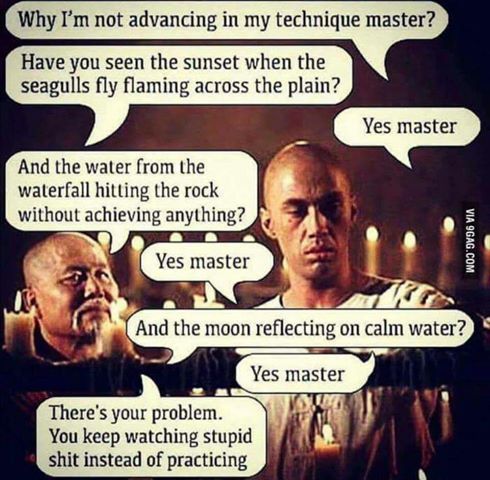
Watching stupid shit is best practice. Unless the stupid shit flame burns in you and consumes you, you never enjoy the world aright. Schopenhauer says it is the Will, Nietzsche says it is the Will to Power, I say it is Stupid Shit what makes Kant´s Ding an sich, and so if you establish a perfect gaze at stupid shit you will be in perfect alignment with the world; it will destroy the limitations of your intellect, spawn omniscience, cleanse the soul, demolish the subject-object dichotomy and evaporate flawed internal systems of reference like yin-yang shit and stuff. Veni, vidi stultum stercore, vici.
Philip HautmannNi Zan, in his not very well known poetry, establishes a perfect gaze at stupid shit, you should get close to it; they say if, on your path to ascension, you meet the Buddha you should kill the Buddha, maybe, but that is not the correct approach relating to Ni Zan, thou should make his eyes thine; some shades of the Buddha are inherently, and necessarily, relative, but Ni Zan is absolute. (See also blog entry about Ni Zan below.)
A reccurent meme on Facebook says: “I like weird people… the black sheep, the odd ducks, the rejects, the eccentrics, the loners, the lost and forgotten. More often than not, these people have the most beautiful souls.” – Schopenhauer called Proclus Diadochus “a shallow, wide, boring windbag”, and I have sympathy for the underdog, So I went to the library, borrowed the only book they have by Proclus in my language, “About Providence, Fate and Free Will, to Theodorus, the Engineer” and intented to write a note, as a hommage and a tribute to this largely lost and forgotten individual, to make him shine on Facebook.
Unfortunately, “About Providence, Fate and Free Will, to Theodorus, the Engineer” is actually quite boring and this has made my originally innocent and well-intentioned plan to write a glorious and triumphant note about Proclus Diadochus go sour. In one of his later works Nietzsche said that Schopenhauer was “wrong on every account” (contrary to what he said in his earlier days and “Schopenhauer as Educator”, the third Untimely Medidation, is a key work to the understanding of Nietzsche at all) but at least in this respect he might have been right. However, I admire intelligence in others but I value highest goodness of character and, according to legend, Proclus was virtuous, hard working, disciplined, engaged in political debates and educational affairs and was prosperous and generous to his friends and a vegetarian. I think if all people had the characteristics of Proclus the world would be a better place, and this shall serve as a monument.
Proclus was a Neoplatonist and the most dominant figure among the Neoplatonists was Plotinus. I recommend getting familiar with his philosophy, for it carries beauty and shall enhance your sense for harmony in the universe. His “Enneads” are nevertheless badly written, a disaster, so I recommend, at least for introductory means, not reading literature written by Plotinus but literature written about Plotinus.
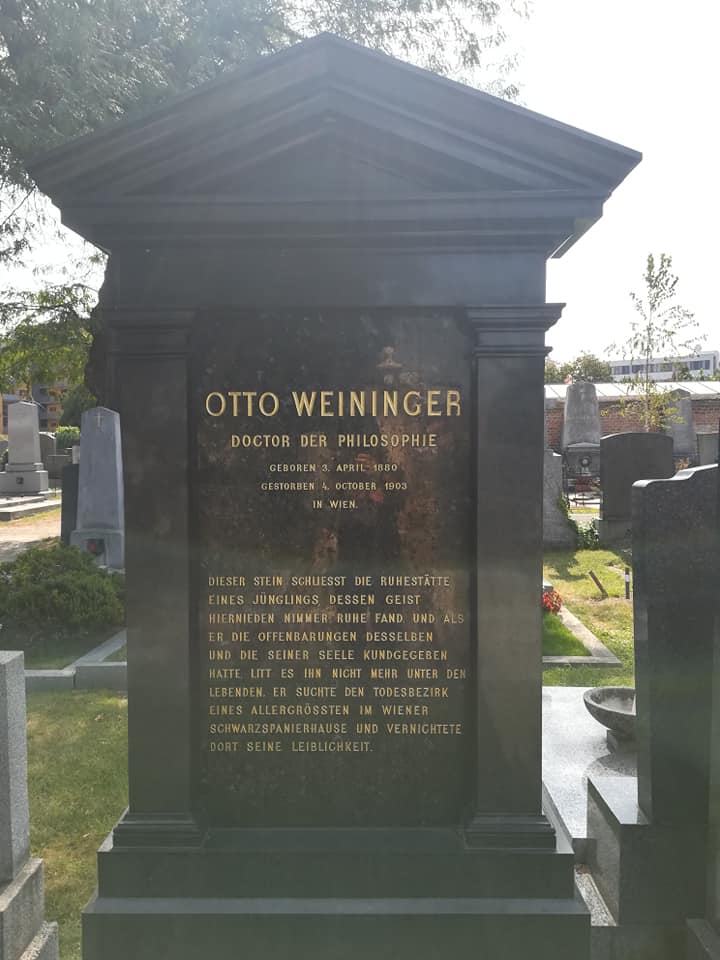
Otto Weininger (who was jewish) said silly things about women and about jews, in their usual demeanour to concentrate on the wrong things first that is how he is, at large, remembered by the human race – but that is not what is important. What is important is that Otto Weininger was the greatest philosopher of all time. Otto Weininger gave the answer to what is the meaning of life. The meaning of life is to become a good person. A person becomes good when she embraces reason and moral, when she strives for a clear, unaffected understanding as well as for empathy, if not love, for the object. „Logic and ethics … are, all in all, one and the same: duty against oneself. Not only virtue but also understanding, not only sanctity but also wisdom are the duty of man, only both combined establish integrity and perfection.“ The means to achieve perfection are being interested. Being interested is the good principle. When I am interested in the object, or the fellow human, I show my respect. When I try to understand him (which does not mean that I excuse him) I pay my highest tribute to him. The outstanding human being is therefore the most universal and the most interested human being. She, who lives with the world as a whole in the most intimate relationship, who strives to understand it most deeply, and with the highest passion most objectively, will also act most virtuously (something also Nietzsche said once). Relying on Kant, Otto Weininger framed an Individualethik about man who has to establish virtue and understanding by himself, in a universe that is „deeply silent“, but according to the good principle. Like Kant, Otto Weininger felt profoundly shaken by that insight and the distinguished person will understand this insight, respectively the grasp on this insight, as something sublime, like „the bestarred nightsky“. Taking away the obnoxious elements, „Sex and Character“ is one of the greatest and deepest books ever written, by an intellect of such an astonishing supremacy, and the posthumously published essays are further elaborations and illuminations. The title of the second book is „About the Last Things“, rarely a title is so accurate, since the basic thought contains the alpha and the omega of it all. Otto Weininger is the redeemer of the post-religious age. And he may be a primary thinker for an age of post-conventionalist moral systems.
While writing on „Sex and Character“ Otto Weininger, who was only at the beginning of his twenties then, became ever more depressed. He made statements, ever ominous, that the book would contain an important truth – which, however, „will bring death: either to the book, or to his author“. After it was published it was largely ignored. Otto Weininger however became ever more restless and obsessed by the thought that he was „a criminal“. He became philosophically interested in the problem of „the criminal“ as a type of behaviour and of a human being opposed to virtuousness (which is, at least, a more accurate way to model this than to take „the woman“ and „the jew“ as opposites to the (logical and ethical) genius). Along with the usual intensity of the inner life and the overexcitabilities which every once in a while torment the genius person Otto Weininger, during his deep mediation about ethics, became tormented with the (rational) thought that he would most likely not be able to live up to his own philosophical ideals and became sucked in the conception that he would be a „criminal“ at all. It is not known why Otto Weininger became obsessed with this thought. He was a very virtuous person. Maybe he became ashamed by the inherent misanthropy of his antisemitism and his misogyny (which were, however, much less prominent in „About the Last Things“), a woman however, who dated him once, later reported about her impression about him in the wording that she had „met Jesus Christ“ (therefore also a person obsessed by her own (actual or virtual) „sins“). Further complications might have added to the confusion. Someone who knew both Weininger and Franz Kafka said about them: „They were both geniuses. And mad. Genius and mad. They both already crossed out a sentence even before writing it down.“ That is not madness but a mind running at ultra-fast speed and an emanation of the inner life of an ultracomplex person. Note however: such a condition can also be pathological or turn pathological. Otto Weininger was a mind so supreme that he seemed to be above the level of even the great existential philosophers who, themselves, were somehow the greatest, most comphrehensive minds in history. Yet those very great philosophers – Socrates, Plato, Nietzsche, Kierkegaard, Wittgenstein, also Schopenhauer (and, if they had lived longer, Pascal and probably Georg Büchner) – were actually meta-philosophers (as well as Fariduddin Attar, the greatest of all existential philosophical poets, was a meta-sufi). Having written „Sex and Character“ at the first shot, Otto Weininger seemed to reside even above them, i.e. above the level of a meta-philosopher – but what would that be? Ultra-intelligent people run in danger of climbing on the very top of a discipline in a short time and then don´t know what do to further, or have difficulties to interpret what they are doing since there is no actual comparison possible: Otto Weininger at least developed a (temporary) identity crisis and considered himself as „no philosopher, not at all. But what would I be instead? Probably nothing!“ Also Otto Weininger reached for divineness. He expressed that the genius person will become a god and in his mediatations about ethics he reached into religion. But since Otto Weininger was a rational person with no religious sentiments he probably became plagued by that inconsistency. His synthetic intelligence reached for the heavens but his analytical intelligence further dissolved everything and probably intensified his perception of „chaos“ (which he became afraid of and attributed to the „criminal“). Another important element, probably the most important of all, is that Otto Weininger simply seemed too young and therefore emotionally immature to adequately handle the weight of his philosophical meditations (therefore also his misogyny and antisemitism who seemed to be the epiphany of an immature person). Again, it is not known what tormented Otto Weininger so much that he felt driven into the final consequence. Probably also finding out, respectively feeling confirmed, that his ethics is not acutally applicable to man. Being passionately objectively interested in the world, anti-egoic and empathetic, in an intimate relation to the totality of the world, is the domain of the genius, and beyond the reach of ordinary man. And possibly also out of reach of the genius. The important message of the „system“ of Otto Weininger is the encouragement of man to become genius, that genius is actually an imperative to reach for itself, yet at the same time he was aware that to ultimately successfully follow this imperative will remain the solitary business of few. In an uncanny state of mind, both being highly mentally disturbed as well as being highly mentally present and logical, he went to the death house of Beethoven in the Schwarzspanierstraße in Vienna and shot himself to death, at age 23, on Oct. 4 1903. Immediately thereafter his book became a bestseller and a longseller, altough his fame mostly stemmed out from being seen as an eccentric figure respectively an idol for anti-feminists and antisemites. Good people also saw the good in him and brillant people saw his brillance, but this perception was isolated and did not become systematic or encouraged scholarship. After World War 2 his remembrance sunk into oblivion respectively degenerated into being remembered as an outrageous crank. The importance of his books as a reflection on ethics was obviously never really fully grasped. Freud, who knew Weininger personally a bit, called „Sex and Character“ „ein merkwürdiges Buch“.
This was the life and death of Otto Weininger (1880-1903), probably the most, or at least one of the most pronouced idiosyncracies in the eternal recurrence of man who does not understand very much, who is not interested very much, and who does not care very much (and this is probably the way it should be (to secure his eternal return)).
„The ego of the genius accordingly is simply itself universal comprehension, the centre of infinite space; the great man contains the whole universe within himself; genius is the living microcosm. He is not an intricate mosaic, a chemical combination of an infinite number of elements; the argument in chap. iv. as to his relation to other men and things must not be taken in that sense; he is everything. In him and through him all psychical manifestations cohere and are real experiences, not an elaborate piece-work, a whole put together from parts in the fashion of science. For the genius the ego is the all, lives as the all; the genius sees nature and all existences as whole; the relations of things flash on him intuitively; he has not to build bridges of stones between them.“ – O.W.
„The reason why madness overtakes so many men of genius – fools believe it comes from the influence of Venus, or the spinal degeneration of neurasthenics – is that for many the burden becomes too heavy, the task of bearing the whole world on the shoulders, like Atlas, intolerable for the smaller, but never for the really mighty minds. But the higher a man mounts, the greater may be his fall; all genius is a conquering of chaos, mystery, and darkness, and if it degenerates and goes to pieces, the ruin is greater in proportion to the success. The genius which runs to madness is no longer genius; it has chosen happiness instead of morality. All madness is the outcome of the insupportability of suffering attached to all consciousness.“ – O.W.
UPDATE AUGUST 31, 2018
When I see something beautiful and intelligent (or genius) I usually get very euphoric and my heart melts. Such has also been the case when I got confrontend with Otto Weininger, and I have to admit that I have only scanned the more outrageous parts of „Sex and Character“ (not least because they rely on an antique and outdated natural science). However, since the more outrageous thing is that Otto Weininger today is more or less only remembered as a crank, antifeminist and antisemite, and concerning his much more important messages pratically forgotten, I considered it rightful to concentrate on the latter. However, concerning his melodramatic and symbolic suicide some other thoughts have come to my mind in the meantime. I considered his suicide (somehow) as a consequence of his genius and his strive as an ethical genius that is bound to find out that his message cannot actually be realised, or as a case of an absolute genius that is bound to live in a relative world and decides that it´s not worth it. You can construct the hypothetical case of an absolute genius that will, due to his perfection that also means impairedness in relation to the world, soon end up putting a bullett in the fucking head as he cannot stand such a paradox. And last not least – respectively first and foremost – suicidal states have been quite prominent in myself, especially when writing the Book of Stange and Unproductive Thinking and the internal struggles for the realisation of genius and of ethics – including the insight into its (quasi-) paradoxical limitations had been quite the same for me as they had been for Otto. Otto says, the genius permanently experiences impressions (as his perception is much more intense and empathetic) and due to the so-called overexcitabilities common for gifted people, depressive and suicidal thoughts can come in with a frightening intensity, also involving heavy bodily pain. When I wrote the Book of Strange and Unproductive Thinking, i.e. a completely outlandish thing that operates at the absolute frontiers and exosphere regions of human thought and imagination, I was thinking as if my mind had started digesting itself (as, somehow, it had digested virtually everything before), and I actually often thought that suicide or some kind of self-implosion or annihilation could be imminent. Those were the days, my friend.
However, between depression, artistic/spiritual struggle and entertaining suicidal thoughts and actually carrying out suicide there is a vast difference (and, as I realised later, although my depressive hallucinations were caused by intellectual/creative/spiritual struggle, poverty, isolation, the perspective that it does not pay off, etc. they had been seriously aggravated by alcohol abuse at that time)! In retrospect I can tell you that, yes, it was a hard time, and the inner struggles alongside strange and unproductive thinking are damn real, they are not some hypochondric shit or luxury problems. Working in isolation with the possibility to reach out denied is resemblant to neurosis and „Dichterwahnsinn“. And so the story of Otto Weininger was told, not least by the people who knew him and from whom I gathered my information, as a „neurotic“ story. Yet remember, he killed himself because he began to consider himself a „criminal“ (about to commit a crime, and before doing so he would rather kill himself (in order to protect others from harm (or to protect his own reputation?) – “The virtuous man chooses death/self-annihilation rather than degenerating into evil.”)). One might think, and this is what I somehow have done in the assessment above, that this self-perception as a „criminal“ was a kind of metaphorical condensation of his inner struggles turning delusional. Yet, thinking over it again, I guess it is more appropriate to take it literally, i.e. that Otto Weininger actually became persuaded by the idea that he was about to become a criminal, not for neurotic reasons but for psychotic reasons. Irrespective of his inner struggles, he obviously was about to become mentally ill, insane – and already his „system“ established in „Sex and Character“ has features of a „Wahnsystem“. Consider that mentally ill people do not necessarily appear as frenzy lunatics that need to be put in a straitjacket and that talk incoherent shit all the time; in many cases they might appear as normally functioning in many domains of everyday or intellectual life until „the thing“ happens. Mental illness is tricky and might grow gradually, usually in a person known for being a bit „eccentric“; as some eccentricities grow, it might be noted but not cause worry among his loved ones, and when it finally turns out that these features aren´t harmless but pathological it is usually too late. Maybe also Weininger was not psychotically delusional about his „criminality“, maybe due to his insanity he actually felt criminal impulses he felt would overpower him if he did not stop himself. Consider infamous mass shooter Charles Whitman who infamousely went on a killing spree in 1966. He had been a normal person before but had felt growing murderous impulses which had not been taken very seriously by his environment when he tried to communicate them – until he finally leashed out. After his death, a tumor was found in his brain, obviously confirming his story that he experienced a gradual and sinister transformation of his personality. One is prone to romaticise the suicides of artists like van Gogh, Kurt Cobain or Marilyn Monroe as the tragic consequence of the tortured genius and, like Weininger, they became cultural icons and symbolic personalities, in fact however, they killed themselves not because of the struggle of genius but because they had been mentally ill, with a history of mental illness running in their families. They, likely, were tragically doomed creatures quite irrespective of life circumstances.
That does not invalidate the genius and what he says, or imply the „genius and madness“ duality. Quasi-neurotic struggles of such individuals and the internal struggles of Otto Weininger are for real, and Otto´s quest for ethical perfection was not insane but hypersane. In that respect, he was like a man actually should be. But this does not rule out that such a person can also be/come mentally ill, which then should not be mixed with genius and creativity, but comes irrespective of it. At any rate, there is too little biographical information about Otto Weininger and any diagnosis about him can just be speculative. His suicide remains mysterious, but that suicides are incomprehensible and leave loved ones puzzled and shattered is not an uncommon thing anyway.
UPDATE JULY 2023
To write about Weininger at all today is, in a certain sense, to descend into hell.
Allan Janik
Although my juvenile enthusiasm for Otto Weininger has watered down – a bit, but not much – I am still with Otto when he says that succumbing to logics as well as to ethics is the duty of man, and fulfilling this duty of man is the meaning of life. And when he declaims – Logik und Ethik aber sind im Grunde nur eines und dasselbe – Pflicht gegen sich selbst. Sie feiern ihre Vereinigung im höchsten Werte der Wahrheit, dem dort der irrtum, hier die Lüge gegenübersteht – die Wahrheit selbst aber ist nur eine. Alle Ethik ist nur nach den Gesetzen der Logik möglich, alle Logik ist zugleich ethisches Gesetz. Nicht nur Tugend, sondern auch Einsicht, nicht nur Heiligkeit, sondern auch Weisheit ist Pflicht und Aufgabe des Menschen: erst beide zusammen begründen Vollkommenheit – I still listen in awe. Otto Weininger still remains the holy one who has outlined the transcendental answer to the most important existential question. He remains the holder of THE KEY. Yet I have now studied most of the (meaningful) stuff that is available about him and I have also read Geschlecht und Charakter in its entirety (remember that I had only dived into the „constructive“ parts of Geschlecht und Charakter before and rather superficially scanned the rest of it.) Despite its everlasting grandiosity on the constructive account, and despite the many facetes and complexities of his reasoning (making him, for instance, not only an anti-feminist but also a feminist, and not only an antisemite but also an anti-antisemite, etc.), Geschlecht und Charakter is unsettling, as it contains hundreds of pages of deeply misogynist (and antisemitic) ruminations (the antisemitic ones actually „only“ form a single chapter). It is profoundly evil, obsessive, cranky, and paranoid. If we try to take it lightly and show great understanding we may account it on the richness of Otto Weininger´s intellect and the breathtaking breadth and depth of ideas he was able to eject, like a volcano: Otto´s intelligence simply was amazing and he clearly was one of the absolutely most intelligent persons who ever lived. Yet, like a volcano, he ejects venom, and he is not sorry to do so (I am usually sorry and feel uneasy when I have to say something negative about something). Much more, he is passionate about it. I still guess the high point of his ethics is pure, but it is surrounded by something that is disturbing, triggering the question about how much it is genuinely entangled in a disturbing mess, if not (an unusual form of) the common stark Good and Evil dichotomy you use to have in paranoid systems. Some have considered Weininger´s lofty idealism an aggressive idealism, if not an (unconscious) camouflage for a basic aggression that is quite universal (as it is, essentially, directed against Otto´s own unpleasant personality (features) – which then resulted in the suicide). Otto Weininger has been considered a saint and a Christ-like figure by many – but, upon reflection, the inner life of saints may be quite complicated, and aggressiveness and hatred and a need to get away from themselves may be their basic motivations. To say the least, Otto Weininger and his suicide (finally) remain intransparent. I was thinking in recent years that he might have suffered from a paranoid personality disorder (i.e. a personality disorder that involves heavy aggression towards others that is nevertheless projected into others), but there is (though considerable) not sufficient evidence for such a conclusion. More (or equally) likely, he may have suffered from a schizotypal personality disorder: which often involves psychosis-like delusions within a convoluted eccentricity. Yet both the paranoid as well as the schizotypal personality disorder belong to the same cluster of personality disorders: the cluster A of personality disorders – which borderline schizophrenia. Also, and especially in the case of Otto Weininger, there is the possibility for cross personality disorders, notably within the same cluster. What is striking is Otto Weininger´s obsession for categorising everything and putting everything into a system (resembling the „magical thinking“ of schizotypals and the paranoia of paranoids). Of course, intellectuals use to enjoy categorising things and attributing some abstract meaning to them. Genius is the power to make novel and unusual associations. The genius lives in an interconnected world where everything is meaningful and resonates. But Otto Weininger seems to have taken his categorisations way too literally and serious, becoming paranoid about them, becoming incarcerated in them. It seems his categorisations and systematisations have even been some kind of necessity for him; otherwise he would have been lost. It seems an uncategorised world (and an uncategorised inner world) would have puzzled him to death. Although Otto Weininger appears to have become less obsessed with „the problem“ of „the feminine“ and „the jew“ after the publication of Geschlecht und Charakter, he went on in establishing a universal metaphysics-as-symbolism, resulting in his notorious sketches about the Tierpsychologie, published in Über die letzten Dinge after his death. Again, his animal psychology is abundant in ideas and breathtaking in its capacity for observation (therefore it delighted Wittgenstein). But it is even more obviously odd than the system presented in Geschlecht und Charakter. Most uncannily, it was supposed to be the humble beginning of describing (respectively „discovering“) the entire phenomenal world as a symbolic system (Was das Meer, was das Eisen, was die Ameise, was der Chinese bedeutet, die Idee, die sie repräsentieren, aufzudecken, darauf gehe ich aus.). From his previous idea that the genius (or, on a more basic level, any man) is the „living microcosm“, he bizarrely drew the conclusion that microcosm and macrocosm are identical, and that anything outside of man relates to something inside of man (and so the dog represents „evil“, the horse represents „madness“ – the topics that obviously were closest to him in his final months – the ass represents stupidity, whereas the monkey is a caricature of the microcosm, etc.). Finally, you get the impression that Otto Weininger was emotionally living pathologically on his own, isolated and detached, that he was living in a bubble – inhabitated by no one but himself. There is solipsism in all of his undertakings. This also accounts for his glorious ethics and his sublime cries about the ethical individual being on his own, alone in the universe – Der Mensch ist allein im Weltall, in ewiger, ungeheurer Einsamkeit. Er hat keinen Zweck außer sich, nichts anderes, wofür er lebt – weit ist er fortgeflogen über Sklave-sein-wollen, Sklave-sein-können, Sklave-sein-müssen: tief unter ihm verschwunden alle menschliche Gesellschaft, versunken die Sozial-Ethik, er ist allein, allein … Das ist das Grauenvoll-Große: es hat weiter keinen Sinn, daß er der Pflicht gehorche. Nichts ist ihm, dem Alleinen, All-Einen übergeordnet … Ja zu sagen zu dieser Einsamkeit, das ist das „Dionysische“ Kantens: das erst ist Sittlichkeit. – Yes, this is Weininger´s significant position within the Individualethik. But ethics is not Individualethik and nothing else. And man is not „alone in the universe“. Of course, we are born and die alone (as they say). But, between these ends, we are living together with others. And ethics, fundamentally, is about how to live with others. Otto Weininger was basically concerned with ethics being about being „true to oneself“, and the like. All his sweet ruminations about ethics are incredibly egocentric and somehow seem to stem out as signals from an otherwise uninhabitated planet („alone in the universe“). His characterisation of love is equally solipsistic and unsettling: through love, a man tries (nothing but) to complete his own self (whereas a woman does not even truly love as she does not have a true self – so much at least for the stringency within his system). In a way, somehow related to this egocentricity that tries to reach ethical higher ground, Otto Weininger´s considerations about relations between the sexes are also deeply ridden with guilt. Although the essence of „W“ (the ideal type of the feminine) is to draw „M“ into complicity in sexuality (therefore debasing M), Weininger eventually is obsessed with the guilt of „M“: as it is M who, via his sexual desire, objectifies and depersonalises W and effectively „robs her of her soul“ (she is, as I was thinking, not even supposed to have in the first place – so much at least for the occasional lack of stringency within Weininger´s system). What is obvious although is that at least „W“(eininger) actually quasi-raped W and deprived her of her soul – solely, if you may, for the sake of establishing a „logical“ opposition and antithesis to the highest point of man: the genius and the saint: this must have plagued him with guilt. Dass ein Mensch irrsinnig wird, ist nur durch eigene Schuld möglich. In a way, despite intellectually diving into this world so deeply and being affected by everything so deeply, Otto Weininger seemed strangely disconnected from the world. But it is also a world plagued by blame, shame, guilt and troubled sexuality. Yet, despite all the writing on the wall, it remains unsatisfactory to truly figure out how they relate to one another and how they form a world (if they even do). Hypochondrie ist abgelenkter Selbsthass und Verfolgungswahn. Yet it still remains an enigma why Otto Weininger shot himself to death. Despite the abundance of written material he left and despite having talked with acquaintances about his despair and suicidal tendencies we do not know and he never clearly revealed what actually troubled him. We know that he began to consider himself a „criminal“, a prospective murderer, who would do something shocking and who would (legitimately) end at the gallows. So that he killed himself „heroically“ to prevent this from happening (Der anständige Mensch geht selbst in den Tod, wenn er fühlt, dass er endgültig böse wird.). Since Otto Weininger supposedly was a harmless, hypersensitive intellectual who could not even hurt a fly, we are prone to find that ridiculous. Although we should not forget about the possibility that Otto Weininger had known himself better and had a more priviledged access into his interior than we do. Remarkably nevertheless was the (apparent) absence of continuous despair in Weininger (Weininger had become suicidal and depressed occasionally before), his complete lack of sentimentality and pity for himself, and his zero regard for his surroundings, including his family, concerning his suicide. His suicide, in a way, appears like a knee-jerk reaction. The ruminations of his final months concern (next to many other topics) the problem of the „criminal“, of the Doppelgänger (i.e. a projection of the suppressed negatives inside oneself), and of the genius as „self-hater“. Yet despite being suggestive, all his ruminations remain inconclusive in regard of the suicide. Also his notorious nearly-final remark – Der Hass gegen die Frau ist immer nur noch nicht überwundener Hass gegen die eigene Sexualität – is both revealing and dubious alike: we do not know what Otto Weininger actually meant by it. What is striking is that everything written by Otto Weininger, also his personal remarks and notes and diary entries, remain grossly impersonal. Also in his letters to friends (for instance from his journey to Italy shortly before his demise) he mostly writes about his impressions and how he processes them intellectually. Despite the abundant richness of his intellectual processions of his vivid impressions there seems to be something – supposedly essential – missing (someone who had known Otto Weininger – Rudolf Kassner – was struck by an apparent lack of „personality“ in him: despite his flamboyant genius and refinedness he appeared like a nervous, faceless young businessperson working in a bank or so. Kassner speculated whether this could have been the deeper reason for his suicide). To write about Weininger at all today is, in a certain sense, to descend into hell. What Allan Janik means is Weininger´s system as a symptom of the dark sides of Viennese culture at the turn of the 20th century – including its misogyny, antisemitism, neuroticism, chauvinism, sexual inhibitions, etc. running parallel to its extreme cultivation and legitimate demonstrations of genius and cultural heroism in countless domains. Of course, Otto Weininger was a product of his time. But he also was – the one and only – Otto Weininger. Who carried his own private hell inside him. Possibly because of my passion for heavy metal I like to descent into hell, too. But for me, „descenting into hell“ is an undertaking in irony and a deliberate (mimesis of) strangeness and complexity that expands and adds additional layers to the ordinary perspective. Apart from this, hell and the satanic I mostly consider something silly. It is something humorous. But Otto Weininger more or less lacked humor. Maybe because of this, he was doomed: as he lacked an important capacity to distance himself from stuff that gets to close. It has been noted that Otto Weininger was afraid of „chaos“ and „dissolution“. Hell, as they imagine, is chaos and dissolution, an unintegrated sphere of partial objects, where integration and resolution is doomed to fail. Das Innere des Körpers ist sehr verbrecherisch. Hell is a place of eternal petty struggle. Maybe, in a strange way, Otto Weininger´s psyche lacked heavenly integration, and therefore, suddenly, without pity or reflection, decompensated. Ein Mensch kann innerlich an nichts anderem zugrunde gehen, als an einem Mangel an Religion. Kierkegaard (rather elliptically) remarked that religion (in its inherent absurdity) can only be beared with humor… Finally, Weininger´s terminal ruminations also revolved around vanity a lot. He also deconstructed the ethical self, das intelligible Ich, that served as the base for his Individualethik (derived from the Kantian ethics), as something narcissistic and therefore unethical (and Kant as someone who was „very conceited“). He wanted to have it abandoned and enthrone the pure idea of the good as the highest echelon. Das „intelligible Ich“ ist aber nur Eitelkeit, d.h. Knüpfung des Wertes an die Person, Setzung des Realen als nicht real; es ist zugleich identisch mit dem Zeitproblem: denn das Zeitliche ist eitel. Es gibt kein Ich, es gibt keine Seele, von höchster, vollkommener Realität ist allein das Gute, welches alle Einzelinhalte in sich schließt. I find it good that I have sensed this all along and jumpstarted to this conclusion right from the beginning. This seems to have saved me. It is not easy to judge Otto Weininger. Why should he throw his life away? Maybe his suicide actually was the work of a saint – or of someone trying to achieve sanctity. Maybe it came out of frustrated vanity, from seeing oneself unable to reach the absolute. Obviously Otto Weininger clearly was desperate and ashamed of himself. Maybe there was also vanity at least going along with the final act and the theatricality of it. Das Problem der Individualität ist das Problem der Eitelkeit. Dass es viele Seelen gibt, ist Folge der Eitelkeit. Der Verbrecher ist eitel, denn er hat den Wunsch zur Einzigartigkeit. Man braucht den Zuschauer, das Theater, die Pose. Darum entsteht der zweite Mensch. Darum ist der Verbrecher homosexuell.
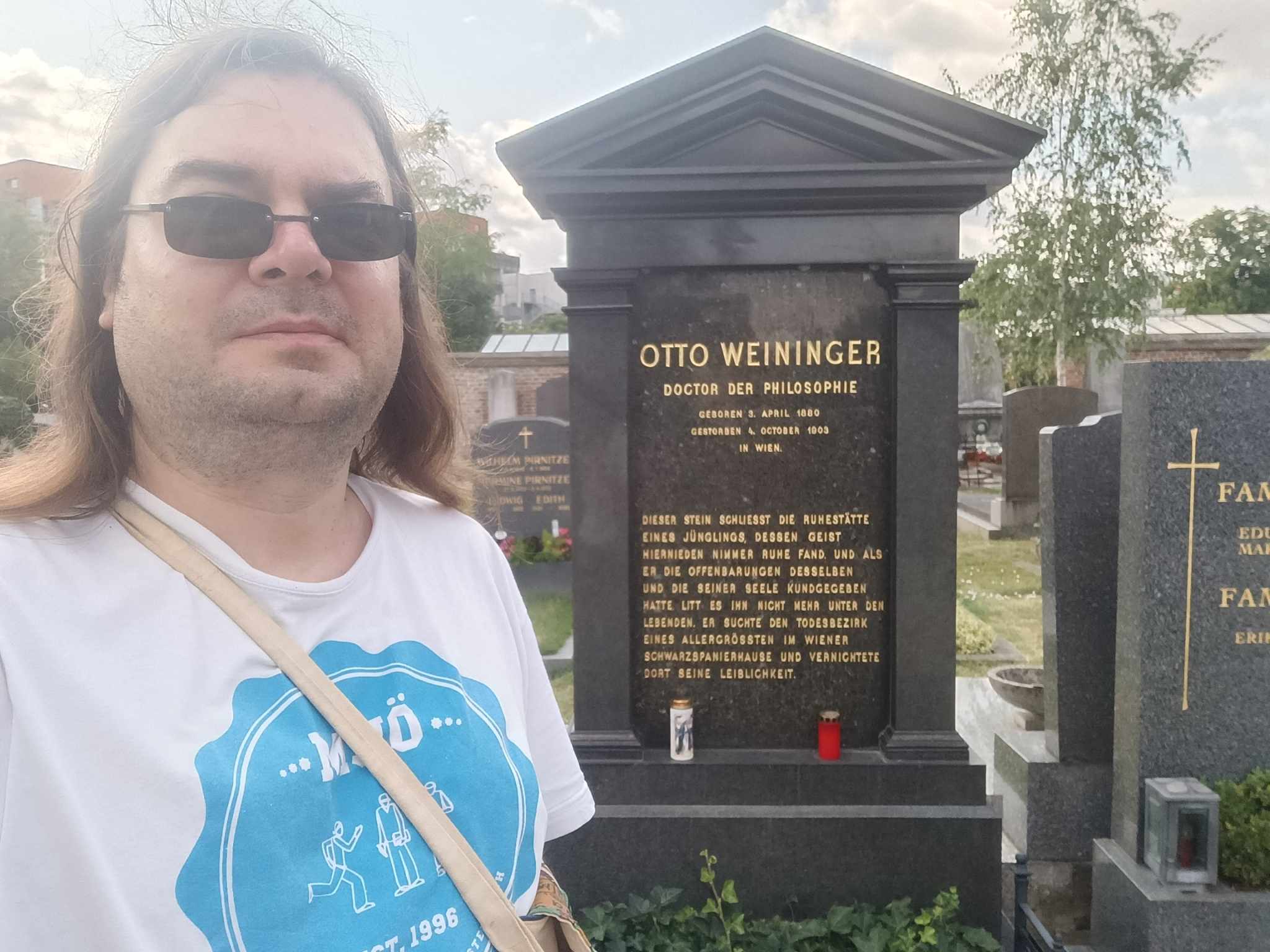
I will visit you on the graveyard in Matzleinsdorf again somewhere these days, man.
ADDENDUM AUGUST 2023
I still think that if you want to establish universal perspective on existence, Otto Weininger (in the constructive aspects of his work) is champion and shows and guides you to how this is going to get. Otto Weininger´s perspective is more universal than e.g. the perspectives of Kierkegaard or Heidegger (not to speak of Nietzsche who seems to get lost in petty struggles, in relation to that). Yet Weininger´s system, and the emotionality behind it, seems way too rigid and inflexible, therefore it is doomed. It is likely wrong to think of the universal as something rigid. You should rather think of it as something flexible. Whereas mathematics and natural science based on mathematics thinks of the all in terms of quantative relationships, the philosopher and the ethicist (and, most specifically, Otto Weininger) thinks of the all in terms of qualities and tries to determine the qualities of existence (respectively existence as a quality phenomenon). Therein, Otto Weininger, in platonic tradition, thinks of these qualities as sharply seperated and in terms of polar oppositions. Yet qualities are not like that. Qualities are fluid, relational, with unclear contours, usually a quality (like „truth“) is a designator for phenomena that are rather loosely connected via Wittgensteinian family resemblances instead of being territory with precise frontiers. I guess if you want to be the living microcosm and embody the absolute you should have a very fluid personality and versatility of the soul. The absolute, the all, the complete, necessarily contains aporias and paradoxes, stuff that does not „add up“. This is a necessary byproduct. It is inherent. That derives from the incompleteness theorem (inside such a structure a search for „truth“ and ultimate confirmation is – ultimately – elusive; and as shows an amplification of the incompleteness theorem by Gödel´s friend and rival Tarski, „truth“ cannot ultimately and adequately defined within a formal system: hence you need to inadequately define it by approaching it via permanent dynamic procession and via family resemblances, via the koan, via meta-rationality and meta-emotionality and the like etc. – actually the incompleteness theorem does not impair most of mathematics; mathematics still remains practical and operational despite or maybe because of it … and, above all, the „meaning“ of the incompleteness theorem is, like the „meaning“ of quantum mechanics, still not understood at all). The all is something that is, in its internal structure, in its texture, loose and somehow incoherent, ruptured. The world is only from quite an abstract viewpoint „one“. Or from a very concrete emotional viewpoint. But this viewpoint needs to be some kind of universal sympathy. Or love. But Otto Weininger hated too many things. Otto Weininger´s idealism was, as they noted, an aggressive idealism. Within this rigidity inside an aggressive system, failure seems quasi imminent. Within Otto Weininger´s philosophy his suicide seems quasi imminent. Yet not because it deals with the highest and the last things, with eschatology, but because of the emotional way it does. There is a casual notion (for instance often entertained by Thomas Bernhard) that eschatology is a lethal domain, that occupation with the highest and the last things needs to lead into implosion and failure. But it is not. I survived it (so far), and I can tell you there is everything to gain from it. Man, I would have liked to know Otto Weininger and talked with him (although I do not think that this could have saved him). This is not possible in a direct way, but I find it „demonic“ that the physical remains of this singular intellect in space and time lie buried only some kilometers away from me.


 A while ago I have started to ruminate about the „hyperset“. The occasion was a diagram I saw which made me think of a, say, meta-diagram as a necessity to competently understand and process the diagram, as a, so to say, conscious reflection over the diagram. Likewise, I have observed that I seem to belong to many groups within the human realm which often venn very thin and marginally, or not at all, making the final intersection a set to which seemingly only I belong, in solitude, on this earth, maybe also in this history. However, I also seem to understand all the sets at a higher level than those who only belong to the respective sets, I have higher awareness, I have higher consciousness of them. That diversification and pluralism is a good thing is commonplace, that the one who only understands a single discipline actually doesn´t understand that discipline either is what they say. Pluralistic understanding is good. Deleuze (and Guattari) refers to transversality as a mode of establishing connection between heterogenous sets that make up reality. Transversality does not try to totalize and normalise heterogeneity but is affirmative towards difference, lets them resonate and explores interdependencies. It is experimental and reflects anti-logos and becoming, the associative method of the Recherche, the instability of the world and the object as well as the emergence of essence through the process of art. Artistic style (i.e. a subjective mode of expression which is of objective substance) is what holds heterogeneity together and is the correlate to the logos (Welsch takes „transversal reason“ as a model for reason in postmodernity). This is vibrant and humming and makes us think of a microcosmic reflection of macrocosm (which also Deleuze does in Proust and Signs). Remember, Otto Weininger says: „The ego of the genius accordingly is simply itself universal comprehension, the centre of infinite space; the great man contains the whole universe within himself; genius is the living microcosm. He is not an intricate mosaic, a chemical combination of an infinite number of elements; the argument in chap. iv. as to his relation to other men and things must not be taken in that sense; he is everything. In him and through him all psychical manifestations cohere and are real experiences, not an elaborate piece-work, a whole put together from parts in the fashion of science. For the genius the ego is the all, lives as the all; the genius sees nature and all existences as whole; the relations of things flash on him intuitively; he has not to build bridges of stones between them.“ That is, well, the purest emanation of the hyperset, not somehow clumsily (or, if you want, more cautiously and operational) as it appears before my inner eye or that of Deleuze, Guattari or Proust (not to speak of Faust). Unfortunately Otto collapsed psychologically under its airy weight.