Failed Note about Proclus Diadochus


A reccurent meme on Facebook says: “I like weird people… the black sheep, the odd ducks, the rejects, the eccentrics, the loners, the lost and forgotten. More often than not, these people have the most beautiful souls.” – Schopenhauer called Proclus Diadochus “a shallow, wide, boring windbag”, and I have sympathy for the underdog, So I went to the library, borrowed the only book they have by Proclus in my language, “About Providence, Fate and Free Will, to Theodorus, the Engineer” and intented to write a note, as a hommage and a tribute to this largely lost and forgotten individual, to make him shine on Facebook.

Unfortunately, “About Providence, Fate and Free Will, to Theodorus, the Engineer” is actually quite boring and this has made my originally innocent and well-intentioned plan to write a glorious and triumphant note about Proclus Diadochus go sour. In one of his later works Nietzsche said that Schopenhauer was “wrong on every account” (contrary to what he said in his earlier days and “Schopenhauer as Educator”, the third Untimely Medidation, is a key work to the understanding of Nietzsche at all) but at least in this respect he might have been right. However, I admire intelligence in others but I value highest goodness of character and, according to legend, Proclus was virtuous, hard working, disciplined, engaged in political debates and educational affairs and was prosperous and generous to his friends and a vegetarian. I think if all people had the characteristics of Proclus the world would be a better place, and this shall serve as a monument.

Proclus was a Neoplatonist and the most dominant figure among the Neoplatonists was Plotinus. I recommend getting familiar with his philosophy, for it carries beauty and shall enhance your sense for harmony in the universe. His “Enneads” are nevertheless badly written, a disaster, so I recommend, at least for introductory means, not reading literature written by Plotinus but literature written about Plotinus.


Failed Note about Ultracomplex People

A while ago I made some plans about writing a note about ultracomplex people who seem to operate at the trans-infinity level, people who spend their life trying to figure out what they´re actually doing, people like Nietzsche, Wittgenstein, Kierkegaard, van Gogh, Shakespeare, Kafka, Pessoa, Faridoddin Attar, Georg Büchner, Otto Weininger, Emily Dickinson or Heinrich von Kleist, but I don´t seem to be so occupied with that any longer; originally I have written a long note in my head, bright like sun, but, within the complexities, it has somehow shrunk to a white dwarf, shining nevertheless (for those who´re able to see afar off and that´s sufficient). To put them in one category those people seem to transcent categories so let us simply mention on this behalf the categories #ultracomplexity #supersanity #hypergenius and what I have labelled as the #whitelodge, respectively the level of profound giftedness in terms of complexity of intellect, soul and spirit. Since they often are to a reasonable degree troubled and sad as well as likely to be devoid of robust identity I want to offer support and encouragement and remind them that although they are occupied with the total sum of problems they also (should) know that, in reality, there are no problems at all, problems only exist for the entertainment of our mind, all that there is is the eternal peace  of the mind; they will be busy trying to deliver a message to humanity, that is their primary occupation, only to find out they have huge difficulties doing that because they are not really a part of humanity (because, as I said, they´re ultracomplex people), so they can deliver no direct message to humanity, only an indirect one, but that is the BEST part of it; because of their eternal eccentricity towards humanity they are situated at the very core of humanity and the human experience at all, maybe ultracomplex people are the only people who ever have truly lived, a woman who knew Kafka said that this seemingly highly neurotic and dysfunctional man was the only man who thought like a human should think and who felt like a human should feel; since they directly stare into the abyss and are terrified by life and existence and horrified by what people do they are also determined to and preoccupied with establishing harmony; usually they are warm-hearted and concerned about others and love will save you. There may be ruminations whether they just are wandering spirits who have failed to reach Satori (although at an intellectual level they have reached Satori; they constantly see things anew and from fresh perspectives, they are independent from traditions and institutions and they are able to create original worlds, autonomously), yet maybe Satori would not pacify them either, because of their intensities (and, remember, the true Zen master acknowledges that he has truley gained nothing by Satori), so let us say that their Satori shall lie in finding out new ways, new exits to heaven, to make everything more interesting and colourful, that shall be their path, although theirs is not „the path“, neither the pathless path but what Hölderlin calls the eccentric pathway/exzentrische Bahn, twist and shout; at the end of it all lies the unio mystica with God. So, concluding this, I will write down no additional material on ultracomplex people (at least not for now). I will however, when I manage to get my relatively comfortable ass up, soon eventually write the Metaphysical Note about Extreme Metal in which I shall teach you the overman. (I am also not in a hurry about that affair since after that my relatively brief writer´s career might be over, similar to that of Rimbaud who also was an ultracomplex person (similar to Lautréamont).)

Comments

Micheal Chappelle I agree with the statement that the ultracomplex are the core of humanity and make up the body of individuals who have truly lived. They are the center of stasis around which everything revolves and everything is measured, by bearing all problems and all ideas they have the greatest impressions of reality, having it seared into their soul as they interact in it.

The Portland Tribune as a Hyperinfinite Set

I get informed that the Portland Tribune changed the cover pic; very impressive shit. Apart from that I have, among others, The Boston Globe, the Los Angeles Times, the Chicago Tribune, the Sudan Tribune andNKNews – North Korea News in my news feed, but, as a recognize, no newspapers from my own country or the German speaking world in general; alas, I don´t use to read newspapers at all anymore since some time; I also have not read any books the last time; maybe, when I reach the omega level, I also won´t read books anymore; that will feel good. I wonder if, then, I will be entirely disconnected from the man´s world or super/omni-connected; but I guess that´s just the two sides of the same medal, maybe the medal will then become more multidimensional or Calabi-Yau space-like; at the infinity level it may become infinite dimensional; mathematicians who´re into set theory are discussing whether there are hyperinfinite sets; according to Gödel´s incompleteness theorem it may be neither provable nor disprovable whether hyperinfinite sets actually exist, at least certain mathematical objects like knots can easier be conceptualised under the assumption that hyperinfinite sets do exist; that´s the incompleteness theorem in action and that seems to be the sense of the incompleteness theorem; there are also some mathematicians who think there is no infinity but a very large number n where n+1 again equals 1; when I reach the hyperinfinite level I will have figured everything about that out; that will feel good.

 portlandtribune

Beyond Good and Evil

Me, of course, I don’t. It is the good which is endlessly complex, endlessly attractive and endlessly fascinating. People use to find evil interesting because they are glueless and not fascinating themselves. The good is the heavens while the evil is, at best, a rusty sorry piece of metal, useless, Lucy in the sky without diamonds. Evil might be labyrinth-like but is not complex nor interesting. Death to false metal.

goodevil

Holy Scriptures and the Profoundly Gifted

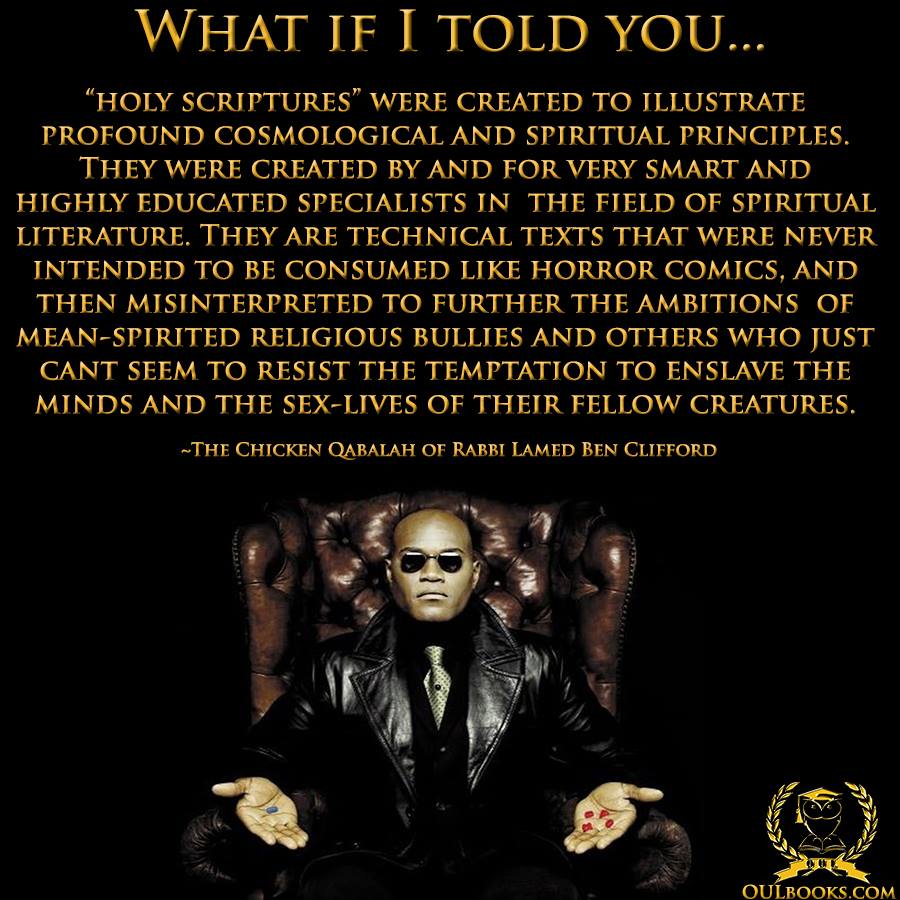
Lol Bhagwan once said most holy scriptures were created by mediocre people, highly intelligent but not profoundly intelligent people, take a look at how badly they are written; indeed, if you look, for instance, into the Old Testament, apart from its many psychopathological contents, it´s convoluted, I also find strange the Kabbalah and the I Ching. Someone profoundly gifted would invent something like Zen Budddhism, write something like the Zhuangzi or the Zarathustra or live his life the way Bayazid Bastami lived his life; eternal sunshine of the spotless mind. It is rather not about organising society but adressing the good core in the individual, cleanse, purify and strenghten the soul of those who possess one, elevate it into the spheres to teach an example. Bhagwan also said that in order to transcend this “obnoxious” humanity one will need to be so extreme that humanity will deem him insane. He also said that when he started as a spiritual teacher he started with a great hope for humanity; now, at an old age, he only has hope left for a very small minority out of humans. Well, mankind, per definition, cannot reach the level of its great men however. Sloterdijk called Bhagwan the Wittgenstein of religion. For the sake of personal interest I´d like to know what the Wittgenstein of Wittgenstein would be. Or the overman of the overman. Emily Dickinson was so intelligent and had such a large circuit and depth that when I try to introject her and make her mine like I try to do with all things of interest that cross my way, i have to squinny my eyes. I admire her.

 holyscriptures

Giacinto Scelsi and the Universe

The definite, most likely the ultimate climax of music is Giacinto Scelsi (also in the respect that it makes the term climax appropriate/inappropriate and therefore transcends it). What you hear in the improvisations/compositions of Giacinto Scelsi is the universe. Tender and powerful. Ethereal and abyssal. Sublime and intimate. Uncanny yet ever providing home. Both the deep silence and the glamour/clamor of being. Curved space which makes the infinite. The fluctuations within which the absolute establishes/relates to itself. Space and time are relative, absolute is the ? field from which they emerge. Colours show up, shifting from blue to a more red, then yellow, into the colour of light. Within the pure sound, the OM, distortions arise and transform, that is how the OM relates to itself. Eccentric loops and attractors. The movements, within the whole concept. The compositions/improvisations of Giacinto Scelsi are the Ear of God. Thus spake Zarathustra.

Giacinato Scelsi, Count d`Ayala Valva, was born in 1905. Not much is known about his life for he was a very reclusive man. He was said to have been a beautiful child with long blond hair. As a young man he traveled through Europe, studied in Vienna, had contact with fellows like Salvador Dali or Henri Michaux, married an English aristocrat and traveled to Africa and the Far East. After his divorce and unhappy with his work he fell into existential crisis and had to be hospitalised. As legend goes he spent his days in the mental hospital sitting at the piano and playing a single note. At age 50 his actual period as a highly idiosyncratic composer began and lasted for 25 years. During this time he hardly cared for his ouevre to become published or performed. Shortly before his death in 1988 his work was discovered and became accessible to the public. It was acknowledged that the history of Western music had to be rewritten and that Scelsi was at least a forerunner of Ligeti.

Most music (and most art indeed) is insipid (if it is debatable at all). Yet Scelsi´s music is NOT insipid. Scelsi was not actually avant-garde i.e. something which is fresh and virgin in the first place and then becomes insipid. Scelsi was a loner who tried to connect to the universe. To do so he abandoned composition altogether and supplanted it with improvisation undertaken with help of the piano or the ondioline. He explored the possibilities of sound and its multiple facetes. The purpose of the game was to connect to a higher, transcendent reality.

Those who want to make art but don´t properly know about it say art is about self expression. It don´t!!! Art is basically science, philosophy (and ethics). Science is about the exploration of the rational aspects of existence and art is about the exploration of the irrational aspects of existence. In order to be able to explore the irrational aspects of existence it is true that art is about the self expression of the artist. Yet in the sense that the artist has to cultivate and grow such an important self that his subjectivity obtains objective quality. The great genius is the most subjective and the most objective personality. He is both most idiosyncratic and hyper-normal.

In accordance with his artistic approach Giacinto Scelsi eradicated the traces of his subjectivity. He saw himself as a vessel, as an intermediary. He banned all pictures of him and erased his signature, respectively transformed it into a line under a circle, as a symbol of Eastern provenance. He said all the other composers just want to appear in the newspapers. He did not have any desire for that. He desired experiencing openess of the mind, to the universe, to creation. All the other composers in the Musik-Konzepte series appear with their portraits on the cover. Scelsi appears with the line under the circle.

The journeyman artist wants to express himself. The brillant artist, in addition to that, searches for new modes of expression. The genius, in addition to that, tries to connect with the world. The hyper-genius, in addition to that, tries to connect with the universe. The (hyper-) genius wants to initiate a transformation. He wants to transform material into something new and, in doing so, exposing the core of the subject. It might well be that before his inner eye the (hyper-) genius sees a field of intensity and now wants to initiate a transformation on that field of intensity. He wants to turn the field of intensity inside out, he thinks he will then, in seeing what´s behind it, see what´s at the core of it. That´s what his main activity is. Count Scelsi turned the intensity of sound inside out. The sound now reached infinity. It became the universe.

My favorite record dealer, Gramola am Graben, told me that only once in some years someone comes around and asks for a Scelsi record. #trigger People would say Scelsi is strange, and scary. Yet Scelsi was very healthy, and normal. It´s people who are strange and scary.


Galina Ustvolskaya

I like Galina Ustvolskaya because she is idiosyncratic and unique. Meanwhile I even find beauty in her compositions. Not an avant-gardist but a loner who initiates a transformation on art itself; a holistic mind, camera-shy, reclusive, uncommunicative, a genius. The great man vs the great artist/mind does not revolve exclusively around art, he primarily revolves around humanity about which he is deeply concerned and empathetic, he wants to find a new solution for humanity, therefore it is necessary to dive into humanity and art and then to initiate a transformation, from the inside out, and art is the medium of expression of the solution he comes up with. The greatest of man is he who carries a sense of responsibility for the cosmos. A deeply spiritual person, like Galina. She was the favorite pupil of Shostakovich. Grandiose were her initial compositions. Difficult to bear seems to be her mature work. You seem to find yourself in the wasteland, as screams out of a black hole, screams into space it has been categorized; exemplified in the second symphony you have the tormented creature, alone in the dark, in confusion, in an environment which is not even uncanny but inherently glueless, crying out for God; more specifically you seem to have the quantum foam of existence, archaic movements emerging from the primal ground, singularities, expression of forces which are older than the subject, the ego, which precede consciousness, where there is no difference between the criminal and the saint, they are not distinguished yet, proto-embryonic, innocent, pure, blind, the meta level of gloom, primal scream, you have proto-subjective movements of fluxes who try to connect to each other, to form a unity, prone to failure, as you also have it in the art of Beckett (Comment C´est) or in the music of Swans or in the paintings of Francis Bacon; people who understand existence at such a level are good people; the music of Galina offers no solutions, no resolutions, no catharsis, there is no harmony, there are no spheres. Yet you find out that there is much more glory in that like, for instance, in the final movement of Beethoven`s Ninth as you comprehend that it is the duty of you, and your personal melody, to establish the spheres, to create harmony, and you do so in being kind. And basically, what you have in the music of Galina is birth, not death. I have read somewhere that Galina used to admire Gogol, for his language being unique. Alas, also with Gogol you are under the impression someone let language dash into itself, resulting in enormous intensity and plasticity, as well as his vision of humanity a result of dashing into itself, misfortunately, Dead Souls is the most hellish and nightmarish vision of humanity anyone ever created, no wonder Gogol had frequent meltdowns and snapped over. Since I am the new Gogol I think I would have had a good channel to Galina, yet, as Turbonegro sing, all my friends are dead.

Worte Bhagwans

… Jenseits der vierten Stufe des universalen Verstandes gibt es noch die fünfte Stufe, die letzte, wenn du sogar über den universalen Verstand hinausgehst. Denn auch nur zu denken, dass es der universale Verstand ist, ist denken. Gewisse Ideen vom Individuum und vom Universum bleiben noch in dir zurück. Du bist dir noch bewusst, dass du bist eins bist mit dem Ganzen, aber du bist und du bist eins mit dem Ganzen. Die Einheit ist noch nicht total, sie ist nicht vollendet, sie ist nicht endgültig. Wenn die Einheit wirklich endgültig ist, dann gibt es nicht Individuelles, nichts Universales. Das ist der fünfte Verstand: Christusverstand … Du bist zum ersten Mal ein Sein, Werden gibt es nicht mehr. Der Mensch ist über sich hinausgegangen, die Brücke gibt es nicht mehr … Alles ist vergangen, der Alptraum ist zu Ende.

Der Mensch ist ein Werden. Mit dem Entstehen des fünften Verstandes, des Buddhaverstandes, des Christusverstandes, wird der Mensch zu einem Sein. Dann ist der Mensch nicht mehr Mensch, da der Mensch nicht mehr Verstand ist. Dann ist der Mensch Gott. Und nur das kann erfüllend sein, sonst nichts. Und gib dich nicht zufrieden mit etwas Geringerem!

… Im Osten haben die Menschen sehr, sehr fragmentarische Egos, und sie halten es für leicht, sich hinzugeben … Ein Fingerschnippen, und sie sind bereit, sich hinzugeben – aber ihre Hingabe geht nie sehr tief … Genau das Gegenteil ist im Westen der Fall. Die Leute, die aus dem Westen kommen, haben sehr starke und entwickelte Egos … Der bloße Gedanke an Hingabe wirkt abstoßend, erniedrigend auf sie. Aber das Paradox ist, dass wenn sich ein westlicher Mensch, Mann oder Frau, hingibt, die Hingabe wirklich tief geht …

… Und es gibt Mondsüchtige, die immer nur nach dem Weitentferntem, dem Entlegenen suchen, und sie bewegen sich immer nur in der Einbildung. Große Dichter, einbildungsstarke Menschen – ihr ganzes Ego ist ins Werden verstrickt. Einer ist da, der Gott werden will – der Mystiker…

… Ein Buddha ist einer, der in die Erfahrungen des Lebens, ins Feuer des Lebens, in die Hölle des Lebens eingetaucht ist und sein Ego zu seiner höchsten Möglichkeit, zum äußersten Höchstmaß ausgereift hat. Und genau in dem Moment fällt das Ego und verschwindet.

Es gibt sieben Türen. Wenn das Ego vollkommen ist, sind all diese sieben Türen durchschritten worden. Danach fällt das reife Ego ganz von allein. Das Kind ist vor diesen sieben Egos, und der Buddha ist hinter diesen sieben Egos. Es ist ein vollendeter Kreis.

Bhagwan/Osho

UPDATE 01242017 How East and West Think in Profoundly Different Ways

Buddhas and Negative Buddhas

In the Book of Strange and Unproductive Thinking everything had to happen quickly, on the spot, according to the principle. Since my thoughts are developing and therefore changing at fast speed I would have written something down and truly think about it later, otherwise I would never write anything down. It now came to my mind that, in comparing Shakespeare and the Buddha, I wrote something about Buddhas and Negative Buddhas. The Buddha teaches us, gives us a deep impression of the Nirvana. Shakespeare (in his plays, not the sonnets), or Kafka, or Beckett give us a deep impression of the Samsara. They´re Negative Buddhas. Buddhas are the hell of writers, their prose is perfect (as can be seen for instance in the anthology of Words of Zen masters edited by Thomas Cleary or in the works of Huang-po). They´re not wasteful of words, which is something that I like. Only a perfect mind cannot be wasteful of words. Little is known about Shakespeare, yet what is known about Kafka and Beckett is that they were the noblest of human beings, holy men. A women who knew Kafka said about him, after having known him for a while, that this seemingly neurotic and dysfunctional man was the only man out of all man who thought as a man should think and who felt as a man should think. <3 Due to their high and rightly guided sensibility and sensitivity Kafka and Beckett, maybe also Shakespeare, experienced the Samsara in a profound way but offered a solution in the way the lived their life. They were reaching out their hands because they understood that existence does not reach out any hand. This is what makes the human. This is then Nirvana. Therfore they´re Buddhas as well. Beckett never spoke about his works, late in life he resumed that the intention of his works was to give an answer to the question about existence, and he was under the impression that the illustrations he provided where only superficial, with Comment c´est probably the most successful try in this fashion. According to Beckett, at the core of existence, there is nothing. Kafka gave me some irritation because in his vision existence is not devoid of meaning, not even absurd but preposterous and counterproductive. It is not rational but traumatic poetry. Dr Cornel West said Kafka is the poet of the existential catastrophy. That sounds good. I have to read Dr Cornel West. I also understood early that the meaning of writing is to illustrate what is existence. When I think of the core of existence, I see trombones, trumpets blowing inaudible yet incredibly loud. Ubi bene, ibi patria.

heyoka7 heyoka11 heyoka4