Some, including Goethe and Schopenhauer, say that the work of the high genius is “practically” useless; I just finished a biography about A.N.; lol a considerable number of those highly gifted people and artists portrayed in there do not seem particularly likeable, who the fuck do they think they are?; given the scope of their intellects their personalities are stupid as hell; I guess if humanity could clearly see through how they really are (fortunately they are protected by the veil of the Maya) they would sink into self-loathing and maybe cease to reproduce; and so that is why (apart from the veil of the Maya) you need the example and the imago of the Buddha, the Christ, that is to say it is actually the omega genius ( = fully realized human potential), who mirrors life for everyone, who has the most important function of all and is the keeper of life. Mediate about that.
Category Archives: Blog
Update about Notes
On weekend it occured to me that I want to write a note about Freud and Lacan. Although that should be easy I found that I want to (re)read one or the other stuff by/about both of them before. In doing so it occured to me I would have to write a particular note about what Lacan has said about Joyce in the Seminar 23 (about the sinthome), since I hate Joyce; yet apart from that I saw Lacan´s concept of lalangue is appealing to understand the literary genius, which may require another particular note (about lalangue). The next day I saw there would need to be written a note about Otto Rank and Anais Nin (maybe before writing about Freud and Lacan), which further requires that I first read extensively into both. Today I wanted to look for the book Epitoma rei militaris by Vegetius, a Roman military theorist of the late 4rd century, to write about it, yet it is not available at the library at the moment but will be available in June, so I can cross this out for the very moment hell yeah. Maybe I will manage to eventually write the very important Metaphysical Note about Extreme Metal these days which will further illuminate the concept of the overman, but it occured to me today that it should be accompanied by a Metaphysical Note about Heavy Metal and I may not be specifically interested in writing that one right now. I also figured out the last weeks I am going to write notes about Stanislaw Lem, Franz Kafka, Samuel Beckett, Fernando Pessoa, Friedrich Hölderlin, Henrik Ibsen and “Peer Gynt”, Büchner vs Goethe, Bayezid Bastami, Afsed el-Chigani, K.O. Apel and Lawrence Kohlberg and the issue of post-conventionalist moral systems, Immanuel Kant and Emmanuel Levinas as well as about political economy and economics as a dismal science, as for now.
Prelude to Note about Freud and Lacan
In the interpretation of Zizek the birds in Hitchcock´s “The Birds” symbolize the Lacanian Real, the register of human reality which resists symbolisation, which is traumatic and with which no rational exchange is possible. – When I was young I was quite fond of radical and abstract theory, the more detached from reality and my immediate surroundings in terms of concept and language the better. But now I´m old and tired. The day before yesterday I took an old book by Zizek out of the shelf (the one about Kieslowski) and wanted to read it but only made it up to p.11 or so.
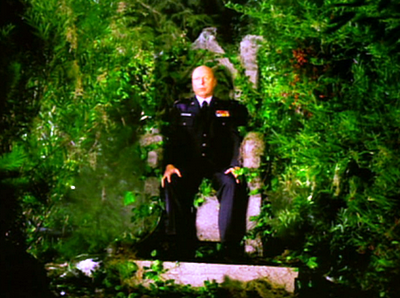
Major Briggs in the White Lodge
That´s Major Briggs, the spiritually most advanced character from Twin Peaks in the White Lodge. The White Lodge is the place where the constructive spirits of the Earth dwell. There is also the Black Lodge, which you must pass in order to ascent to the White Lodge on your way to perfection. According to legend, in the Black Lodge you will meet your shadow self, and if you meet it with impefect courage, it will “utterly annihilate your soul”. Few are able to get through. The Black Lodge, let us say, symbolises the terror reign of subjectivity disconnected from the Earth and from the universal spirit, i.e. the common condition of man; whereas the White Lodge IS the universal spirit. Love opens the gate to the White Lodge while fear attracts the spirits of the Black Lodge. Being tortured by Windom Earle Major Garland Briggs answers the question about his greatest fear as: “The possibility that love is not enough”. That is not the fear of the ordinary, not even of the extraordinary man, yet of the ethical genius. The Major is, at his innermost core, not concerned about himself but about the world and is afraid that there never is the possibility to take enough care of the world. Therefore the Major has superseded his subjectivity and become objective, transpersonal, a spirit, and does not even encounter a shadow self or negative doppelgänger. (Meditate about that.)
Although the Lodges are out there in the woods, known through an Indian legend, and seem to interfere with most real events in Twin Peaks (maybe even govern them), they are hardly explored in any detail by almost no one. Only a few, „gifted“ individuals have a deeper or conscious connection to the Lodges: Windom Earle, Dale Cooper, the Log Lady, and Garland Briggs. Yet what they all have in common is that they both seem to know „so much and yet so little“ about the Lodges. – Windom Earle, the most malicious character of the series, the evil genius, wants to align with the evil spirits of the Black Lodge in order to attain a „power so vast that its bearer might reorder the Earth itself to his liking“. Yet he finds a meager and pathetic end in the Black Lodge when Killer BOB flat out rejects him and annihilates his soul: Apart from reasons of dramaturgy Windom Earle does not seem to be interesting prey for the evil spirits since he already is completely corrupted so that in possessing his body BOB would not achieve a higher level of completeness (BOB´s endeavour has been to amalgamate with Laura Palmer, the intelligent, originally good-natured, and as we can see at the end of Twin Peaks – Fire Walk With Me: brave Homecoming Queen of Twin Peaks (where she rather lets herself being killed than being possessed by BOB in order not to become a host of evil); since BOB as a force which is completely evil is psychopathic, demented and throughout the series a reduced, therefore parasitic entity). Windom Earle is the bearer of the by far most powerful human intellect of the series but is devoid of all other qualities which make a human, therefore he slips into oblivion; in former times he was a man of the law, of high ideals and a person who loved, yet jealousy and an overly possessive attitude had let him degenerate into madness. One is a bit under the impression that Windom Earle´s monstrous intellect has dried out the rest of his human qualities and that, in this way, he had never been a well-rounded individual at all.
Special Agent Dale Cooper, the former junior partner of Windom Earle, is, despite his young age, a considerably advanced human being, who nevertheless falls prey to the evil spirits of the Black Lodge at the end of the series. He is both eminently rational and a master detective, yet his true mastery derives from his emotional and spiritual qualities working in tandem with his intellect. His emotional and spiritual qualities give him access to the irrational respectively the a-causal and the a-logical, therefore he can successfully maneuver through the Twin Peaks pandemonium respectively through the multiple layers of reality, and he has not only logical but psychological understanding. Despite the many misfortunes he encounters in Twin Peaks – being shot (by Josie), being kidnapped and nearly killed by thugs, being screwed by his own FBI colleagues etc. – he does not seem to lose his generally positive attitude and his faith in humanity (which is why he also is positively rewarded over the series as well). He meets the world with curiosity and wonder and never fails to be delighted by the small things and the little wonders of everyday – the trees, the coffee, the cakes… Despite being instantly a bit irritated by the emanations in the Black Lodge which he confronts in the hitherto last episode of „Twin Peaks“ he never loses courage, not even when he confronts BOB, so that it remains a bit of a mystery why he suddenly becomes afraid when he finally meets his own shadow self which he cannot bear, so that he falls prey to the spirits of the Black Lodge, his „good“ self remains trapped in the Black Lodge and he becomes the new host for Killer BOB. Apart, again, for reasons of dramaturgy (i.e. to give the story an interesting twist), it seems to be dubiuos why a thing like this would happen. Cooper remains practically flawless throughout the whole series. Yet his young age seems to indicate that he cannot be a fully grown and mature individual. And indeed, in „The Autobiography of FBI Special Agent Dale Cooper: My Life, My Tapes“ which was published alongside the TV series it is somehow revealed that Cooper carries imperfections: he is „an unreliable narrator, obsessive, anal-compulsive, deluded, immune to irony, not very perceptive about himself“. Cooper, in general, is an individual who is on a journey, who wants to explore life. Due to lack of self-awareness, afraid of his own „unconscious“ he experiences and gets lost in his shadow self – traps everywhere, as the condition of life. The third season which was cancelled but will now be aired next year, „25 years later“, would have been about the rescue of Cooper from the destructive forces of the Black Lodge.
There are two characters in the series who seem to have been in the White Lodge: The Log Lady and Major Briggs. Both did not seem to have been in any way affected by the Black Lodge and the shadow self. Yet both also don´t know very much about the White Lodge either. They seem to be under amnesia of what happened to them in the White Lodge, all they can remember is an overwhelming white light and some owls (and „the owls are not what they seem“). They are spiritually connected to the White Lodge and bearer of messages which, however, ultimately remain cryptic also to them. – That the Log Lady does not fully understand (she rather „feels“) the White Lodge seems evident, since the Log Lady has spirit, but no intellect. She is an eccentric who lives outside of society. The Major, like Cooper, is both spiritually and intellectually gifted – but he is not a philosopher i.e. he has no unified knowledge and is not operating at the highest level of consciousness. Like Cooper he works in a profession whose duty is to guarantee order, safety and protection, yet as a military man inside a hierarchy he is – even more than Cooper – likely to fall prey to serve as a puppet for the execution of evil intent in higher places (without possibly knowing it, not being aware of the intentions from above nor of the causal chain of reactions the operations he is involved in are likely to produce; it seems to carry a double meaning that all the operations he is involveld in are classified and that he cannot really talk about them with anyone: they seem to be out of his knowledge and intellectual reach as well). He is able to „heal“ his stupid, hilariously unsympathetic and immature teenager son Bobby by telling him about a beautiful dream of a palace „where fathers and sons are united“ (under the obvious protection of a guiding maternal spirit), yet his overly soft, overly stoic and also seemingly a bit detached parenting style seems to have provoked the acting out of Bobby´s idiotic masculinity in the first place. Bobby however is a young human being, overly immature but set on the course for reaching higher levels of maturity; Cooper as a man in his mid-thirties is overly mature and falls back into regression, Major Briggs as an elderly person seems to be a future projection of Cooper, respectively a possible future for Cooper if he had not entered the Black Lodge. It was revealed that in the third season the Major would have played the key role in saving Cooper from the Black Lodge. Within this duty, it can be assumed, that both Cooper and the Major reach a higher level of human perfection and therefore a better understanding of the White Lodge.
In an allusion to Twin Peaks I have, a while ago, described the White Lodge as a state of ultraperception and omniscience. When you live such a state of mind you experience yourself as an unlocated focal point within a region of white light where the objects of the world appear and pass by, and they are all equal to you. Nothing hinders you from grasping and understanding them at an infinitely deep level (which means: fractal-like since infinity cannot be seen itself), and this is the case because the subject which grasps them has also been dissoluted into the white light, the seeing eye has become unlocated and omnipresent, the dismantlement of ego allows free navigation through the all. This cannot be learned by intellect alone but by personality which, in accordance to how Scientology calls it, has to reach a „clear“ and become free of fabricated ideological or unfathomable emotional attachment to itself or to the object. As Nietzsche or Otto Weininger have already noticed the person who tries to purely objectively relate to reality (via dissolution of the „subjective“ distortive element) will also be the ethically most conscious person, therefore, if you go further down the White Lodge you will become the White Lodge yourself.
The transcendent (ethical) genius lives in a world full of people with whom, more or less, no authentic communication is possible (hence also the disfigurement of language in the Black Lodge), so that the ultimate ethical genius will have to cut off his arm or, like Mansur or Christ, get executed to teach people ethics in the only language they seem to be able to understand, partially it is nevertheless in vain; yet understand, mate, that this is in accordance to God´s plan, apart from that, in earthly terms, only a dead genius is a good genius quod erat demonstrandum etc. bla bla
Philip Hautmann https://www.youtube.com/watch?v=kjeCNnbVYAQ

Heyoka Empaths
“Among the Lakota people, the heyoka (heyókȟa, also spelled “haokah,” “heyokha”) is a contrarian, jester, satirist or sacred clown. The heyoka speaks, moves and reacts in an opposite fashion to the people around them … The heyókȟa symbolize and portray many aspects of the sacred, the Wakȟáŋ. Their satire presents important questions by fooling around. They ask difficult questions, and say things others are too afraid to say. By reading between the lines, the audience is able to think about things not usually thought about, or to look at things in a different way … Principally, the heyókȟa functions both as a mirror and a teacher, using extreme behaviors to mirror others, thereby forcing them to examine their own doubts, fears, hatreds, and weaknesses. heyókȟa also have the power to heal emotional pain; such power comes from the experience of shame — they sing of shameful events in their lives, beg for food, and live as clowns. They provoke laughter in distressing situations of despair and provoke fear and chaos when people feel complacent and overly secure, to keep them from taking themselves too seriously or believing they are more powerful than they are.[3]
In addition, sacred clowns serve an important role in shaping tribal codes. Unbound by societal constraints, heyókȟa are able to freely violate cultural taboos and critique established customs.[4] Paradoxically, however, it is by violating these norms and taboos that they help to define the accepted boundaries, rules, and societal guidelines for ethical and moral behavior. This is because they are the only ones who can ask “Why?” about sensitive topics and employ satire to question the specialists and carriers of sacred knowledge or those in positions of power and authority.” (Wikipedia)
Carnival of Souls
I watched Carnival of Souls, an unusual low budget horror film which became cult over time and also a major inspiration for David Lynch. And indeed, apart from the solid craftsmanship, it´s deep fucking shit. You see, it is about the gradual loss of soul, due to weakness and disconnectedness from the whole, resulting in destructive madness, entropy and annihilation; in a world where lack of competence, personal depth and understanding is the rule among people; not that anyone is truly to blame; it´s simply a place of eerie inhabitants, where the living are mirrored by the undead. Meditate about that.
Gebet für die Unheilbaren
Eil, o zaudernde Zeit, sie ans Ungereimte zu führen,
Anders belehrst du sie nie, wie verständig sie sind.
Eile, verderbe sie ganz, und führ ans furchtbare Nichts sie,
Anders glauben sie dir nie, wie verdorben sie sind.
Diese Toren bekehren sich nie, wenn ihnen nicht schwindelt,
Diese … sich nie, wenn sie Verwesung nicht sehn.
F. Hölderlin
Ni Tsan
Ni Tsan (ca. 1300 – 1374) war ein chinesischer Kunstmaler und Dichter aus Wuxi (Jiangsu). Bei uns kaum bekannt und kaum übersetzt, mag ich ihn sehr und er erfüllt mich sehr. Seine Gedichte geben reine Eindrücke wieder, da sein Geist, wie man sieht, vollkommen rein und durchsichtig ist. Trotzdem bemerke ich stets ein smaragdenes Schimmern, das sich in einem angedeuteten höheren Raum verliert, wenn ich in sie hineinsehe; aber das ist mein Problem.
Der hohe, Wahrheit suchende Mönch, wohin geht er?
Vor ihm (auf dem Weg nach) Indien (liegen) sehr hohe Berggipfel.
(Wie ein) fliegender Gabelweih möchte er dorthin ziehen, (wo sich) der Himmel auf die Bäume senkt.
Mit seinem Metallstab muss er dorthin gehen, (wo) jenseits der Seen die (Tempel-)glocken (klingen).
Auf einer halben Matte unter weißen Wolken neben dem smaragdenen Wasserfall,
(Wenn) zur vierten Nachtwache der fallende Mond in hohen Kiefern hängt.
(Kann man) in Meditation versunken wohl dreitausend Jahre zurückkehrend (durchmessen)
Und gleichfalls die gepflückte Blume sehen (von der die Kunde in) fernen Lehren überliefert ist.
Im hohen Pavillon der Familie Teng weilte ich zehn Tage lang.
Des Herrn Lu Weinboot kam hundertmal her und fuhr (hundertmal wieder) zurück.
Seerosen-Suppe und Seebarsch-Haschee hatten wir überreichlich.
Eisgleiche Schalen und schneeähnliche Becher, wie oft handhabten (wir die ?)
Flusswolken, duftig und zierlich, nahmen hingegeben am Feste teil;
Uferweiden(-zweige), lässig hängend, fielen in die Weinschalen (hinein).
Trinkend und trunken bemale ich spielend die weißseidenen Fächer.
Ein schönes Spiegelbild auf dem Bergfluss, flattert der Mond hin und her.
Einsam und verlassen der Fluss mit den Ufern darüber,
Das Boot rudernd begegnen wir am Abend einander.
Bei zusammengerolltem Vorhang besingen wir die blauen Bergketten,
(Auf) der nahen Strömung zerstreuen sich die weißen Gänse.
Das starke Herz, ein Tausend-Meilen-Pferd,
Kehrt träumend heim über der fünf Seen Wogen.
Der Stein im Garten (liegt) verlassen und Bambusschösslingen überwuchert
Im Winde wild erheben wir die Stimme zum Gesang.
Bei Nacht durchwandere ich den West-Garten der Insel,
Des jungen Mondes Glanz ist überklar.
(Den Schritt) verhalt` ich zögernd unterhalb des Steines der Schlucht.
(Wie) liebe ich des Waldes Baumschatten!
Still und verloren das Chung-chü-Kloster.
Im Frühlingswind wachsen die Hui-Pflanzen.
Im verlassenen Wald auf dunkelgrün-moosigem Boden
Smaragdgrüne Blätter und purpurjade-farbene Stengel.
Früh erwacht spürt man (sie) in die Gedanken eintreten,
Am Ende (des Tages sind sie) die Ursache, wenn die magische Verwandlung sich vollendet.
Die Gestalt ihrer Unstofflichkeit lässt sich nicht erschöpfen.
Im hellen Mondglanz erblühen sie.
In des Herrn Chang Hütte plaudernd ziehen wir den Lampendocht immer wieder hoch.
Einander gegenüber (sitzend wie) Schatten können (wir uns) nicht trennen, Traum und Schlaf werden eins.
(So) sitzend erreicht uns die Tiefe der Nacht, still ist die lärmende Welt.
Vor der Halle im vereinzelt stehenden Bambus erhebt der Herbstwind sich.
Am grünen Fluss der lichte Bambus geistreich nach der Vorlage kopiert.
Bekümmert-zarter Kieferndunst, so fein als wäre er gar nicht da.
Das ungeordnete Blattwerk „leer“ gezeichnet, teils von der Vorderseite, teils von hinten.
Des kalten Stromes siegelförmige Felsen ganz ineinander verschlungen.
(Angesichts) des Wolkengedränges um die Frühlingsinsel denkt man an Trommeldröhnen.
(Beim Anblick) des über den blauen Klippen fallenden Mondes hört man Vögel rufen.
Wer Wesen und Bedeutung dieser wundervollen Formen mitempfindet,
(Erliegt der) Täuschung, er erfreue sich am „Rot-Blau“ einer knochenlosen Malerei.
Zierlich wie Rauchwolken im Winde sich wiegende Zweige, noch ist die Tusche nicht trocken.
Die Schönen an den Wassern des Hsiang (musizieren) harmonisch auf Mundorgel und Glocken.
Unruhig auf meinem Kissen träume (ich) von einer Fahrt zu den Unsterblichen.
Reine Schatten (tanzen) hin und her; kalt (strahlt) der Mond in den Bergen.
An T´ai-hu spärlicher Schnee, es will kalt werden.
Im Pavillon „Reines Gedenken“ sind die Weinschalen trocken.
Bei abgeschirmter Lampe und Farbpinsel ist (schon) die dritte Nacht vergangen.
Die fernen Berggipfel, der lichte Hain jedoch dulden (noch, dass ich sie) anschaue.
Die blauen Berge aufrecht und hoch, die Wasser weithin gedehnt.
(Wo) das offene Land auf die Hochebene trifft, beginnt der Regenhimmel aufzuklären.
Völlig gleichen (einander) die drei hohen Pavillons, die man auf der Höhe erblickt.
Der Menschen Häuser dicht angeschmiegt an weit ausladende Bäume.
Die kleine Schale taugefüllt, von reinem Weiß des Bleis,
(Wie) Jade und Schnee (und) gleicherweise gefärbt (wie) Smaragd und Rosenwolken.
Die Zartheit ihrer Form, die Feinheit ihrer Haltung machen mir Altem Freude.
Über den Bambuszaun des Nachbarn fallen Ranken mit herbstlichen Blüten.
Wie ist es möglich, dass die Seemöwen mir misstrauen?
Der Alte der Wildnis, der ich jetzt bin, hat lange aufgehört, praktischem Leben zugewandt zu sein.
Ein Fremdling lass ich mein Mattensegelboot oberhalb der Südinsel ankern.
Wolken, Wogen, Dunst und Bäume (alle) Umrisse verdunkeln allmählich.
Der Nachkomme des Großen Mannes von Fu Li
Ist auch ein Nachfahre seiner Wesensart.
Er liebt die Berge und liebt auch Bilder;
Er nötigt zu Leckereien und nötigt zum Becher.
Jedesmal, wenn ich den Wolkenschlaf-Fels erblicke,
Dringe ich deshalb durch den Bambus und klopfe an die Tür.
Heute morgen (sogar) im Nebel und eisvogelblauen Dunst;
Es war ganz passend, dass es dazu in Strömen regnete.
(Innerhalb) der Mao-(Seen)-Ufer weile ich lange Zeit, im Wechsel von Frost und Sommerhitze,
Wo könnt ich unstet Wandernder in Wäldern und Höhen (eine Bleibe) finden?
Beklagenswert ist, dass Eigentum nicht ständig Besitz bleiben kann;
Wenn ich doch wenigstens, meinem Herzen folgend, irgendwo Frieden fände,
Unter dem Boden des Bootes fließendes Rauschen, leise seufzender Wind,
Die zwischen dem Ried aufgehende Sonne ist schon völlig rund.
Ob meine Freunde tot sind oder leben ist schwer in Erfahrung zu bringen.
In meiner Kümmernis schreibe ich Gedichte, um mich über mich selbst zu erheben.
Ich sitze und schaue dem Moose zu, das mein Kleid überwachsen möchte.
Der Teich und die Frühlingswasser schimmern im letzten Abendglanz.
Im verlassenen Dorfe wird es Nacht, kein Lärmen mehr von Wagen und Pferden.
Freundschaftlich geleiten zerrissene Wolken die heimwärts fliegende Kranichschar.
Kühl ist der Abend dieses sommerwarmen Herbsttags.
Ich trinke Tee und schlafe bis zum Morgen tief in meiner Einsamkeit.
Der reine Wind schüttelt die Bäume im Hof,
Und eine frierende Grille klagt im betauten Gras.
Des Morgens schaue ich fröhlich dem strömenden Wasser zu,
Des Abends blicke ich voller Erwartung nach Westen.
Von des menschlichen Treibens Komödie weiß ich nichts mehr;
Nur noch die grünen Berge sehe ich mit Liebe an.
Außerdem empfehle ich die Lektüre von Tao Yüan-ming (ca. 370 – 427).

Visions of Immortality
According to legend, having achieved Satori means that you are able to see the realm of existence as an infinite weave of jewels which illuminate and mirror each other. Each jewel, prescious as it is, is an aspect of existence, both distinct and unique as well as well as embedded in the whole, serving as a reflection of the whole. The whole, therefore, is an interrelated system of mirrors which reflect the highest light; and each movement within the structure alters the whole structure, so that in every moment a new world is born. Satori means you are able to see the world as being in constant motion, objects are moving, mirroring and relating to each other so that the subject-object dichotomy is transgressed into an all-seeing, yet unlocated, eye (respectively an all-seing eye which is located everywhere). The intellect is transgressed into pure perception and pacified: the whole universe bond together by sympathy and governed by mutual friendliness, there is no need for you being (as usual, once unenlightened) agitated.
And do you remember Richard M. Bucke´s book about Cosmic Consciousness, originally published in 1901? Probably not, since it is not very well known. Bucke, a psychiatrist, achieved enlightenment and suggested that his „cosmic counsciousness“ is a state of mind prominent in all enlightened individuals across history, yet only expressed in somehow different state-dependent language (the language of their specific time and culture) i.e. that all revelations of enlightened consciousness in art, philosophy, spirituality, religion, relate to the same basic experience – in which the enlightened individual experiences herself as a living, spiritual part of an entirely living, spiritual cosmos in which the individual, itself, is an illusion and mortality is an illusion. Everything is governed by the supreme, perceptive intellect who is familiar with the whole and with every aspect of the whole, and the enlightened individual is the bearer of that intellect. Bucke surmised that, apart from usual suspects like Gotama Buddha, Jesus Christ, Laoze or Plato also fellows like Shakespeare, Pascal, Balzac or Walt Whitman were among those who have achieved cosmic consciousness. Mediatate about that!
In the Book of Strange and Unproductive Thinking I have ruminated whether Satori is the common state of mind of the genius. At least there are some resemblances. The genius, at least, has the second sight! With the second sight the genius is able to see through things, to see their true essence, and even beyond that: It is not raw intelligence (in its many facettes) but introspection and the capacity for deep intellectual penetration which makes the genius. The root ability for that is a quality Cooijmans calls associative horizon: that is the ability to see many associations to a given concept, to see (seemingly paradoxical or counterintuitive) associations between remote concepts and the ability to switch from motif to background. Associative horizon is a quality in its own right, relatively independent from g-related intelligence (expressed in IQ). At a basic level associative horizon manifests in (off-the-wall) humour and/or some kind of „deeper“ perception. I see people who have the second sight on Facebook, they´re posting paradoxical memes respectively images which are ambigous and connotative, not definitely to catch intellectually but eternally open, referring again to an innocence of perception yet in a dialectical way. People who have such a perception are very rare. High IQ intellectuals on Facebook are also very rare. That these qualities merge in one person is the rarest. Associative horizon is the basis basis for creative intelligence. IQ-related intelligence enables the bearer of associative horizon to operate at a high level of intelligence and to have a broad intellectual circuit in which his associative horizon can operate and make novel, original and meaningful combinations (as somehow distinguished from conclusions which you derive from g-related intelligence). With intelligence you see many things and the way they function, with associative horizon you see the Matrix. You´re intuitive. If associative horizon and intelligence amplify each other and both get amplified by conscientousness, i.e. intellectual discipline, the possibility of the productive genius arises, and when conscientousness also carries ethical conscientousness the possibility of completeness comes up (see Paul Cooijmans of genius on his website). – So the genius lives in a state of interconnectedness plus the ability to see through and beyond the connections and establish new ones which last forever. He is glued to everything because he is sympathetic. He (intellectually) mimics everything because he is empathic. Before his inner eye he sees into the universe. He gets sucked into the universe, sometimes feel painfully sticked to the universe, like hanging in outer space, being enchained to outer space and hardly able to move (which is one of the more unpleasant experiences, referring, in ordinary language, to inability to live an ordinary life). At one time he feels sucked into space, at one other struck down by the intensity of his perceptions, which constantly form impressions in correspondance with an intense (sometimes painfully intense) inner life.
Otto Weininger has noticed that the genius always stands under impressions. In here, the genius is both perceptive and reflective, mature and innocent, intellectual and anti-intellectual, both open and longing for closure and, then, openness again. In doing so and being that way, he creates his world constantly anew and each act is of significance; and of deviance: High intelligence means that one is able to come to sophisticated and comprehensive conclusions, to make abstractions and generalisations. Yet, as Lichtenberg notices, the higher the genius, the more one is able and prone to see only the individual, respectively individual aspects. This might confuse the genius, at least at a young age, make him think he has not a razor-sharp wit as others, a more nebulous and diffuse way of thinking and of perception, therefore to operate at a lower level of consciousness while in reality he is operating at a higher level of consciousness (since of course the genius is able to see the abstractions as well, and very well; what seems to be an unfocused view is an actually more focused one). A bit resemblant to that Pessoa has noticed: the higher the consciousness, the lower the consciousness; which only means that the genius does not relate to ordinary things the way ordinary man does because they are not as closely located to him – in reality the genius is closer also to ordinary things and, if it gets serious, is likely to handle them in a more competent way than ordinary man – I only say that to encourage the genius because due to his highly critical way of thinking the genius is prone to underestimate himself, sees himself to critical, is afraid of inadequancy, and usually gets depressed when he senses inadequancy within himself (yet is also the one who is able to transform his feelings of inadequancy and inferiority into something truly productive, whereas ordinary guy does not sense much inadequancy about himself, with, however, the unarticulated inferiority complex lurking in the back of his mind (and becoming acute when the genius enters)). Because of his ability to see only individuals the genius is able to „think outside the box“, transgress categories and finally establish new ones. Therefore the usual internal state of the genius is some seemingly unproductive brooding which might come along with, again, feelings of inadequancy, lack of identity and unhappiness. With time he will unlearn those connotations, yet remember them, that is to say, the will remain but become less frightening. Finally, when the genius in all aspects only sees individuals (and is able to categorise them), his mind has become the mind of God (as also Lichtenberg has noticed). That is the imperative. – Genius is an eminently rational man and longs to establish rational concepts with a determinedness no one else carries. Yet in contrast to the purely rational man the genius has an access to the seemingly irrational, respectively the a-rational. Usually being synaesthetic, the genius often strives to develop eminently rational concepts in tandem with a-rational or synaesthetic visions or along unusual questions (e.g. questioning what would happen if he moves along a light ray, a question which would not make immediate sense to the purely rational physicist); he throws, for instance, some thought into a vision of black with red dots and the red dots with white dots in them, sees how it amalgamates, transforms or contrasts, then lets it reflect in mirror 127 in his internal system to see what´s happening, etc. Therefore, darkness and light aspects before his inner eye, or in his mind, shimmer through each other, or, for instance: there is some bright oval light in the center of the vision and then the vision falls down, becomes seam-like, fuzzy, falls into the abyss, becomes irrecognizable; but that is when another circle – of perception and of reflection – begins… That is to say, genius is neither purely rational or irrational, he operates at the meta level of rationality. – Genius is immortal and not afraid of death because genius is largely spirit, not person or individual, and his spirit will last forever as well as it has always been. Since he has seen through life in his only life, life extension or reincarnation is not necessary for the genius. #nirvana
In the Book of Strange and Unproductive Thinking I have also ruminated about the hyper-genius, the transcendent genius, and the Omega Man. These venn quite similar with each other. A hyper-genius is more comprehensive than a genius, or operates at a higher level, at least in his specific domain (at 5 sigma level compared to 4 sigma level of the genius; Einstein was, as a physicist, a hyper-genius, although in other respects, and as a person, a genius; Wittgenstein, as the other emblematic genius of the last century, was a hyper-genius in general, respectively not only as a philosopher but also as a person). A transcendent genius has the most radical thoughts and is transcendent in his personality, a both extremely eccentric as well as extremely in the center of humanity located man (Goethe was a hyper-genius, yet not necessarily a transcendent genius, he was a homo universalis (although he did not understand lowlife very well and was not very very concerned or sympathetic about it) but not transcendent man, yet of course operated close to that level; Büchner, an intellect probably superior to that of Goethe (one cannot definitely tell since he died at age 23), understood lowlife, was deeply sympathetic, a fearless revolutionary who might have died in jail like some of his comrades; his language was transcendent and of absolute agility, later in life he might not have cumulated his efforts in a grandiose yet mislead endeavour like the theory of colours but may have become one of the major existential philosophers, etc.). Omega Men are (spiritual) frontier workers of humanity. Resemblant to that Bhagwan says that beyond/above the „universal intellect“, the fourth level a human being can attain, there is a final, fifth level, at which the distinction between the individual and the universal, the larger context, vanishes and is transgressed. That is when the ego is abolished and the intellect of Christ or of the Buddha emerges. At this stage man has ceased to constantly BECOME something, he has begun to finally BE something, his journey (respectively, as Bhagwan says, his „nightmare“) has come to an end. Thou shalt not settle for something less than to attain that fifth stage, says Bhagwan. And indeed, genius is still full of imperfection and should be superseded. Genius does not necessarily work at the last layer of all things. Genius may be, and usually is, a distinct and marked person, but: a person, likely with an ego, maybe a strong or even narcissistic, therefore annoying ego. Geniuses often do not relate well to other geniuses which is the saddest thing among all. That should be overcome. Man should become devoid of ego and become open space – that is the plan, that is the end of the road. The ego (respectively what is commonly taken as the ego) is disturbing, it distracts, impurifies the thinking process and the emotional economy, and it should not be. When you look at the transcendent genius (like Beckett) he does not resemble very much an ordinary person, or, despite his most distinct individuality, a person at all – rather a fluid, an aura, an atmosphere, he is ghost-like because he contains all qualities at once and they do NOT contradict or stand in the way of each other while probably also not being there in harmony, like the universe or the earth is not harmony, simply all exists at once; the great man is the living microcosm, the all, as Otto Weininger put it. Where the genius maybe tries to and puts his energy into becoming a marked person, the transcendent genius will do everything to evade it. He is impersonal, transindividual, and objective. He only seems to be a marked personality because he is „the center of infinite space“ (Weininger). The hyper-genius has ceased to be a person, let alone ego, and has become a spirit, a soul, a guiding light; even his intellect has transformed along those lines. Ahhh … the transcendent beauty of having gotten rid of human/personal qualities… do you see the luminosity in that?
– The Omega Man can be envisioned as reaching up into the spheres and down into the dark fond, the primal ground, where his interior is the endless hall of mirrors. Genius is kind of universal man, he encircles mankind, but the omega genius encircles all the other geniuses as well and has become universal spirit. The intelligence of the transcendent genius and the Omega Man is the highest and the most alien, yet at the same time the most elementary, the most basic, the most authentic; being eternally eccentric he and his solutions directly adress the core, the heart of it all and are the most profound. – Whereas the genius relates to the world, the hyper-genius relates to the universe (the infinitely larger, boundless context). The genius will strive to create a work of importance, of significance; the transcendent genius, will, more abstractly and more purely, strive to create values. Likewise, the genius may seek a concrete immortality, becoming inscribed in the book/s of mankind, whereas the transcendent genius will rather seek an abstract immortality, he does not thow himself into mankind but into the universe, longs to become one with the ontological texture of the universe. When you look at the genius you may see a spherical space with positive curvature; the genius tries to establish harmony and give words and objects a definitive meaning. When you look at the transcendent genius you see a line of negative curvature, an open universe in which everything flies into the infinite along an eccentric pathway, also in order to establish harmony, but not in the visible spacetime but in a sort of hyperspacetime; in the visible spacetime the transcendent genius seemingly ever creates disruption and dislocation of identity (think, most prominently, of Nietzsche, Wittgenstein or van Gogh). When the genius is constantly convulsing, the hyper-genius seems like constantly exploding, yet both do so in stasis. Look at the ramblings for instance of the transcendent hyper-geniuses of literature like Kafka, Beckett, Shakespeare, Rimbaud or E. Dickinson and you see that behind their words, their language, some deeper structure constantly seeks to emerge and overpower it, that is the dark world, the fond, as well as the heaven that tries to break through, it is the constant shifting of meaning, it is the second world which shimmers through the first, the immediately presented one, the psychosis of the genius language; the works of the (hyper-) genius are characterised when you see behind the first, the immediately presented world a second world emerging. – This nebulaic, yet anti-entropic entity, the purely subjectified and purely objectified trans-person able to navigate freely through inner and through outer space with both the most solid, yet unlocated inner core, is, then, the overman. The overman encircles the earth and is the meaning of the earth. He can communicate with the earth and with any alien civilisation from the depths of outer space since he understands all of those. Potentially, along the above mentioned lines, every man is an overman. The hyper-genius/Omega Man is the most easily understood and embraced by every man, and by the child, and is the trajectory of human endeavour. That includes all and is the bond which connects all. Ahh, the hall of mirrors, what beauty lies in this system… <3
OH YES be taught, my friends: Thou shalt not hold artificial ideas about man! Don´t take man as being overly good or overly evil. Ordinary man, per definition, cannot reach the level of the great man, yet he can reflect him, as a mirror. What concerns me, is that I am 10.000 times more stupid and evil even than ordinary man, yet also me – a worm, not a Cherubim – longs for ascension, just like everyone else. Be taught, my friends.
Micheal Chappelle This is the best description of me and my life that I’ve ever read.
Micheal Chappelle You know me like the back of your hand.
Problems and Perspectives in Contemporary World Order
(I edited some comments I made on a thread in the Polymathica group into a note, content relating to a master thesis I wrote years ago at the university. Ahhh … apart from that not much is happening inside me at the moment, before my inner eye, looking inside my mind, the current vision is a yellow-coloured space and there are three black dots in it forming some triangle, these days I keep looking at them, watching them in silence and inertia, not producing, or feeling the urge to produce, overly relevant thoughts. Incipit Zarathustra.)
In 2005 I wrote a pretentious Master thesis at the university titled „Problems and Perspectives in Contemporary World Order“ in which I tried to discuss all the current major world problems as well as current and prospective developments in the world regions on 50 pages. In the introduction I ruminated that a heuristic framework in which the New (post Cold War) World Order may be conceptualised is established by a coordinate system made out of the „Fukuyama Narrative“ on the one hand and of the „Huntington Narrative“ on the other.
The „Fukuyama Narrative“, established in „The End of History“, in general, argues that after the end of the Cold War respectively the system competition between capitalism and communism, with capitalism respectively free markets (and liberal democracy) having „won“, there are no principled conflicts (Grundsatzkonflikte) in the world anymore and the world is headed for (cultural, political, social and economic) „unification“. Look at science fiction movies where foreign planets with advanced civilisations are usually governed by a planetary government – the road ahead seems intuitively clear (which does not, however, mean: straight). In a globalised world respectively a world dominated by reason and by looking after the common good multilateralism or global governance and a unified spirit seem imperative (at least in the child´s eye and children are always right). The „Fukuyama Narrative“ is Hegelian and stands in the tradition of enlighenment, given at least the more blunt implications of a reading/reception of the „Fukuyama Narrative“ however it is a (probably, likely) dangerous and undialectical, naive form of enlightenment ideology. And at the time when I wrote the thesis the Bush II administration seemed to be guided by such a spirit in their (originally much more far-reaching neoconservative/PNAC) endeavours to bomb in democracy into the Middle East. (Many motives have come into play for marching into Iraq, with George W.´s inferiority complex as the family idiot trying to „get the job done where daddy didn´t“ being one of them, but more general toppling governments hostile to the USA and replacing them with friendly ones as a neoconservative agenda mixed with a genuine hope to promote democracy and progress in the world and, most important, getting a foot in the region: according to an article I read only once (in Harper´s magazine) Cheney´s idea was that with Turkey, Saudi-Arabia and Iraq being allies to the USA US global hegemony would have been secured for the next 50 years, as being the core motive for the Iraq war.) Before that the Western world was guided by such a „Fukuyman“ spirit when it promoted hardcore neoliberalism for the ex-communist countries in Eastern Europe after the fall of the Soviet empire, with mixed results, at best. The „Fukuyama Narrative“ has become somehow prevalent or the underlying narrative among globalisation enthusiasts, another prominent label for it is e.g. the maxime about „the world is flat“ established by Thomas Friedman.
Huntington´s book „The Clash of Civilisations“ was written as a critical reaction to Fukuyama. In general, the „Huntington Narrative“ is based on the concept that principled conflicts are still in place and likely to remain indefinitely (with, however, the nature of principled conflicts shifting), where Huntington argues that the dividing lines of the nearer future lie across cultural dividing lines. Although Huntington´s thesis and argumentation was in the utmost majority of cases disapproved or modified (for instance that the actual dividing lines for conlicts will not lie along the grand cultural divides since actually different cultures like Orient and Occident are more likely to be indifferent to each other, but rather in the (seeming) „narcissism of the small differences“ e.g. between Sunna and Shia, etc.) it was a major work of reference, and, as I argued, in the light of the general implication: namely that principled conflicts are not a thing of the past, not a thing which can be, in the spirit of enlightenment, resolved within „rational discourse“ but are likely to remain. On an abstract level the „Fukuyama Narrative“ is about a world headed for community based on mutually shared values and mentality, the „Huntington Narrative“ is about idiosyncracies and (core) differences between people and peoples likely to remain indefinitely. Yet this does not mean that cooperation and becoming closer to each other and unusual, unexpected marriages are impossible or rare (among people as well as among peoples). „Huntington“ is a nemesis to „Fukuyama“ – but also it is the other way round. That may be the, somehow more complicated and diffuse, dialectics of contemporary world order.
So, made up by that coordinates, the question of new world order seems to be: is the world headed for unification and peace or for conflict and divide? And the answer is that within that practical framework complexities are likely to arise which go over the head of politicians and people. This seems to have been confirmed by the developments in the last 10 years. Note also that a defining question for world politics will be what power blocks will stand against each other and in what relationship to each other in the future, and current attempts obviously are about forging such power blocks which, by nature, does include both inclusion and exclusion (or exclusive inclusion as the West seems to try with Russia, which the West tries to weaken in order to subjugate Russia; also consider the ongoing politics to reshape the Middle East, etc.). The relationships within and between the power blocks are likely to be more flexible and fluid, yet maybe also more fragile, unstable and unpredictable, triggering additional policy errors. Concerning the prospects of a world government it was, somehow ironically, Fukuyama himself who, a decade after the publication of „The End of History“ (in 2002) called such an idea, prominent in the West, naive, also in the respect that the larger and more comphrehensive the political entities are the less are the chances that they are democratic and that the multitude can identify with them. What can be said however is that governance in the new world order will/should involve many layers and that people of very high intelligence who are usually excluded from institutions of any sort but who are able to oversee those layers should be included the respective institutions.
The question for democracy in the world is also settled within that coordinate system. It has been argued that in most world regions democracy is „not wanted“ as a perceived cultural artefact of the West, alien and inappropriate for, for instance, Russia, China, Saudi-Arabia or African countries – and not only by Russian etc. leaders but by the populace themselves. Yet democracy was alien in the Western world as well up to recently and the hostility of the insecure European elites and significant parts of the general population like the petty bourgeoisie against the democratic regimes installed after WW1 led to the dictatorships which led to WW2 (however it has to be noted that without the devastations caused by the Great Depression history would likely have gone in another direction). For the most part of history man has been reluctant or hostile to change and progress and feared it. That people are (relatively) open to progress is a new phenomenon and clusters in the industrialised world. Note that for the most time in history man struggled against nature on a day to day basis and established routines were literally held sacred as providing security, and deviations were seen as great dangers to survival, not in a few cases, because of the usual trial and error method with which innovations come into being, for justified reasons. A friend of mine once worked at a developmental project in Ethiopia. Well, it was largely about transfering money from one pocket to the other, apart from that he made the observation that the major obstacle to change and to do something against the hunger in the land was the ordinary farmer´s resistance to try out new agricultural methods, because they feared that it might lead to bad harvest. From that perspective the brutal policy in communist countries, notably under Stalin and Mao, to modernise agriculture with the intention to end the recurrent famines become apparent and, despite their horrendous execution, not the work of psychopaths (which neither Stalin nor Mao were, though they have nevetheless been highly unpleasant characters), and at least Mao was praised by Henry Kissinger as a moderniser of China, which, as should be remembered, was unable to emerge from its backwardness against the West for 300 years.
This needs to be taken into account adressing the initial question of the threat whether democracy is applicable for the Middle East or more general in many parts of the world. In order for democracy, innovation and modernisation to succeed it needs to lead to positive results in the first place. The hostility in Europe soon faded (apart from the most memorable consequence of Nazism/Fascism and WW2) when European countries became (economically) successful, however the conditions of the golden age of postwar prosperity in the Western world were in parts contingent, local and unrepeatable, we were lucky, but there are also other opportunities to be lucky, for instance being a late moderniser who initially just has to copy everything and profit from the lessons learned by predecessors in order to progress relatively smoothly and at fast pace like China. Yes, people in Russia, China or Saudi-Arabia may be unfavorable to liberal democracy, maybe also out of an inferiority complex-triggered cultural narcissism against the Occident, but this does not mean they´re right with their assessment. Time and circumstances may overcome that. Of course it has to be noted that social structures and mentalities influence a lot whether liberal democracy can be an option. Western countries were not composed of multiethnical tribal societies with clientilist structures and they were not overly corrupt. Yet China is an example for a highly corrupt and authoritarian country which is (at least at the moment) (economically) successful. In general in should be avoided to look at single factors as supposedly major determinants of how societies respectively complex systems may develop. It is the interplay of many factors which make up for it. Yeah, we are relatively helpless and incompetent foreseeing the future, but the best approach is to know all the single theoretical models and to keep your models open.