More recently I purchased CDs with Masses by Orlando de Lassus, Hymns and Songs of the Church by Orlando Gibbons, some cool CDs from the Harmonia Mundi label with music for Epiphany and for Corpus Christi, and some other early music. I attended Christmas Mass at the Russian Orthodox Church this year and got me some CDs with respective music, I occasionally listen to Renaissance music on the internet and years ago I bought a CD with works by Thomas Tallis (motivated by the Fantansia on a Theme by Thomas Tallis by Vaughan Williams, which is very beautiful). Apart from the ethereal vibration of that kind of music, resemblant to that of Scelsi, I was always attracted by the sacral, though I am not actually a religious person and not exactly a believer. But I seem to have always liked gravitas and sincerity, and the mix of sublime and the celestial as well as piety and humility, specifically expressed in such a kind of music. It gives me a sense of the gravitas and sincerity, the depth of the world – with, however, the deep ground not being a hostile or nihilistic abyss, but something that cares and protects, unobtrusively, even if that is only a mirror image of myself amidst cosmic indifference. Think of darkness in a late november evening, there is a cabin in the woods where inside there is a subtle light that illuminates and warms. That is the religious deep ground of the world.
Spirituality means a heightened and intimate intellectual/ethical/emotional attachedness to the world, somehow resulting in transcendence of personality and a transcendent perception of the world. There is a notion of a certain amalgmation of subject and object/world, respectively with the transcendent (God, infinity, nature, Tao et al.). It should bring about tenderness and familiarity with all that exists. A spiritual disposition can exist in a person per se and need not be something difficult to achieve; spiritual attachedness can be to anything, there is also superstitious or occult spirituality, or it can be a tool for a person´s narcissism.
Mysticism on the one hand refers to a deep (and very sincere) connection to the world, but to (aspects of) a world that is not immediately there but that are concealed, mysterious, deep and profound. The true mystic experience is considered to be a matter only for a very elevated mind, the mystic´s path usually involves pain, profound life experience and some sort of asceticism. Mysticism also refers to the unio mystica, i.e. the becoming one with God or with the supreme or primal instance of existence (e.g. infinity or Tao). It is not as plebeian as „mere“ spirituality, but maybe invokes false sense of grandiosity and megalomania. Mysticism involves some potential for obscurantism and diverse hallucinations, or it can be a tool for a person´s narcissism.
Religion etymologically refers to „careful consideration“ and devotion to the commandments. Unlike spirituality and mysticism it primarly refers to awe and deep respect for a higher instance that is forever out of our reach, and that is, finally, intangible. Although I am not exactly a religious person I referred elsewhere that I appreciate the idea of gravitas involved in that sentiment and that, although not exactly a believer, I like the idea of thinking of an instance that is forever more intelligent and better than myself and considering what it might say to me and how the instance would judge me, somehow like Kierkegaard´s jubilation about the idea that „against God we are always in the wrong“. Religion is a means for imposing power of a ruling class over people and also a means for giving an identity to people and a collective. Holding on to religious beliefs may be primarily based on lack of creativity and need not change or elevate a person very much (i.e. a paranoid person will have a paranoid understanding of religion, an anxious person an anxious one; good and altruistic persons will see it as an amplifier of goodness and altruism, etc.), or it can be a tool for a person´s narcissism.
To truly experience spirituality, mysticism or religion i.e. to increase attachment to the world and establish communication with the horizon of the world (i.e. the transcendent), it needs to involve the fundamental aspects of spirituality, mysticism and religion. Spirituality, mysticism and religion is a kind of trinity. Einstein´s „Cosmic Religion“ (based on awe for the sublimal depth and harmony of the universe and the quasi-sanctity of the truth-seeker) is like that and an expression of the extreme „mystical“ immersion and empathy of Einstein´s scientific mind and may be the expression of a religious sentiment in a modern, scientifically enlightened age, and gives a sense of how correct balance of the individual and the (horizon of) the world can be achieved, and, bearing that in mind, on rare occasions even be transcended: Extremely sophisticated and pure individuals like Sufi mystics Attar of Nishapur or Bayezid Bastemi are even in the position to argue and express anger (however: not revolt) against God, due to his shortcomings, occasionally they win the argument, occasionally they lose.
I see the spirituality/mysticism/religion trinity as a kind of sun before me, however it shrinks to a shining sun (or white dwarf) in my hand, maybe I move along, there are other planets surrounding me as well, but that one is, of course, important.
I welcome it that after a period of stagnation there are fresh and fruitful developments in extreme metal again! While extreme metal bands of former generations like Morbid Angel or Meshuggah sounded like if they came from another planet, bands like Abyssal, Pyrrhon or Mitochondrion sound as if they directly came from the depths of outer space (maybe from close to the region where Azathoth dwells). I call this progressive. Within those song structures we have nice chaos invocation and abstract beauty amalgamated with uncanniness giving an impression of the sublime. It gives you a sense of place – of belonging and forlornness. Of your attachedness and your seperatedness in the universe, etc. It´s a borderline, exurbia and edge phenomenon; look at how ambiguous it is and how much enigmatic meaning it carries, permanently shifting the Great Frontier! It´s metaphysical.
What I always liked about extreme metal is that it definitely confronts you with other, strange worlds (that aren´t so strange after all and for instance the occasional lyrics about Satan etc. are much more realistic and less phony than the love songs you hear on the radio). – It is both strange and surreal, and hyperrealistic and more human than human. It adds a (or multiple) dimensions to your perception. It confronts you with that that is the other and that that is unexpected. It unites the hemispheres.
„WESTERN“ METAPHYSICS
Let us, ideally, say that the „Western“ mind is analytical, scientific. It is about isolating and analysing things to gain rational knowledge about the thing, with the possibility (or the permanent horizon) to get to know the „thing in itself“. It strives for knowledge to manipulate things and transform civilisation via technology. It is concerned with the possibility of solid knowledge.
„EASTERN“ METAPHYSICS
Let us, ideally, say that the „Eastern“ mind, exemplified e.g. in the metaphysics of Zen, is more about getting to know and experiencing the faculty of perception and rationalisation itself. It is about dissolving the subject and amalgamating it with the object world, into a state of (for the sake of simplicity) productive mimesis. However, this state will involve serenity and sedateness, an acceptance of a certain resistance of things against manipulation and an acceptance of fate. It is concerned with the possibility of solid awareness.
UNPRODUCTIVE SYNTHESIS
Bhagwan says, people in the East have soft, fragmentary egos, and they are able to surrender and devotion (Hingabe) easily – yet their surrender is not very deep: it remains superficial. People of the West have strong and solid egos, and they are resistant towards surrender and spirituality. He concludes that a person that synthesises East and West may become something that is really interesting and transformative, but that is difficult.
„Eastern“ metaphysics somehow was designed as a pacification from unproductive upheaval and turmoil in a pre-scientific age i.e. when things could not fundamentally be changed. „Eastern“ metaphysics does not „solve“ the metaphysical problems but dissolves them, but unfortunately may also dissolve physics respectively the scientific mind, and its relaxedness may result in apathy, the insight that some things cannot be changed may make people forget to try to. The „Western“ metaphysics of the rational mind may lead to a tunnel vision and feelings of estrangement and disconnectedness from a greater whole, a disrespect for „soft“ sciences and arrogance. The „Eastern“ downside is being unscientific, the downside of the „West“ is being soulless. From a sociological point of view, Eastern societies are collectivist societies whereas Western societies are individualistic societies (with both easily abhoring each other or finding each other uncanny, although the productive synthesis includes the better elements of both).
THE CONSCIOUSNESS OF THE OVERMAN (PRODUCTIVE SYNTHESIS)
It is said East and West are very different and difficult to unite. They are respective others. However, if you approach the other you can gradually internalise it. The trick is not to make the other a toy of your ideology and accomodate it to you, but to take it serious. The full internalisation of the man´s world is the overman. It can also be described as the so-called unitary consciousness where all forms of life, where reality, dream, fiction, time, space, matter unite into a single, fluid, penetrating experience, where contours of individualities do not dissolute but become osmotic. The analytical mind is not pacified but intensified and empowered. There is not perfect exchangeability of background and motif as you have it in the vision of Zen, rather a fractal geometry of the universe, i.e. where the „deep structure“ can be progressively revealed and calculated and where there is no stubborn resistance against „inconvenient“ truths or discoveries, since nothing is truly „inconvenient“.
By permanently approaching and confronting the other, you increase your experience and widen your perception. By trying to integrate the other and internalise it, you widen your intellect and your personality, and you reduce your indoctrinations and your ego (if, however, you don´t have much of an ego in the first place). You transcend personality into the transpersonal and become open space. It is very profound.
Meaning of life – and meaning in general – lies in establishing connections (and pathological/endogenous depression means inability to establish true connections to anything). By connecting to the other, the most wide-ranging and permanently evolving connectivity is possible. Overmen usually appear „otherworldly“ (whereas they are also the most realistic persons) because they primarily relate to the other and to their respective counterpart (Socrates and Kierkegaard talked to anyone in the streets, T.W. Hickinson noticed that obscure Emily Dickinson was very aware and concerned about him as her counterpart, Shakespeare is hardly tactile as an individual but rather seems a transpersonalised consciousness over the tapestry of life, Wittgenstein, Kafka and Beckett were also very concerned about others including the possibility of self-sacrifice, etc.). Therefore, they include otherness and the Great Other in themselves and therefore they carry and execute the so-called divine law in themselves. They appear „alien“ as nothing is alien to them. And why? Because they actually relate to the other!
(Written 2015-2017)
Postsciptum: If you think this is stupid and esoteric wait for the various Postscripts to the Metaphysical Note about Extreme Metal which shall appear over time since of course I am able to discuss Kripke and Quine as well, as well as Gadamer and Ricoeur et al.
Carl Schmitt has to be understood as a guy obsessed about order. As a young conservative intellectual in the Weimar Republic he was concerned with the question how a modern state derives its legitimacy, as the influence of religion and the church had waned, monarchies had been overthrown, no consensus and self-conception of democracy had been established and (bourgeois, capitalistic) democracy was under siege from left and right – in such a turbulent age it was actually no mean question about how the modern state could actually be grounded. After the Nazis took power, Schmitt became a member of the NSDAP and although his career suffered a major setback already in 1936, he remained „Kronjurist“ of the Third Reich. After the defeat of the Reich he ruminated, somehow enigmatically, about himself and his role in history (with important writings that expose the core of his thinking been published posthumeously). At the core, Schmitt was a conservative Catholic and his central obsession was that human action had to be grounded in the divine relevation, i.e. in the law of God. He opposed relativism, liberalism and modernity and held antisemitic views. One of his best-known concepts is that the political is about the relationship between friend and foe, and therein an autonomous, and primary, sphere of human existence. In a modern, „pacified“, democratic world, the primacy of the political would easily be forgotten, but could easily break into reality again, as a principal, fundamental conflict within the community (or between communities) of what is, fundamentally, right and what is wrong (respectively about who is friend and who is foe). As tensions mount, the sovereign could call for emergency rule (and, to Schmitt, he is the actual sovereign who can impose emergency rule). Schuh once called Schmnitt a „razor-sharp“ thinker: that is actually what he was – with the apparent consequence that Schmitt was rather not very vocal when it came to think about nuances and that plurality and vagueness are things that make up reality as well (also he was not very vocal when it came to depict what a friend is, but concentrated on outlining the qualities of the foe). In such respects, liberal, postmodern thinking is a nemesis on Schmitt – but Schmitt is also a nemesis for the liberal and postmodern approach. At any rate, Schmitt was a relevant and original political thinker – and when Kojève visited Germany once he said that he would only go to Plettenberg, as Schmitt was the only person in Germany worthy of intellectual conversation. When he was examined after the second World War about his collusion with Nazism, Schmitt describd himself to be an „intellectual adventurer“.
Leo Strauss has to be understood as someone concerned about the role of philosophy and the philosopher vs the realm of the political. That is, in fact, the central question of the oeuvre of Strauss. The political/public realm is where faith and opinions (and, notably, interests) dominate and complexity is not very well understood nor welcomed – the zeal of philosophy is to find out and establish truth (which the public sphere of course also wants and needs), hence the relation between the philosopher and the political is a potentially conflictual one: And Strauss` work mainly elaborates on that conflict in its many facets. Strauss placed great emphasis on the hermeneutic principle that a thinker has to be understood the way he understood himself – and not be abused as a toy to underline one´s own peculiar opinion. Likewise, Strauss also considered the philosopher, and the role of philosophy in the political realm, as one of questioning authority in order to search for truth, to escape from a Plato´s cave of wrong our outdated concepts and perceptions – therein, Strauss also had some reservations against political philosophy as establishing conclusive theory (that somehow longs for totalitarianism of itself and may be supportive to authority) but rather was affirmative of philosophy as a permanent questioning: Socrates was an important figure for Strauss. Strauss´ works were comments on other philosophers and he refuted „originality“ in favor of adressing the great and everlasting questions and truths which are, therefore, anonymous (he said that the gravity of a thinker does not lie in his originality but in his capability to adress the great fundamental questions). Like Schmitt, Strauss was a conservative who opposed liberalism and modernity in favor of divine revelation which alone can be absolute guidance for human action. Law also had to be based on natural law, a sentiment that includes elitism. As a community is made out of individuals of different talent, Strauss voices for a meritocracy of the most talented individuals, of „gentlemen“, as democracy leads to populism and decline – the philospher is not wanted by the hostile and envious masses, so the spirit of the philosopher has to be institutionalised by enlightened leaders. The American neoconservatives drew some inspiration from Strauss, although also Strauss, like Schmitt, is a more comphrehensive guy. Strauss commented on Schmitt´s book about the political as realm of distinction between friend and foe, largely favorable (Strauss was a Jew and Schmitt a Nazi at that time) and tried a synthesis with Hobbes´ political philosophy (i.e. that order has to be imposed on a state of virtual anarchy among humans). Both Schmitt and Strauss saw conflicts between men as something unavoidable and profound, as inescapable and out of man´s control, hence as something „metaphysical“.
The hipster cannot be adequately understood. Despite it is being claimed that this phenomenon with its allegedly striking appearance is the big thing of our time (although his heyday he may have already had in the past of the last decade), I cannot sense it so easily. I deliberately walked through hipsteresque places like Neubau or the Museumsquartier recently again, and then there is also the Brunnenmarkt or the Karmelitermarkt and stuff, and although it is frequently quite fancy there, I cannot see stereotypical hipsters (supposedly with beards, undercuts etc.) there, nor even bobos (Vienna is, of course, not a hipster capital like Berlin or, as they say, Portland, Oregon, but if I understand this correct we are talking about a cultural phenomenon that has allegedly spread at least over the Western world). Of course, I do not see hipsters, nor people in general, I only see Buddhas when I look into the world =“> And it annoys me how negativistic people are of each other: Georg opens a new bar and S. and O. and, and, and… spread negativity: Look at the shitty bobo bar! – although it is a quite casual bar and not specifically boboesque! Such a thing happens all the time among humans! – Of course, upon reflection, I also do not feel completely at home in diverse fancy places, although they are not hipsteresque to me; as far as I can see it is where a younger and relatively educated audience dwells, which, however, cannot be subsumed to be bobo or hipster – with the indication that the bobo and the hipster do not actually exist. I find it sad that I do not have a true overview over the social realm, but if someone claims he has, it might just be a hallucination, for instance people complaining about other people, that they are under par where, in reality, they just do not conform to their worldview, the old generation complaining about the youth, and the like… What I hear about the young generation is that they are indeed unpolitical and quite focused about their career and their looks and their lifestyle. It is not a rebellious but quite conformist youth (which doesn´t mean that such a thing would be completely wrong). Bertl, who is a bit older than me but studies at the university now claims there isn´t much to conversate with the youngsters: Though they are pessimistic about the future, they are optimistic about their personal future (which might be accurate) and, in general, „bei denen geht´s um nichts mehr“. They are not rebels, do not adress society at all, like we did, they are private and bourgeois and they do not have any message to tell. – Then there is this thing called hipster black metal! I also cannot sense the vital ingredients of metal – like obscurity, challenging attitude, schizotypal creativity, antisocial stance, outsiderdom and individuality et al. – in there. It is (hipsteresque) independent musicians that have conquered some metal style but do not transport a metal message! It is, obviously, about individuality, but not about an obscure and rebellious, truly schizotypal individuality of the outsider! It does happen at some fancy, elitist margins of society, not outside society, like a concert of a true band like Rotten Sound or Brutal Truth. Hence, it is not actually a metal culture. (Note also that the hipster does not want to be a hipster and when he asked whether he is one, he will decline.)
If we try to understand the hipster however, we refer to the common narrative of the hipster being someone who tries to pronounce his fancy individuality in a millenial age. He is, and wants to be, socially included as well as excluded. In reality, he is socially included and has no desire for true outsiderdom although usually comes up with such a style as a means of elitist, dandyesque destinction. He is avant-gardist as he longs to be the first to spot new, fancy trends and he wants to be cool. He usually does not create art but longs to work in the „creative industry“ and likes to see himself rather like a curator or an initiated consumer of art. He embraces both high and (supposedly) low level art and culture, is heterogenous and eclectic, but not as a natural manifestation of true creativity but as a means of distinction. He opposes the „mainstream“, not because of the void it carries but because he wants to be special. He is not very political and career-motivated – which need not be a bad thing, but often is. He is flexible and, actually, gas-like, as he does not stick to anything in substance and everything becomes exchangeable and disposable to him and he does away with things when they cease to be regarded as „cool“. As he is not fundamentalist, he is ironic – in a likeable way as irony is intelligent, resisitant to a totalitarian and absolutist sentiment and pluralistic, and unlikeable as it runs against true commitment and true intelligence which is about sorting the real thing out. Despite his ironic attitude, the hipster may be quite arrogant or at least blasé (like the avant-gardist or dandy, but without creating true elite culture). He cares about quality of food and may open up fancy restaurants (which is also a plus) but may not care much about animal rights. Sociologically, the hipster may be interpreted as an expression of a homogenisation of society because of increasingly blurred traditional (class) distinctions and stratifications (i.e. the hipster actually being bourgeois, bohemian and exploited proletarian all alike) while, however, distinctions and stratifications are still in place (and are, on the one hand, denied, but also fiercely affirmed and established by the hipster). In terms of gender the somehow feminine/androgynous appearance of the hipster signifies the softening of traditional gender roles. Someone has said, with his zeal for individuality, the hipster is an expression that true individuality is less and less common (or more and more difficult to achieve, or that true or aristocratic individuality or genius is not what is wanted in our time). – As far as I can see there are friendly hipster (?) bars/shops etc. with extremely friendly hipsters (usually females) as well as there are arrogant and unfriendly ones. I recently read a book by Philipp Ikrath (Die Hipster) in which he ruminated that the hipster (who is a youngster now but may occupy positions of power in society in the future i.e. be the coming ruling class and therefore is a relevant object to study) with his non-binding nature is the end of all politics – as solidified positions do not really matter anymore and everything becomes exchangeable, politics in the traditional (and, maybe, any) sense loses its meaning or at least significance. And that was the main motive for writing this note as it sprang to my mind how this would relate to a view on politics as we have it with Schmitt (and Strauss)!
To philosophise about the hipster, Ikrath comes up with Richard Rorty´s ideal type of the ironic. Opposed to the metaphysicist, who sticks to a concept of absolute truth that governs it all and of life being subjected to subjugate to that absolute truth, including the possibility of personal sacrifice, the ironic denies that there ever is such an absolute truth. Which does not mean that the ironic is a nihilist, just that he would refute absolutist claims. The ironic is constructivistic, embraces plurality and is lenient and tolerant. He is aware of the relativity of all being, and there is no „jargon der eigentlichkeit“ as something the metaphysicist strives for so deeply. Irony works against usurpation and absorption (Vereinnahmung), also against oneself´s possible claims of usurpation, on the other hand there may be a loss of standards, liability, resposibility and true commitment. So much for the philosophy of/about the hipster.
Think of, now, how especially Carl Schmitt would react and what he would do if confronted with someone like the hipster! – I had to smile into myself when I read Ikrath´s book, and the rumination that the hipster is the end of all politics: Indeed, Schmitt with his pronouced (and, I guess, somehow narcissistic and edgy) friend-foe dichotomy and his admiration for hard and sharp decisions! How would he try to grasp the hipster when the hipster is evaporating, or just innocently smiling to him, like a different life form, and then innocently escape like a colourful and innocent butterfly from Schmitt´s angry and nervous grasp, with his latent indecisiveness and not actually knowing pronounced friend and foe demarcations as he embraces everything that is cool at the moment and just opposes anything that is uncool, without regard to the substance so that things are all the time in flux? Schmitt was vocal against „the Romantic“ i.e. a kind of aetheste who is fond of the colourful multifacetedness of the world and his own genius subjectivity that embraces this colourful multifacetedness without, however, engaging into the realm of authentic decisions (i.e. the realm of politics) – there is some allusion to the hipster in there. While such an existence may be pleasant for itself and intense, the political life is actually more intense since it is about profound decisions. In general, the self-empowerment of man is to Schmitt the original sin, and through his eyes the constructivistic hipster with his genius subjectivity may be a false replacement of the true God (again, without however possibly the hipster ever coming up with such an idea and therefore being very confused about Schmitt). Schmitt and Strauss are „metaphysicists“ par excellence and directly opposed to the ironic (hipster). Both were opposed to modernity and the state of bourgeois „security“, i.e. that life has become merely a quest for a pleasant, consumerist life. Both thought that would deprive man of his true inner essence, and of his nobility. A central idea/sentiment of Schmitt was that there should be space for the „anspruchsvolle moralische Entscheidung“ (sophisticated/challenging ethical decision) in which the individual reveals his competence and nobility. Unfortunately, in the case of Schmitt his „anspruchsvolle ethische Entscheidung“ was joining the NSDAP, and his quest for a „Jargon der Eigentlichkeit“ made him, and others like Heidegger or Marinetti, prone to suspect that „authenticity“ and profoundness in Nazism/fascism because they thought that within modernist „confusion“ it is a „real“ thing. Strauss will not be likely to view the hipster as an elitist „gentleman“ who should govern, I guess he would be unhappy about the hipster, yet probably more interesting and open-minded in what he would have to say about the hipster. If I am correct, Schmitt admitted that modern democracy and the Weimar Republic in fact weren´t so bad after all. And, under neoliberalism, the hipster does not actually live in a state of „security“.
A while ago I started to write my fourth work of literature, „Die Reise nach Süden“ (Journey to the South) which is about a dream-like scenario in which I, the genius writer, am commissioned by transcendent authorities to go to Ebelsberg/exurbia of the town in the south to teach the people there „the word“, some kind of ominous lesson (I have not yet figured out, and I also stopped writing on it soon thereafter since time and the book market isn´t ripe for a work like the Journey anyway – and me neither (since the message probably will be my final conclusion about life at all which I have not reached so far)). In this place, people live in three blocks of flats, there is an eternal day; it is, allegedly, the end of culture and the triumph of pleasant civilisation, where nothing meaningful about man can be said and no meaningful culture and art is possible anymore. An allusion that may be to Nietzsche´s „last man“ (and Schmitt, Strauss and others say respectively on that behalf), a type of man whose goal is to live a pleasant life, in a levelled, homogenous society, and who is culturally impotent since he does not want to transcend himself anymore and to bring sacrifices to his art; a human being that has lost his connex to a greater cause, or to a great other (be it God, the nation, communism or transcendant art), solely revolving around himself and harmless self-actualisation devoid of true substance, as the triumph of Western enlightenment (people from more collectivist societies may critisise it from a collectivist sentiment). You have „Ich-Verpanzerung“, that Schmitt depsises (and human subjectivity, for itself, if it does not relate to something bigger than itself, is actually in a number of cases quite feeble). – Nietzsche however said that the last man will be a kind of negative of the overman, and in the realm of the last man there will be the incipit Zarathustra. Let us assume that the overman will be a genius subjectivity that embraces the colourful multifacetedness of the world (the „Romantic“, as described by Schmitt) and will be above politics, yet also able of „anspruchsvolle moralische Entscheidung“ as he embodies the quasi-divine law, as he naturally sticks to what is right and opposes what is wrong, socratically, as he does not have a particular ideology and is an ironic as well as a metaphysicist all alike (since the relative and the absolute mirror each other in a multifaceted and occasionally contradictory realm of being and absolute moral asks for some moral relativism, etc.) (Kierkegaard, an overman, was both a staunch metaphysicist as well as a distinct ironic, which confused people so much that they slightly began to understand him only thirty years after his death). Concerning real dichotomies and the question of friend and foe he will acknowledge that in the human realm and as a motive and movens in history you have both (as probably metaphysical categories, as Schmitt said), but he will, as the wise man, and as the Weltgeist (= as the virtual fulfillment of history) never speak himself out of hostility (as Kojève wrote in letter to Schmitt (without however going as far as to reflect that question on the overman). He will stabilise himself in his own complexity and, as he embraces all otherness, he will be his own Great Other within himself.
Neither the hipster nor the metaphysicist nor the ironic nor the overman are completely there in reality, they are some kind of abstractions and ideal types with which we can philosophise about relationships between things and write casual-serious notes like this one.
Like Kafka, Wittgenstein, Emily Dickinson, Bodhidharma or Heinrich von Kleist, Socrates was an overman. The overman is someone who is affected by the totality of human/existential problems – the extreme quasi-nervous affectedness and being agitated by the totality of human/existential problems is quasi the essence of the overman – and handles them at the highest level of analysis and integration (commonly referred to as the meta level). Being the conscious reflection of the totality of sets of human/existential affairs, he is the hyperset. Think of some kind of smoke emerging from the flat surface of the populated earth, in apparent serenity, and diffusing into the air, as a cloud of smoke, then gradually diffusing into ever more transparency, and you have the overman (for instance, as a mental image that may come to mind). No one will be more located and more dislocated on earth than the overman! No one will find human/existential affairs more silly and absurd and not be affected by them, and no one will clinge to them with greater sincerity and gravity and be more affected by them. No one (unfortunately) will escape the grasp/embrace of institutions and institutional logic more, but also recognise the depth and profoundness of institutions and of the law like no one else does than the overman (with Melville for instance being the only honest and uncorrupted person in his office in which he had to work after his career as a writer came to an end due to human ineptitude). At some point there will also be some coolness towards the science, philosophical, escatological stuff, as at the overman level there is not so much anymore at stake and as he has become medium and instrument of sticking to escatological etc stuff, and that is enough – science and philosophy and the growth of knowledge will go on, fractal-like, the individual overman cannot foresee what will be 3000 years in the future, at any rate he will not be surprised by it and that is what matters. He lives both in the Weltzeit and in the Heilszeit – respectively in what I called a while ago the Continuum (of the spiritual essences of the great ideas of man). As he clinges to truth, he becomes depersonalised and objectified. As he finds out, establishes and holds truth, he becomes transpersonalised and extremely idiosyncratic in his subjectivity. The nebulousness of ego allows a much higher level of psychological integration. Due to his fluidity, the overman might clash with the man´s (intractable) world.
Socrates was put on trial at the age of seventy for „corrupting the young“ and „not believing in the gods in whom the city believes, but in other daimonia that are novel“. To understand this, specifically, one has to know that – as one of the odds that usually characterise societies and that may become contradictory in critical situations – Athens at that time was a very rational and progressive, democratic society – but also very traditional when it came to clinging to its own religion and mythology; in that respect Athens was backward to more peripheral regions of Greece or Asia Minor (which probably triggered feelings of inferiority within a superiority complex) and Socrates was not the first person to be put on trial for religious reasons, there had been examples before. Five years before Socrates´ trial, Athens had suffered defeat in the Peloponnesian War which triggered insecurity among the population, conservatism and hostility towards experiments and a challenging, adventurous spirit like that personified by Socrates. The main prosecutor, Anytos, obviously was free from mean-spirited motives, but actually believed Socrates to be a danger to religion and social cohesion. More generally, Socrates explains in his apology how his quest for truth, sincerity and human betterment had to a significant degree always been met with hostility and envy by those whose feebleness he exposed and, as such, cannot be turned into anything better („to his grief and to his heartache“ he found out that he made himself unpopular by the learned and educated as he exposed their lack of substance, and, furthermore, that the common people – whom the intellectual outsider may come to regard as more pure and authentic than the pretentious intellectuals – in reality are not any better – and neither are the artists). Socrates´ tragedy was that in his quest for grace of man he put disgrace over many people. Someone like Socrates stands in a certain opposition to society, that may become lethal. – After Socrates was sentenced to death his friend Crito tried to persuade him to flee. Socrates, however, refused. The main argument was that in doing so he would cease to be a law-abiding citizen, and even if the law may be(come) problematic or conflictual, the law is older than the individual, an order ancestral and higher to the individual that should not be refuted for egoic motives (other aspects were that Socrates would lose his dignity if, as a 70 year old philosopher, he was so obsessed with living a couple of years more, in a foreign polis, where he likely would not be taken serious and also had spilled his reputation among the people of Athens further; as at the trial he did not try to defend himself by appeasing the others but only by holding on to the truth he would now have to bear the consequences) – on the whole, Socrates` legacy as a philosopher and wise man and as an icon would not have been as powerful and uncorrupted if he had followed Crito´s advise, indeed. Socrates died as he lived, hence his spirt became immortal.
Philosophy does not mean that someone possesses all wisdom, it means love for wisdom, and with his unpersonal clinging to truth itself, Socrates is the archetype of philosopher. Finding out and holding on to truth and knowledge and being virtuous can be seen as ends in themselves and to make up for a happy (probably socially excluded, but also self-contained) life. It is an eudaemonia. Philosophy, as a quest for virtue and truth, finally is a matter of the individual, and can finally only be reached by exceptional individuals, for a personal, subjective goal as well as for a general, objective one. Philosophy is transindividual, transsocial, and transpolitical. Philosophy can make guidance for the human/political realm but, to a certain degree, is likely to be at odds with the demands of the political sphere – pure philosophy cannot be executed in matters of politics and neither can philosophy purely be attributed to the human/political/social realm without losing its edge and sincerity (as Socrates said in his apology, he could have not remained a virtuous man if he had become a politician). These are, to some degree, heterogenous realms. In the human realm, and in political entities, you have a certain primacy of people holding to faith and to opinions, to ideologies and to emotions (not only necessarily among the populace but also among those who govern), and the philosopher, with his quest for unideological truth, is a kind of intruder who may not be properly understood and, moreover, met with jealousy, envy and hostility, as he does not flatter people´s egos. The fluidity of the philosopher meets an intractable world – and probably not without reason, since it may be the philosopher who, with his colourful mind, is detached from (a drab) reality.
Politics is about regulating and managing the affairs of people that live together in a community. It means balancing the interests of individuals and groups to which they belong. The interest of people and groups usually revolves around enabling a good life for themselves, accomodating the world to their respective worldview and maximising their profit (Will to Power, as Nietzsche remarks). In doing so, individuals and groups may be at odds with each other, how they are balanced then is a matter of their respective power (where the power attributed to them can a personal one, or attributed to them due to anonymous, unpersonal matters of fact, for instance changes in technology that produce „winners“ and „losers“). A good political system is where a maximum number of people benefit, where there are just rewards and power/interest balancing is uncorrupted and impersonal. A good political system seeks to reproduce itself at a higher level of quality (and also taking the interests of foreign communities in account). Such a community will believe in itself and act in a disciplined way and the common good will be achieved. A political system is, at first, about accomodating people´s material interests – but also emotional and ideogical aspects are important and somehow „transpolitical“ or metapolitical. They are about how a community understands itself and how social cohesion can be established. A community is based on a feeling of togetherness (Wir-Gefühl), and where such a feeling of togetherness erodes it is likely to become a political problem and to undermine trust in the political system or the whole trust a society is based on (note that such an erosion of Wir-Gefühl need not be a direct problem for the individual or a social problem, as for instance the Islam of immigrants need not affect anyone in Europe but themselves, but will be articulated as a political problem of identity politics). The ancestral is a primary source of identity. Nationalism, religion, ideas like „liberté, egalité, fraternité“, communism, being a member of Nato or a neutral state, etc. are such ideological/mental brackets, whose sources need not necessarily be a simple emotion, but heavily involve emotions, amalgamate emotions, interest and rationalisation and reduce complexity. They are a substitute for the philosopher´s usual awareness of feeling integrated into a greater whole of a (transcendent) order, and they are not necessarily an extension of a person´s ego, but of the persons´s heart and mind. Therefore, such mentalities are important to people and important when it comes to political discourse (and, as rulers know (?), in the name of „religion“, „the nation“ and the like it is relatively easy to make people bring sacrifices or even sacrifice their own lives, whereas altruism or reason per se are not). Political discourse is relevant as, in a maybe-contrast to the wise man who prefers inner mono/dialogue, people like to talk, usually all day long. It is vital for them to talk and chat and make themselves feel know-all. Eventually, such attachments to mentalities/ideologies/cultures, designed to embed the individual in a greater, meaningful whole, are, to some degree, also an alienation of the individual or a diversion from his own emptiness, as the understanding of people of the ideologies they clinge to or may even defend with tooth and nail usually is feeble and shallow and phraseological: Socrates, who clinged to nothing but the truth, even at the cost of his own life, exposed that – incipit tragoedia. The philosopher, however, has the power to give new meaning to the human realm or the specific requirements of his age and plays therefore a vital role in the history of mankind, be it an asynchronous one.
All people are equal, and no one ever is (and thus Thus Spake Zarathustra a „Book for All and None“). Lacan once said in an interview the „average Joe“ would not exist to him, respectively is not something he could observe in reality – as all people that consult him as a therapist and doctor do so because of very specific and individual problems that are their own. The overman´s problems are also problems for all and none. Basically, the overman is the individual in its own idiosyncracy and trying to make sense out of it. In so far, as one never is a complete conformist, free from alienation, sorrow or things that personally matter to oneself, somehow always is a bit detached from society and is born and dies alone, and in between tries to make sense out of his own, there´s an overman quality in everyone. Eventually, the overman is the perfect individual and full realisation of human potential, hence transhuman, and very eccentrically located in society. – There may be the question about how politics among a population of overmen-geniuses would be. Contrary to what one might think, geniuses often are not particularly fond of each other if they inhabitate the same space/time. Maybe for low reasons (jealousy and the like) or disagreement, but also because they think that they have to protect their own work and their own message from the message of the fellow genius, as an act of more or less legitimate self-defense. The overman however will not be very apt to have a specific message to transmit to mankind at all, since he´s too comprehensive and transgressive. The overman will like to put intellectual things/messages at disposal. Let us say the defining characteristic of the genius is originality – i.e. there´s some self-referentiality in it which might clash with other self-referentialities. The characteristics of the overman are openness, humility and humour, i.e. characteristics that evade everything. Whether there can be war and hostility between overmen cannot be said, since they are too infrequent and hardly ever have the possibility to meet personally in their lifetime. They are alive and well in the Continuum (in the Q-Continuum of the Star Trek series btw, a habitat for some kind of overmen, there has been a civil war once nevertheless upon a question that is actually undecidable based on logics but can only be decided via personal preferences (the question whether it would make sense for the nearly divine Q to make contact with other species at all, or not) – consider that individuality seperates us from each other, hence is potentially conflitctual, and also that the persistent and hard problems usually are dilemmas, i.e. they cannot be solved but only managed, or, as Kissinger says, politics is a choice between two evils, so that there is actually not so much hope that between overmen such things would be completely absent). Great thinkers, as is usually observed, carry contradictions – and it may be the privilege of a great thinker to carry contraditions – respectively the internal consistency of their stuff is usually achieved by excluding stuff that happens in reality nevetheless (external consistency) – the overman will not carry contradictions, due to omniscience, fluid psychology and clinging to unpersonal truth (hence Socrates did not carry contradictions). As he encircles the earth however, the overman might be not very communicative and (in contrast to the example of Socrates) hate long conversations. So that a community of overmen might rather resemble Mycroft´s Diogenes Club in the Sherlock Holmes series. – Nietzsche however was right to criticise morals, the law, religion, institutions etc., not least if they may produce shit like the Socrates trial, and he was right that they require a truly fundamental critique: In his deep affection for everything that is sincere and binding and profound (in his natural, well, catholicism) the genius/overman habitually clinges to religion/the law/transcendent stuff, and may produce stuff that is alienating for him and for others. It is interesting what would have become of Nietzsche if he had not died so early. Before that, his mind and spirit was permanently evolving like hardly any other. (In Schopenhauer as Educator, a key writing to understand Nietzsche, he rumintated that in his time and age, Socrates would have not become 70 years old btw.)
UPDATE 5. März 2018
“Der Ironiker hingegen ist die Weissagung oder der abgekürzte Ausdruck einer vollständigen Persönlichkeit (…) die Wirklichkeit selber hat lediglich die Gültigkeit, dass sie ständig nur Anlass zum Hinausgehenwollen über die Wirklichkeit ist, ohne dass doch dieses geschähe; dahingegen nimmt das Individuum diese Beschwernisse (molimina) der Subjektivität in sich zurück, schließt sie in ihr Inneres ein in einer persönlichen Befriedigung: dieser Standpunkt aber ist eben die Ironie (…) Ebenso wenig aber wie die Dutzendmenschen irgend ein “An-sich” besitzen, sondern alles Beliebige werden können, ebenso wenig hat auch der Ironiker ein “An-sich”. Dies kommt indes nicht daher, dass er lediglich ein Erzeugnis seiner Umgebung ist, vielmehr er steht über seiner ganzen Umgebung; aber um so recht poetisch leben zu können, möchte der Ironiker kein “An-sich” haben. Dergestalt versinkt die Ironie in dem von ihr am meisten Bekämpften, denn ein Ironiker bekommt eine gewisse Ähnlichkeit mit einem vollendeten Prosamenschen, nur dass der Ironiker die negative Freiheit hat, mit der er dichterisch schaffend über ihm selber steht. Darum wird der Ironiker allermeist zu einem Nichts … aber der Ironiker bewahrt stets seine dichterische Freiheit, und wenn er spürt, dass er zu einem Nichts wird, so dichtet er dieses mit … und dasjenige, von dem die Christen so häufig sprechen, nämlich, dass man ein Narr in dieser Welt werde, das hat der Ironiker auf seine Weise verwirklicht, nur dass er nichts dem Martyrium Ähnliches empfindet, denn für ihn ist es der höchste poetische Genuss.”
Sören Kierkegaard: Über den Begriff der Ironie mit ständiger Rücksicht auf Sokrates
Aufblende. A sitzt an einem Tisch und blickt ins Publikum. Es vergehen einige Minuten. Plötzlich kommt B von hinten links hereingestürmt, auf A zu. Er bleibt in ca. zwei Metern Entfernung von A stehen. A und B sehen sich an. Daraufhin stürmt B wieder zurück, hält kurz vor dem Bühnenausgang spontan inne, kehrt wieder um und stürmt wieder auf A zu und bleibt wiederum in ca. 2 Metern Entfernung von A stehen, der sich B wiederum zuwendet. A und B sehen sich an.
Das Publikum lacht.
B stürmt wiederum plötzlich von A weg, hält vor dem Bühnenausgang spontan inne, kehrt wieder um und stürmt auf A zu, wie vorher. A und B sehen einander an.
Das Publikum lacht.
B stürmt wiederum plötzlich von A weg, hält vor dem Bühnenausgang spontan inne, kehrt wieder um und stürmt auf A zu, wie vorher. A und B sehen einander an.
Das Publikum lacht.
A (etwas krawutisch): Ja, was ist denn nun eigentlich?
Das Publikum zerkugelt sich. Einige Leute im Publikum lachen laut und kichern anschließend intensiv eine Weile fort.
B setzt sich nach einer Pause neben A an den Tisch. Beide blicken nun etwas indigniert ins Publikum.
Das Publikum schüttelt sich vor Lachen.
A und B wenden ihre Köpfe einander zu und blicken sich gegenseitig etwas indigniert an.
Das Publikum wiehert vor Lachen.
A und B wenden sich wieder voneinander ab und blicken wieder etwas indigniert ins Publikum.
Das Publikum brüllt vor Lachen. Als das Lachen etwas abschwillt
A und B fallen plötzlich, aber synchron nach außen weg von ihren Stühlen auf den Boden.
Woraufhin das Lachen im Publikum wieder stark anschwillt.
A und B winden sich auf dem Boden, stoßen unverständliche, kindliche Geräusche aus. Schließlich kriechen sie aufeinander zu und langsam übereinander hinweg. Sie befühlen und betasten einander dabei in einer Mischung aus Zärtlichkeit und Aggressivität, dem ambivalenten Charakter der Sexualität und der menschlichen Zuneigung Ausdruck verleihend. Schließlich richtet sich B auf und setzt sich an den Tisch, während A etwas verzückt am Boden liegen bleibt.
A (in möglichst unpassendem, affektiertem Ausdruck):
Kommissarin Galehr fährt zum Tatort, der Firma, wo ein spektakuläres Verbrechen stattgefunden hat: Die rumänische Diebesbande hat in der Firma alles gestohlen! Kommissarin Galehr ist zuversichtlich, die Gaunerbande endlich auszuheben und freut sich, am Tatort neue Männer kennenzulernen, da sie sich hinter ihrer schroffen und für ihre Umwelt oft rätselhaften Fassade nichts sehnlicher wünscht als einen Mann. Bald stellt sich heraus: In der Firma gibt es nur Idioten, und die Verhöre gestalten sich schwieriger als Kommissarin Galehr es erwartet hatte. Da ist die despotische, übellaunige Chefsekretärin Olga, die von einem Augenblick zum anderen freilich zu einem freundlichen und redseligen Wesen wird, wenn man ihr Gelegenheit gibt, über ihr Privatleben oder ihren letzten Urlaub zu plaudern. Die befremdliche Natalie, die für jeden statt einem normalen Gruß nur ein abschätziges kurzes Lachen bereit hat und selten antwortet wenn sie was gefragt wird, freilich aber ganz freundlich wird, wenn es darum geht, dass man ihr ihr selbstgebackenes Brot abkauft. Der halbbeschäftigte alternde Philosoph und Schriftsteller ohne Namen, der stets zwanghaft und reflektierend von seiner „Mittelmäßigkeit“ redet und darüber brütet und dessen Verhalten und Innenleben so verworren ist, dass man es kaum für möglich halten würde. Der dicke und gutmütige Lasse Benissen, der sich bei den harmlosesten Gelegenheiten und oft gänzlich unerwartet in die Ecke gedrängt fühlt, und dann nervös – aggressiv – unbeholfen sofort damit droht, die Polizei zu holen, die Anwälte, die Gerichte einzuschalten, das Innenministerium u. dergl., und der nicht zur Ruhe kommt bevor er nicht lange, penible Eingaben bei der Firma gemacht hat. Der rätselhafte, undurchsichtige, stets nur nachts, oftmals aber auch gar nicht arbeitende EDV – Techniker John, der zwar sehr beflissen ist, Kommissarin Galehr mit Informationen und Einschätzungen zu füttern, dessen Aussagen jedoch fast immer widersprüchlich sind oder sich überhaupt gegenseitig ausschließen, sofern sie nicht mit der Realität gleich gar nichts zu tun haben. Watscheslav, der Firmenkasperl und Scherzbold, der alle aufheitert, aber auf dem Höhepunkt seiner Witzvorträge immer wieder plötzlich inne hält und dann zu weinen anfängt aus Schuldgefühl, „so fröhlich zu sein, während sein armes Polen gedemütigt in Ketten liegt.“ Yussuf, Atef und Göcksel, die sich die ganze Zeit über ihre eigene geistige und sprachliche Primitivität und ihren mangelnden Willen, sich in die heimische Kultur zu integrieren, selbstironisch lustig machen, oder aber ihren homosexuellen Kollegen, den verschüchterten Heinerle, drangsalieren, dem dann niemand in der Firma hilft. Die Hausfrauen und Mütter jenseits der Fünfzig, die überall gleich sind. Das geschwätzige, tuschelnde und ständig kichernde Eiserne Dreieck, das boshaft alle Leute ausrichtet, vor allen Dingen schwache, zu dem sich Kommissarin Galehr freilich unweigerlich hinzugezogen fühlt. Und über all dem thront als Chef der weltfremde Althippie Werner. Kommissarin Galehr findet zwar heraus, dass 98 Prozent der Angehörigen der Firma glauben, dass die Juden an der Weltwirtschaftskrise „zumindest mitschuldig“ sind oder dass ein Viertel nicht weiß, wer den letzten Weltkrieg gewonnen hat, und stößt überhaupt auf eine schier unglaubliche Ahnungslosigkeit und Begriffsstutzigkeit der Leute gegenüber Angelegenheiten, die nicht unmittelbar den kleinsten, persönlichsten Lebensumkreis betreffen, im Hinblick auf die Täter tappt sie jedoch mehr und mehr im Dunkeln, und scheint wichtige Spuren zu übersehen, während sie die Falschen (unter anderem die von dem EDV – Techniker John absichtslos ins Blickfeld gerückten) konsequent verfolgt – und dann dieser Sexismus bei der Polizei! Auch ihre ansonsten bestens bewährte Intuition scheint Kommissarin Galehr im Stich zu lassen: Die Sterne, die sie jeden Morgen nach ihrer eigenen Methode berechnet, scheinen zu lügen, und ihre Träume scheinen so sinnlos, dass sie auch mit Hilfe von ihrem bewährtem „Handbuch der Traumdeutung“ nicht schlau daraus werden kann. Gleichzeitig hat es Kommissarin Galehr in ihrem Privatleben nicht einfach, wo sie an einer schrecklichen Einsamkeit und sexuellen Frustration leidet, da sie ja auch schließlich jeden Mann, dem sie begegnet, reflexmäßig als Idioten abqualifiziert. Kommissarin Galehr weiß natürlich, dass das allein eine Rationalisierung der Ergebnisse ist, die ihre sehr niedrige soziale und emotionale Intelligenz mit sich bringen. Doch trotzdem sie den Zusammenhang erkennt, kann Kommissarin Galehr da gar nichts dagegen machen. Da bringt die italienische Firmenputzfachkraft Silvio mit seinem hochgradig primitiven, aber hochgradig wirksamen Charme Kommissarin Galehr jedoch ganz, und gegen ihren Willen, aus der Fassung! Ist sie eine Idiotin, wenn sie auf den hochgradig primitiven, aber hochgradig wirksamen Charme von Silvio reinfällt? Oder ist sie eine Idiotin, wenn sie auf den hochgradig primitiven, aber hochgradig wirksamen Charme von Silvio nicht reinfällt? Fragen ihres Herzens, über die die unentschlossene Kommissarin Galehr den eigentlichen Fall immer mehr aus den Augen zu verlieren droht, und von der rumänischen Diebesbande, die alles gestohlen hat, verliert sich Spur um Spur. Doch war es denn wirklich die rumänische Diebesbande, die alles gestohlen hat?
Du die interessante Frau!! Ich du liebe du ich mir! Du die himmel auf boden das goldkaeferchen. Du das feuerzeug zu meine Herz!! Du das reine gutte Maedchen mit die gutte Sele! Du – die Zuckerpupp! Ich du liebe das dich auch! Ich bin dem mal mit dem man nicht nur niocht sein und verkehr sei geworde bleibt! Ich dir fahre Paradies! D unf ich,
dir Silvio
Lieber Silvio,
offenbar hast du einige Dinge fälschlich interpretiert. Der Entscheidung, mich mit dir zu treffen, lagen rein berufliche Motive zugrunde, und obwohl dabei auch Privates zur Sprache kam, sehe ich gar nicht ein, wieso von dir etwas anderes angenommen werden sollte, wenngleich es mich natürlich konveniert, dass du so nette Worte zu sagen versuchst.
Das bedeutet aber nicht, dass es angeht, mir eine solche Depesche zu schicken! Was soll denn der Postbote denken, wenn er eine solche Depesche zu lesen bekommt? Außerdem habe ich den Verdacht, dass du diese Depesche auf Firmenkosten verschickt hast, was doch ganz und gar nicht zu rechtfertigen ist. Hast du nun also diese Depesche auf Firmenkosten verschickt? Wenn ja, erwarte ich mir, dass du mir ehrlich gestehst, ob der Versand der Depesche auf Firmenkosten geschehen ist, oder ob du ihn ordnungsgemäß von deinem eigenen Geld bezahlt hast, so wie es ganz selbstverständlich sein sollte, hörst du?
Bessere dich, lieber Silvio, dann bin ich möglicherweise bereit, dir zu verzeihen.
Kommissarin Jane Galehr
Commissare!
Meine Bezeichnung – Silvio! Du die wunderschoene blum im Garten der nAtur! Ich liebe dir! Wenn einer zu dir bos ich den hau in die goschn mit händ undf ärm! Du mein Naturwesen! Du – Springbrunnen!! Mein Herz fure sich, es springe springe über die ganze plaza und zruck! Wenn du mich nicht wolle meine ganze lebe tot nur noch einzwei woche zu lebe! Pasta Asciutta Pizza Maserati Fiat! Du mit mir fahre ich dir zeige meine Alfa Romeo 260 PS schnell! Du dann habe was Gscheids unterm Arsch!
Ich kusse deine fuss!!
Du Silvio
Silvio!
Bereits zum zweiten Mal hast du mit eine Depesche auf Firmenkosten geschickt, und das, obwohl du mir versprochen hast, das nie mehr wieder zu tun! Ich frage mich wirklich ernstlich, was dich davon halten soll, mehr aber noch, was DU dir denkst, dass ich von dir halten soll, wenn du so offen deinen Beteuerungen mir gegenüber zuwider handelst und dein Wort brichst. Ich finde, du solltest dich schämen, und das finde nicht nur ich! Dein Verhalten ist ganz und gar ungeziemend, und so erteile ich dir hiermit
EINE ERNSTE RÜGE
Hörst du? Du scheinst dir gar keine Begriffe zu machen, wie sehr du mich inkommodierst. Dass du so feurig bist und der Gedanke an mich deine Sinne verwirrt, mag EINMAL entschuldigend und mildernd in Anschlag gebracht werden können, nicht aber ein zweites Mal, und das nach all den deutlichen Hinweisen meinerseits.
Ich erwarte mir nun also, dass du, lieber Silvio, der Firma nicht nur das Geld heimlich zurück zahlst – so wie wir es ausgemacht haben, damit du dein schönes Gesicht wahren kannst – sondern dich dieses Mal auch offen bei der Firma entschuldigst! Ob du das bis morgen gemacht haben wirst, werde ich mich bei Werner erkundigen. Außerdem weiß ich doch, dass du Silvio heißt! Warum eröffnest du deinen Brief, indem du dich namentlich bei mir vorstellst?
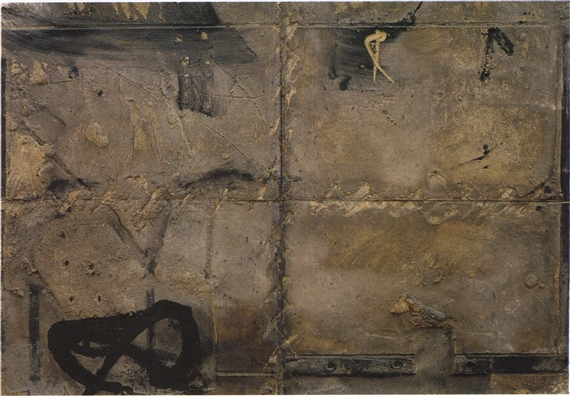
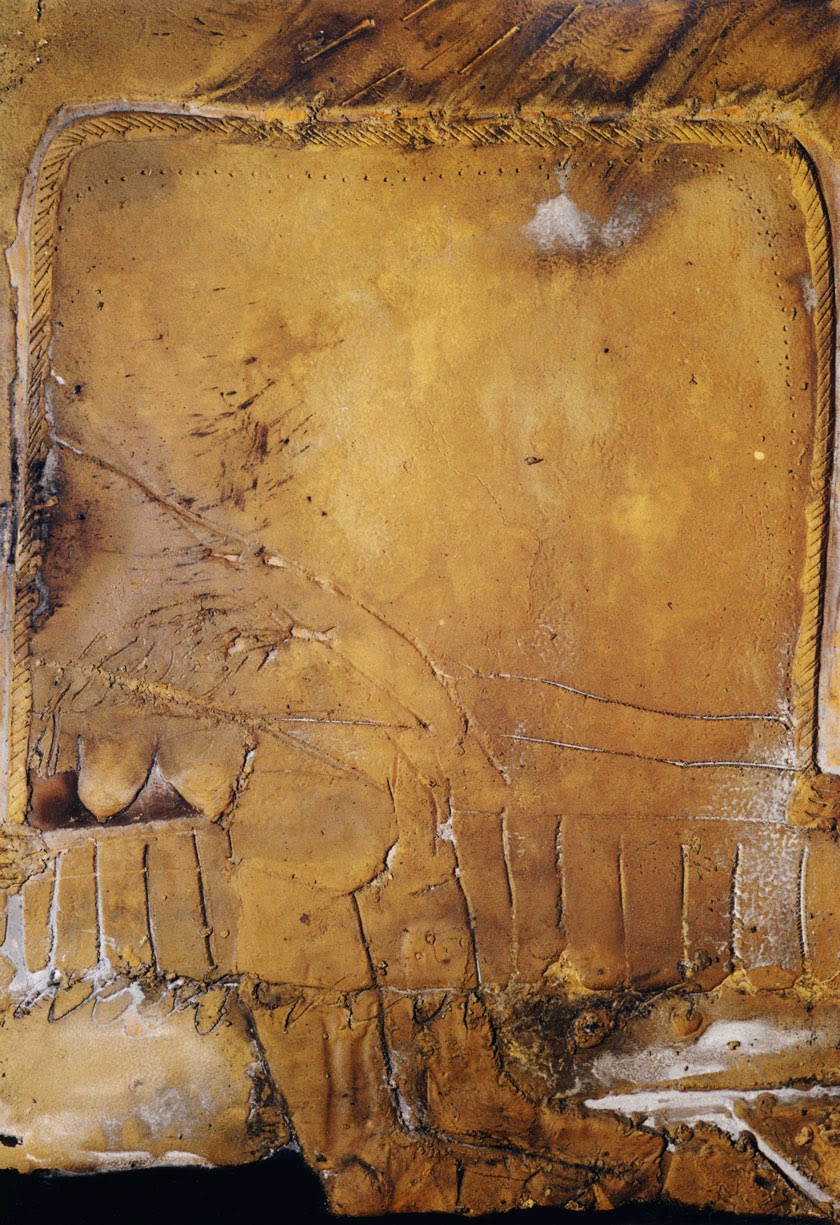
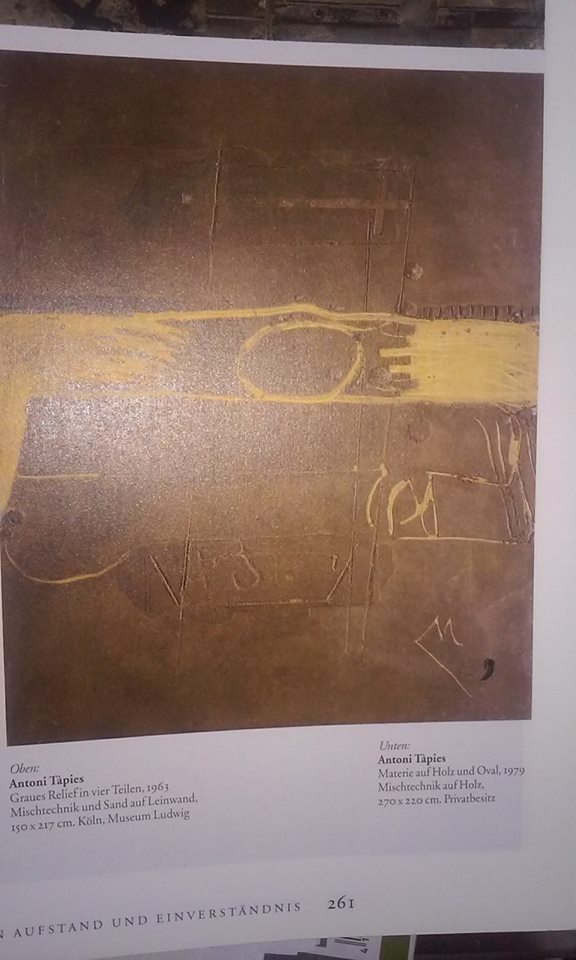
Antoni Tàpies produces kind of primal landscapes, sunken continents, relicts or only ground plans for ancient temples or fortresses, seeming relicts of a past long gone, traces of the most atavistic humanity, presence both of the earth and its inhabitants. It is submerged, it has lost its meaning and functionality, it has become levelled and incomprehensible but is still there and is indestructible and will there be long after our demise. Sunken into the depth and weathered those architectures probably did not make much sense in the first place but still they confront us with the enigmas of the world and of humanity that tries to overcome them and gain mastery. You want to come close to those paintings, to better understand them. They´re immersive. In their silence they seem talkative and carriers of knowledge – as they carry ancient dignity. You´re attracted to them. They´re pacifying and stirring.
Like Wols, Antoni Tàpies was a master of Art Informel, in contrast to Wols his expression was less explosive and volcanic, it was meditative and concerned about giving order. He liked to use materials like clay, sand, etc. and someone said that Tàpies´ artworks are more „tellurian“ than they are metaphysical. Yet of course the tellurian with its mystery and its depth and ancientness and reaching into the most shapeless and faceless future as well is the most metaphysical of all: That is what Zarathustra meant when he said: Die Welt ist tief/Und tiefer als der Tag gedacht (i.e. the world cannot be fully discovered by even the most advanced mind but always carries surprises). And Antoni Tàpies scratches on the strata of the earth, or throws them up. „I was obsessed with materiality … the pastiness of phenomena which I interpreted using thick material, a mixture of oil paint and whiting, like a kind of inner raw material that reveals the „noumenal“ reality which I did not see as an ideal or supernatural world apart but rather as the single total and genuine reality of which everything is composed“, says Tàpies (so again you have it that art, and creative sentiment, supersedes the epistemological „thing“ vs the „thing in itself“ puzzle and replaces it by a meta-noumenon, as it reveals the existential ontology of a thing, i.e. the embeddedness of a thing in all possible context). These artworks are haptically suggestive, and acoustically. You may want to touch them or stroke them with you hand, to get a sense of it, or hold your ear to them, to listen to the silent sound of the earth. Someone said, the earth is constantly making a sound. That sound will be all in your mind.
It is something you cannot directly communicate with, it is ancestral. It is mysterious, enigmatic, evocative. It gives you a sense of your own vanity and your own importance. Probably we´re alone, or very intelligent species are really very, very rare in the universe due to the right biological combinatory play to produce complex life being very unlikely (hence the Fermi paradox i.e. that, if the universe was so crowded with intelligent life, why hasn´t there been an obvious contact between us and them so far?). And that´s not even the end of the glorious story: In the future, as we advance, we might even colonise the mindless universe, or at least the milky way! That will be the heritage of mankind, over the long run. It is actually a very important heritage. We should not forget that.
A very sophisticated, yet underrated form of art is extreme metal, and it is good that extreme metal gained some new impetus in recent years. While more initial bands like Morbid Angel, Meshuggah or Brutal Truth sounded as if they would come from another planet, newer bands like Abyssal, Mitochondrion or Portal sound as if the came from the very depths of outer space itself (from close to the region where Azathoth dwells). Sarpanitum, a band hitherto unkown to me, are also of this kind, and what is peculiar about them is that they combine some „Mesopotamian“ elements with their chaos and forlornness in space as you have it with bands like Melechesh or Nile. (Although the album Blessed Be My Brothers has a medieval setting) you feel as if you´re in an ancient temple or some kind of stucture, long abandoned, of an atavistic high culture, so ancestral that you could not even name it. So, as well as in outer space, you are forlorn in an unreal situation/setting which is however tangible as well as it refers to very ancient humanity, to something that once made sense although that sense is faded but could be (partially) reconstructed. You have sameness in otherness, and vice versa, and that somehow feels good and chilling (at least for me, for my boring fellow humans probably not). You´re inside the continuum of history and humanity as well as you´re in the vast, but also local universe. It gives a sense of place and belonging, but not an immediate one, as it also gives you a sense of seperatedness and unrealness. Those sacred ancient halls, erected by Sarpanitum! They´re sublime, but it is a kind of undefined sublimity or infra-sublimity or transcendent sublimity, as it is something to which you have profoundly lost connection. I mean, if you´re able to get immersed into things you can somehow reconstruct it, as allegedly primitive extreme metal musicians can. Be taught: (extreme) metal mainly is surrealistic exaggeration, it is abstract and it is erudite. The lyrics (about satan, etc.) are more attached to reality than the phony love songs you can hear on the radio. With Blessed Be My Brothers Sarpanitum probably had the death metal album of the year 2015. And I think I´m going to write the long promised Metaphysical Note about Extreme Metal soon. It is good that I have already noticed some things about it, because to some degree I forgot what I wanted to say in that note hell yeah.
“When listening to the likes of “I Defy Therefore I Am” or “Thy Sermon Lies Forever Tarnished” the band’s blend of clinically chaotic but elegant almost cosmic riffage, and the historical imagery and themes makes me picture some sort of giant celestial knights clad in steam punk crusader garb usurping Sumerian thrones in far away galaxies. It’s not catchy or immediate, but presents an epic, swirling, nova of brutality and glistening beauty.”
Review of Blessed Be My Brothers by a guy named Lustmord56 at metal-archives.com
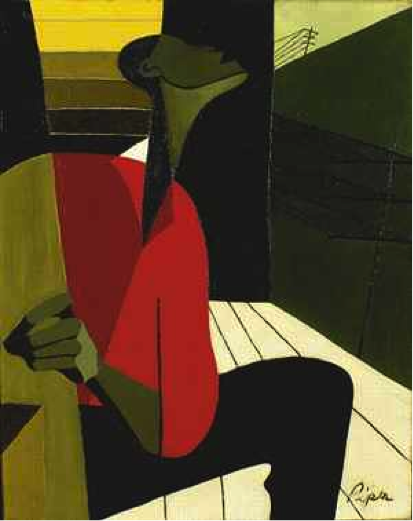
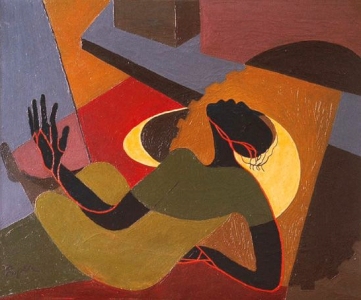
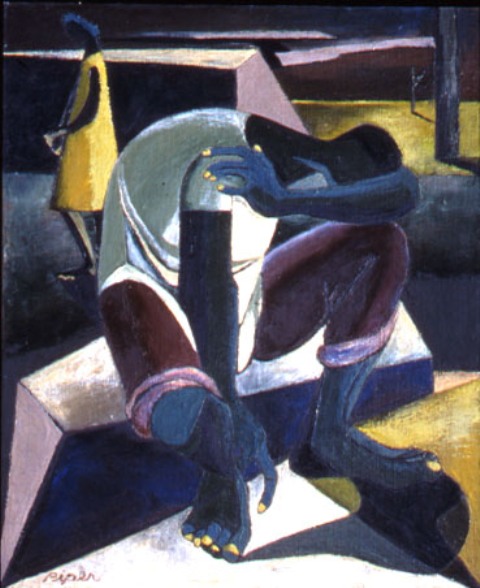
It repells me that hardly anything can be found (neither in the library nor on the internet) about Rose Piper (1917-2005)! In the late 1940s she did some paintings (oscillating between abstraction and figuration) that recently had considerable impact on me. They´re about the situation of black Americans. About people who live in the social abyss, but long for a better life in the land of opportunity. It is obvious how they are trapped and their chances to ascent are dim – although there is some indication of hope. They´re painted semi-abstract, but they are – as you have it in good art – „more human than human“. In Grievin´ Hearted (1948) the grief of an (anonymous, faceless) individual as well as of a collective is expressed in the most powerful way possible. – Who has ever done a thing like that in the history of art? (Notably) Grievin´ Hearted is a very great painting and should be approached with the same awe as the Sistine Madonna or stuff Goya did (it at least was voted the best figurative painting by the seventh Atlanta University Annual Art Exhibit jury in 1948). If you like abstractions and generalisations you may even go as far as to think of a suffering humanity in toto that you have in Grievin´ Hearted – but no! Though of course such a generalisation is not without justification, Grievin´ Hearted is distinctly about the suffering of „negroes“, and the genius of Rose Piper is how she makes that clear. „Nobody suffers like the poor“, says Bukowski in Barfly. Suffering cannot so easily be generalised and thought to be a common good. Empty Bed Blues (1946) was a statement about black female sexuality – also an idol of Rose Piper, blues singer Bessie Smith, was quite offensive and confrontational against social norms as it came to being assertive about female sexuality – Piper´s The Death of Bessie Smith (1947) is probably her best known artwork. – When Rose Piper did those paintings her success was quite immediate and she began to feel that she „could make it“ – becoming a premier league artist, like Pollock. „I had the greatest time. The world was at my feet.”
Rose Piper was born in New York on Oct. 7, 1917 and grew up in the Bronx in an educated middle class family. When as a young lady she wanted to become a painter she was also heavily inspired by blues music and the situation of black Americans in the South and in rural America (she had not been familiar with up to then). She received two Rosenfeld stipendiums in the later 1940s with which she made trips to the South, originally she was a highly figurative painter who soon turned a bit more into abstraction, obviously to make her display of the human situation more universal without losing individuality. Her first exhibitions had been a success and she could earn a living with her art by then. Unfortunately, due to bad luck and family circumstances (she had to care for ailing family members) she had to give up art and instead became a (successful, but anonymous) industrial designer. When she retired, in 1979, she was Senior Vice President of her company. She then turned back to art, painting in a quite different style from that of the 1940s however. She died on May 11, 2005 in a Connecticut nursing home of a stroke.
Rose Piper was the aunt of performance/conceptual artist and philosopher Adrian Piper. I came across Rose Piper via Ann Eden Gibson´s valuable book Abstract Expressionism. Other Politics, which tries to shed light on artists of that era excluded or forgotten because of their race, gender, or sexuality (the Abstract Expressionists were actually quite macho-like and unemancipated, you see).
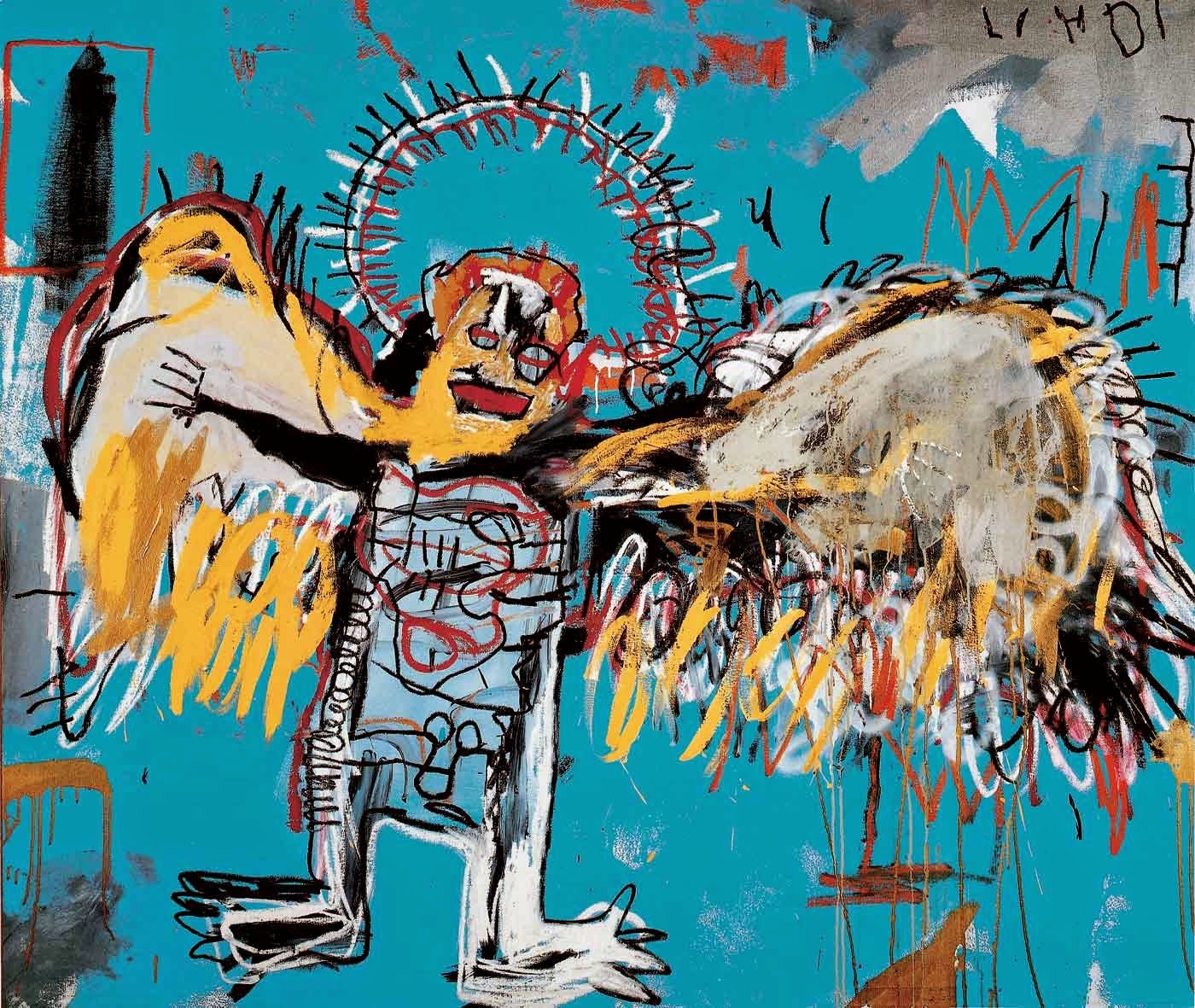
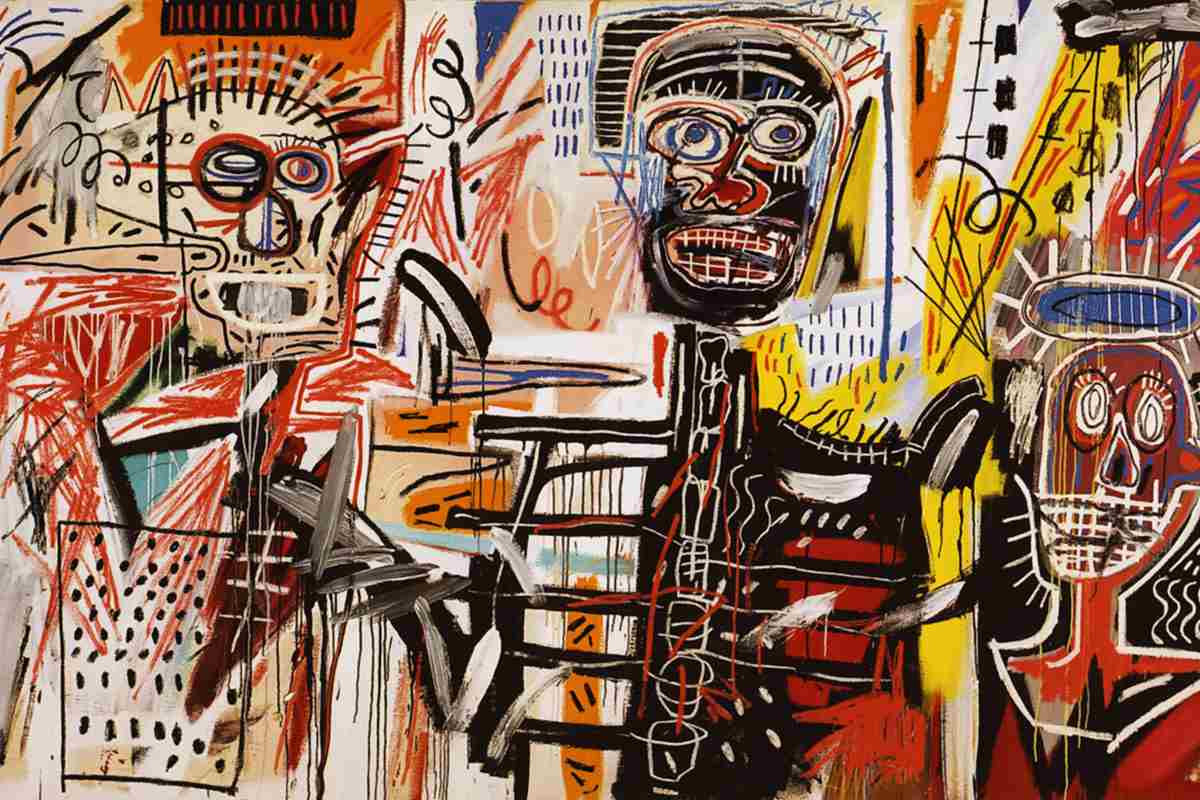
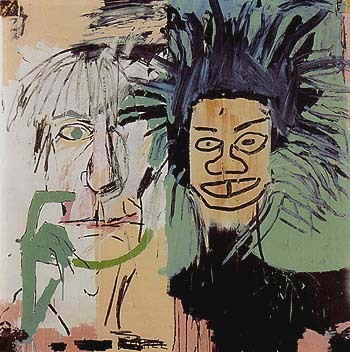
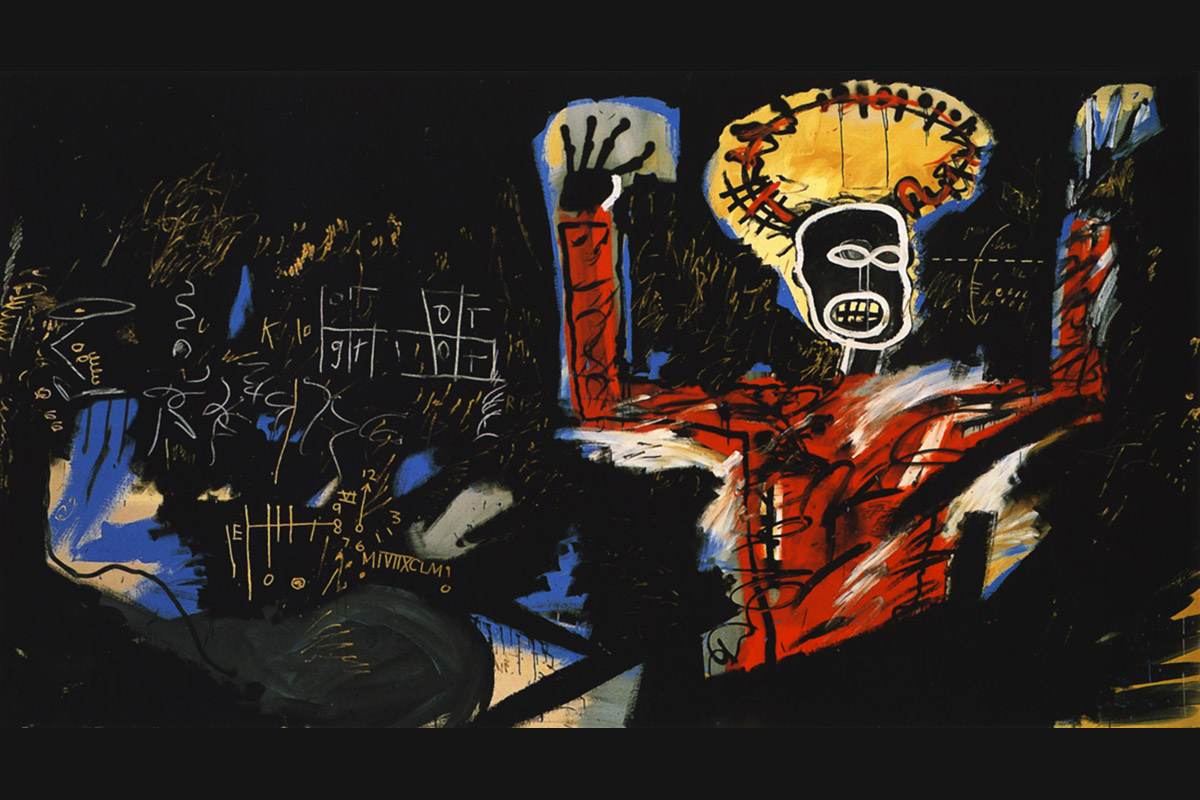
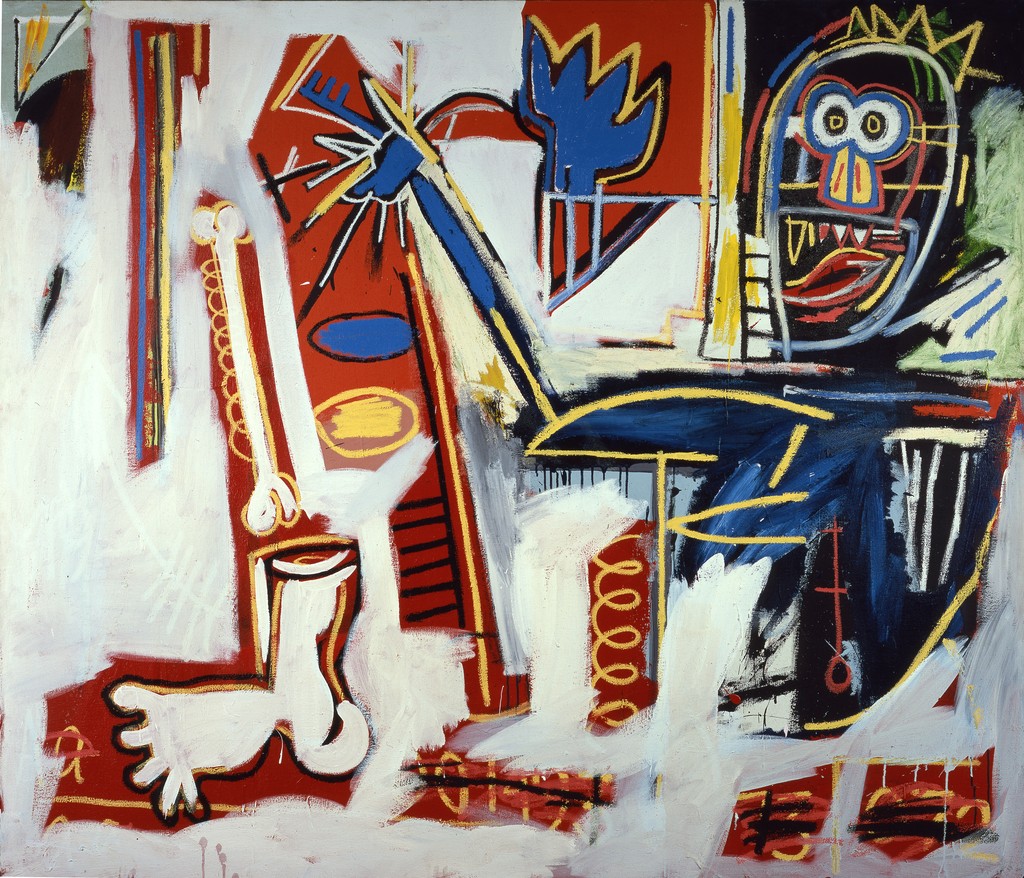
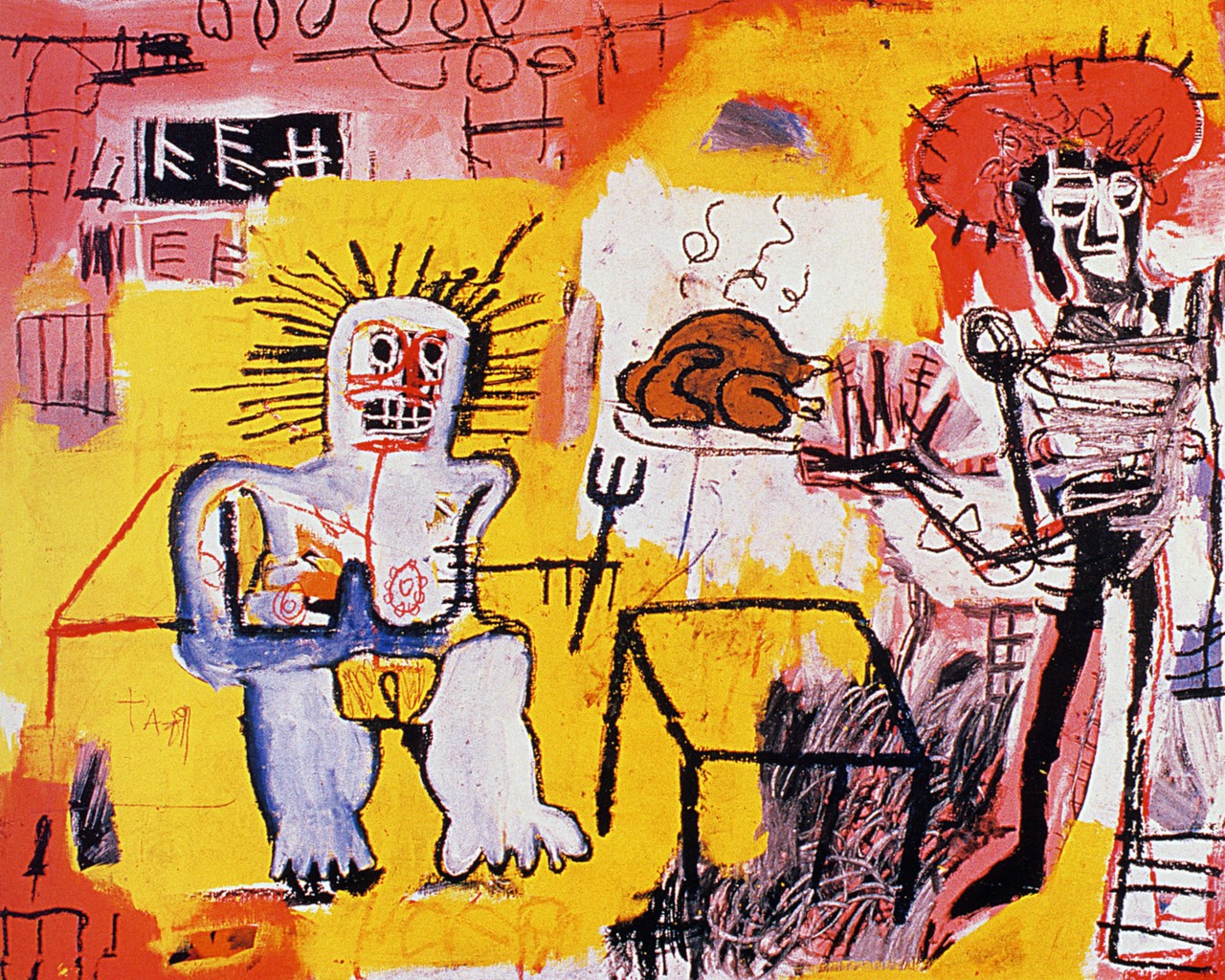
In a crowded and overpopulated millennial art market Jean-Michel Basquiat was the rare occurence of a true genius. And his genius was for immediacy. He immediately did things right and did not need to have a program or ideology or philosophy so that, like in the case of Modigliani, there wouldn´t actually be much to add to and analyse about his artwork. – We can, however, say that Jean-Michel gave an impression about how a painting could look like at the turn of the millenium and that he made a solid statement that, with the right attitude, after the supposed death of painting (by exhaustion) authentic painting is still a possibility. – In the works of Basquiat you have the credible erection of figure! You have the masterful use of colour! You have spatiality and the location of the figure in the world (a somehow flat and immediate, but also hypertextual space that is both segmented and has open/undefined ends)! You have individual physiognomy (with the personnel being both individuals, types, caricatures and – what is essential to art – „more human than human“)! Although it is suggested that Basquiat´s painting style is „raw“ (and associates, e.g., to Dubuffet) it is actually immediate and the figures usually are complex and sophisticated. Also Basquiat has been labelled a Neo-Expressionist (like other artists of that time), but with expressionism you would, somehow, associate a content that is dynamic and that emerges out of itself, still has hidden meaning, but in Basquiat´s paintings nothing seems to be hidden. Everything is there and is fully illuminated and in bloom. Masterful – no, genius! – how the seeming immediacy (and „rawness“) he puts something on the canvas with and suddenly nothing else needs to be added (and with his immediately drawn double portrait of Warhol and himself, with which he tried to approach Andy, he immediately stunned Warhol). You have the highly associative intelligence of the genius as Basquiat never hesitates to put all kinds of stuff that crosses his mind into his paintings making up for the rich and saturated and (ironically) suggestive texture a great painting is about. Basquiat´s paintings even allude a bit of parody on painting – and in the respect that it´s definitely not but may seem to carry it, it adds another aspect and to the completeness and multidimensionality.
Complexity and immediacy – on the one hand a sharp contour and great definedness, on the other hand an elusiveness and enigmatic openness – was what Jean-Michel Basquiat possessed and what helped him make him a star. It was also this mix of coming up expectedly, but in an unexpected way. A black guy who was socialised with Afroamerican as well as white (counter)culture. Who hung around in East Village at the turn of the 1980s. Who turned graffiti into „something (artistically) serious“. A street artist who made it clear that his desire was to become a glamorous star (and, as such, was dragged into a world with which he actually could not identify either). A wanderer between worlds, both integrated in all of them and isolated from/in all of them. An early demise (at the wicked age of 27) due to heroin. This spring a work by Jean-Michel sold at a record price of 110,5 million dollars at Sotheby´s (to a Japanese online retail magnate, Yusaku Maezawa). Already when he was alive Basquiat would do senseless things like renting an entire floor in a hotel because he made so much money – on one occasion, and putting bundles of money into the pockets of the homeless on another. You had the mysteriousness and the heavenly impertinence of the genius. They called him the Radiant Child.
I took minor notice of Jean-Michel all over the years of couse, via art books like Fineberg´s Art Since 1940, etc. There are usually some paintings shown by major/remarkable artists and those presented by Basquiat actually didn´t really have an impression on me. Yet a while ago I bought a whole book about Basquiat, and that was when it did „take“, and so I wanted to write a note about him because I was shaken by his importance. When I looked at his stuff again now, I have to admit that I wasn´t that struck anymore, but that may change again and at any rate I found it necessary to sing this hymnos and paint this tableau. In the chapter about the East Village art scene in Art Since 1940 there follows a chapter about David Wojnarowicz. I have not come close to Wojnarowicz so far (so that maybe there may happen the same epiphany I had with Basquiat). Before he became an artist he worked as a male prostitute (and died of AIDS at age 38). His memoirs have the intriguing title Memories That Smell Like Gasoline. But I could not get them so far.