
I have some attraction to the style of hyperrealism, that had its heyday in the 1970s and was championed by artists like Richard Estes, Ralph Goings or, for this respect, Don Eddy. You can see it as an epiphenomenon to pop art, or as an approach in technique (since the techniques behind attaining a hyperrealistic expression in painting are non-trivial), or as blatantly mindless and commercial. You can see it with reference to the Baudrillardian Simulacrum. Nevertheless you also seem to have some eerie metaphysics in it; and so you might regard hyperrealism as a form of the highest endeavour in art: of art trying to be “the true metaphysical activity” (as Nietzsche postulated it (with reference to Schopenhauer)).
Metaphysics in art means that art should reveal the “true”, “deeper” essence of a thing that is supposedly hidden beneath its surface, an essence that is both revealed and concealed by the surface and therefore reveals and conceals itself in interplay with the surface. In truly great art you therefore seem to have two worlds constantly shifting and shining through each other. The realm of the metaphysical is of another dimension. In the empirical world you are supposedly barred from directly gazing into the metaphysical, as you lack proper dimensionality. However higher dimensions will make themselves apparent via imprints and footprints in the empirical world, that are both revelatory and enigmatic alike. You therefore have to follow the footprints of the metaphysical and try to then deduce its entire structure; you will do so via speculation (in philosophy) or via apprehension (in art). The great artwork, where you have (at least) two worlds shining through each other, will evoke apprehension (Ahnung) in the viewer. Apprehension/Ahnung is the true mode of perception of the metaphysical, as expressed via the means of art.

Hyperrealism, as the term already implies, presents reality as a hyper-reality. Hyperreality, or making a thing go hyper, does not necessarily mean reaching into the metaphysical; in itself it just means blowing things up (or something similar to that). This alone, however, addresses the (metaphysical!) question, whether our understanding of “the metaphysical” is but a mere blow-up of our ordinary understanding and abilities (as an interpretation of the nature of metaphysics and religion in the tradition of Feuerbach would go), or something distinct to it. In the great artwork at least, you will have an evocation of the “inner reality” of the presented object, its “inner reality” will pour out of the object. In hyperrealism, objects beam and glow; you have that metaphysical glance pouring out of them. Of course, these are just mirror reflections of their lookalike surroundings on polished surfaces: indicating that they have no inner or original essence. They are derivative. Yet in their universally mirrored togetherness and assemblage they seem to create an own and autonomous sphere, governed by its own logic. It is the sphere of technology and industrial mass production and consumption. The metaphysical glance of the mass product you already had within pop art.
Hyperrealism seems to present a timeless, static, stainless and perfect world, a world that seems “metaphysical”. Like the Stillleben/still life, hyperrealism presents everyday and mundane objects. In the case of Don Eddy, it is mostly Volkswagens. Volkswagens are the product of a very sophisticated culture, they are unlike the fruits, dead animals and flowers presented in original still lives. They are the product of a very sophisticated technology. Therein, hyperrealism also bears resemblance to American precisionism of the 1920s, notably the “still lives” trying to capture the metaphysical aspects of industrial landscapes by Charles Sheeler. Technology, as Heidegger suggests, introduces a new Existenzial to human existence, and technology is also metaphysical and otherworldly. While technology is implicitly perfectly understood and mastered by man, the implications of technology cannot be; therefore technology confronts man with the Not-I, with the Other.
Also the traditional still lives confront man with the Not-I, with the Other. And they both confront man with persistence as well as transience and decay. The vegetables and flowers are prone to wither away, the dead animals are waiting to be consumed. Also the shiny Volkswagens will rust and become dysfunctional. You seem to have a dead or inanimate world in still lives and in hyperrealism. Therefore it confronts the viewer, who is alive, with death: which is something metaphysical. Which one is of superior order: the animate or the inanimate? That is a metaphysical question. You have a strange encounter of those orders in still lives and in hyperrealism: it translates into a metaphysical encounter. In the mundanity of its objects, something magical still seems to shimmer through. The magic of the existence of mundanity. Still lives, hyperrealism or the Pittura metafisica confront the viewer with the metaphysical character of pure presence. Pure presence does not speak and is not revelatory of itself. It evokes apprehension.
All metaphysics is strange. It is alienated, yet it is familiar as well. You feel connected to it and you can relate to it, but there is also a gap. The gap can only be grossed via the mind and via imagination. Although metaphysics is therefore only mildly strange, it never loses its strangeness and fascination, it is a dynamic strangeness that never becomes boring.
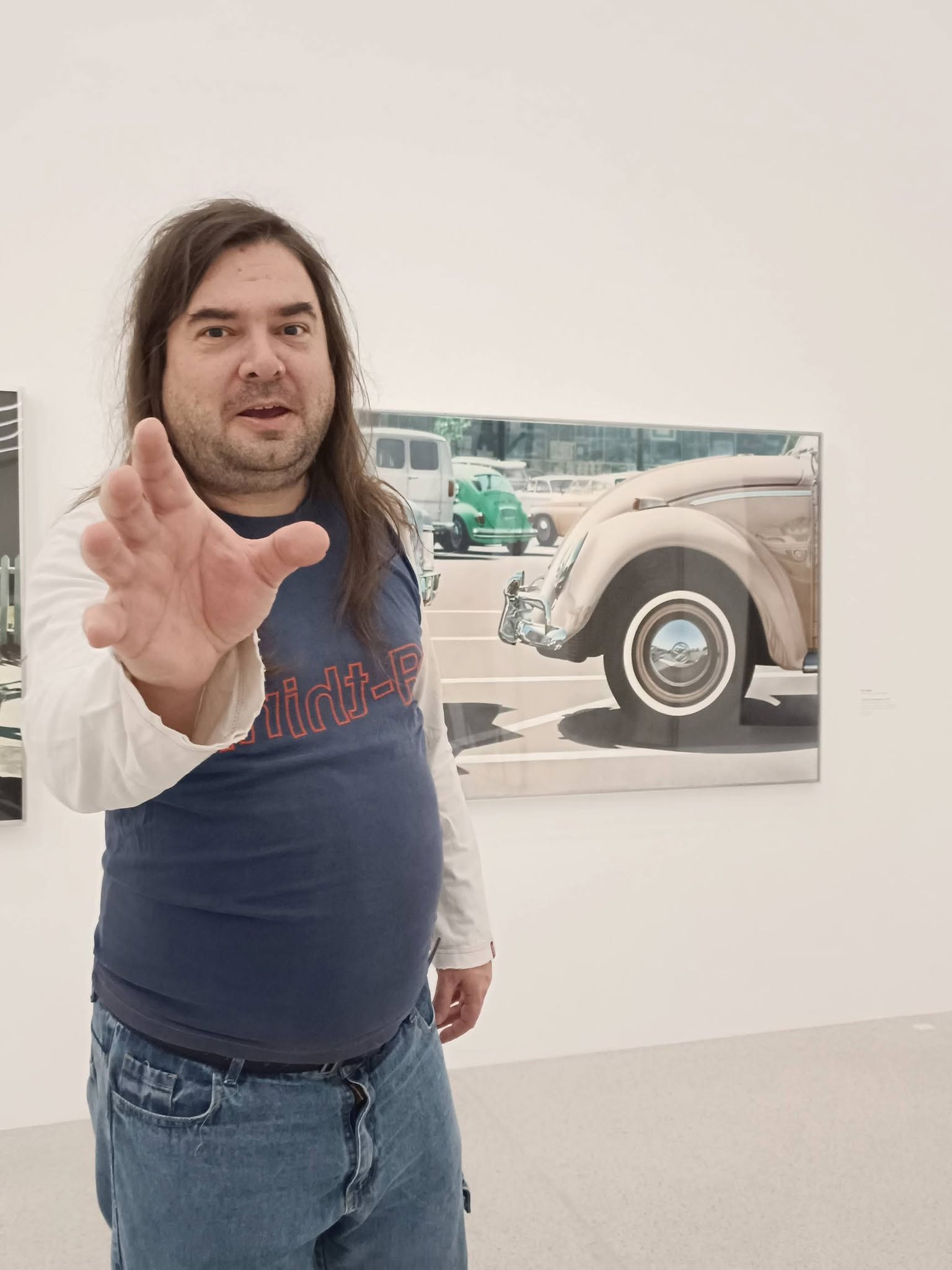
It is interesting though why we would usually think of the realm of the metaphysical as something static, silent and immovable. Why would the image of the metaphysical not be dynamic, even wild and chaotic, and loud? Since dynamics, chaos and sound are most obviously also principles that guide our existence. Maybe this is so because our dominant understanding of the metaphysical is still rooted in Plato´s concept of the realm of eternal ideas. Yet, apart from that, our natural aspirations seem to point in the respective direction. You like to think of the metaphysical realm as being primary, dominant, the unmoved mover, eternal. Overally, you will think of the metaphysical realm as something sublime. Therefore, as the counterpart to your nervous and ephemeral subjectivity, the metaphysical will appear as static and timeless, as a sublime objectivity. Of course, you have the expression of the metaphysical and of the sublime also in music, and music involves time. However, sacred music is usually static. And also for painting and sculpture, expression of the metaphysical is not at all necessarily static: It necessitates the two worlds constantly shining through each other, making up for something sublimely static as well as highly dynamic at once. While we may not know how the metaphysical realm actually looks like, the interaction between the empirical world and the metaphysical world is a constant fluctuation, a constant pulse. Within the pulse, the static and the dynamic become unified.
In the paintings of Don Eddy you usually will have presented a world soley made out of objects, absent from man or creature, or of any subjectivity. However, subjectivity you have in the usually very subjective angles that establish the perspective in his paintings. It is usually a narrow perspective, from which you see bits and pieces and fragments. And from what you can see, it is a narrow and packed world, it is confined. Despite the (odd) elegance of the Volkswagens, you do not seem to have an elegant world. Genius spiritualises everything, says Salvador Dali. In the actual works of Don Eddy you seem to have a de-spiritualisation of the sublime metaphysical realm, populated by Volkswagens, which are elegant but do not populate their realm in an elegant way.
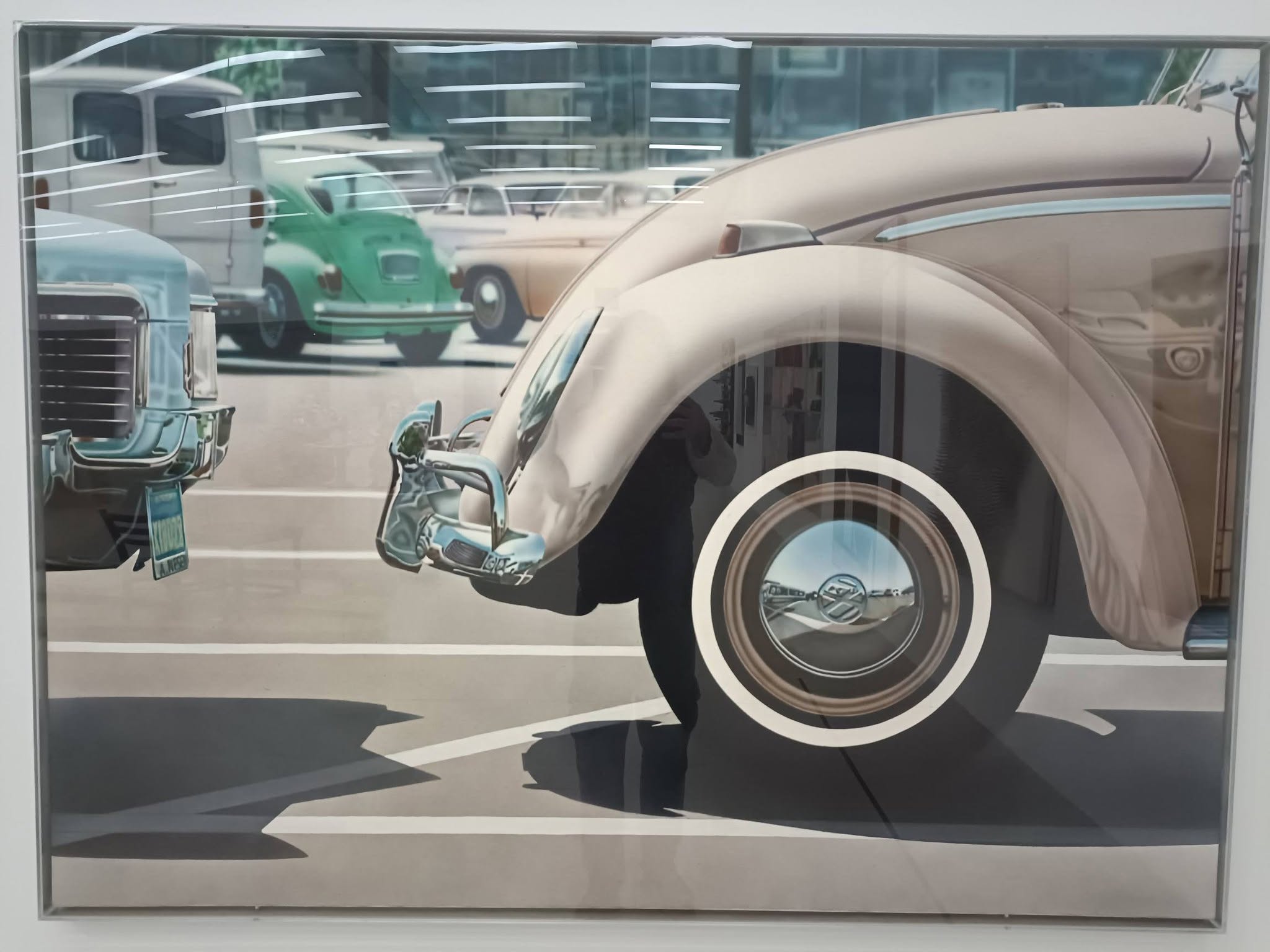
That again raises big metaphysical questions. It might be that the metaphysical realm always will remain confined and restricted to our subjective viewpoint and therefore cannot fully be embraced by us, or so the story may go. However, like the Pittura metafisica of Giorgio de Chirico and his (surrealistic) followers it also seems to imply another, more uncanny interpretation: That the metaphysical realm itself is confined and unelegant. We would like to think of the realm of the metaphysical as something lofty and celestial, but actually the realm of the metaphysical might not be such a pleasant place to be. Like in the empirical world, there might be cruelty in it, and it might be intransparent and opaque to itself, it might be a battleground of conflicting forces or even a warzone. It might actually be quite mindless (and therefore silent, because it is too stupid to speak and elaborate on itself). Enter the metaphysics of H. P. Lovecraft and of the Necronomicon (although I would not like to go that far, but this might only be due to my optimistic personality).
Understanding these possibilities at any rate elevates the human mind. And therein, art “is the true metaphysical activity”. Over the course of time Don Eddy shifted away from capturing the metaphysical via Volkswagens or industrial landscapes; he often paints triptychs that show unrelated yet somehow ethereal images of the sea, of the sky, of plants or of ancient architecture. Of course, the metaphysical perpection cannot be a perception of the “whole”. It might likewise be the perception of distinct units of the whole simultaneously, suggesting that unification between these distinct units will be done by the mind, or the metaphysical ether – out there as well as within you – that puts all of this together. Thank you, Don Eddy; thank you, Hyperrealists.